
A heat pump is an electric heating and cooling system that moves heat instead of burning fuel to make it. In winter it pulls heat out of the outdoor air (or the ground) and moves it inside; in summer it runs in reverse and works like a central air conditioner. Because moving heat takes far less energy than creating it, a heat pump typically delivers 2 to 4 units of heat for every unit of electricity it uses.
This guide explains what a heat pump is and how it works in plain English: the refrigerant cycle, the main types, what the efficiency ratings mean, how well heat pumps handle cold weather, what they cost to run and install in 2026, and how to tell whether one makes sense for your home.
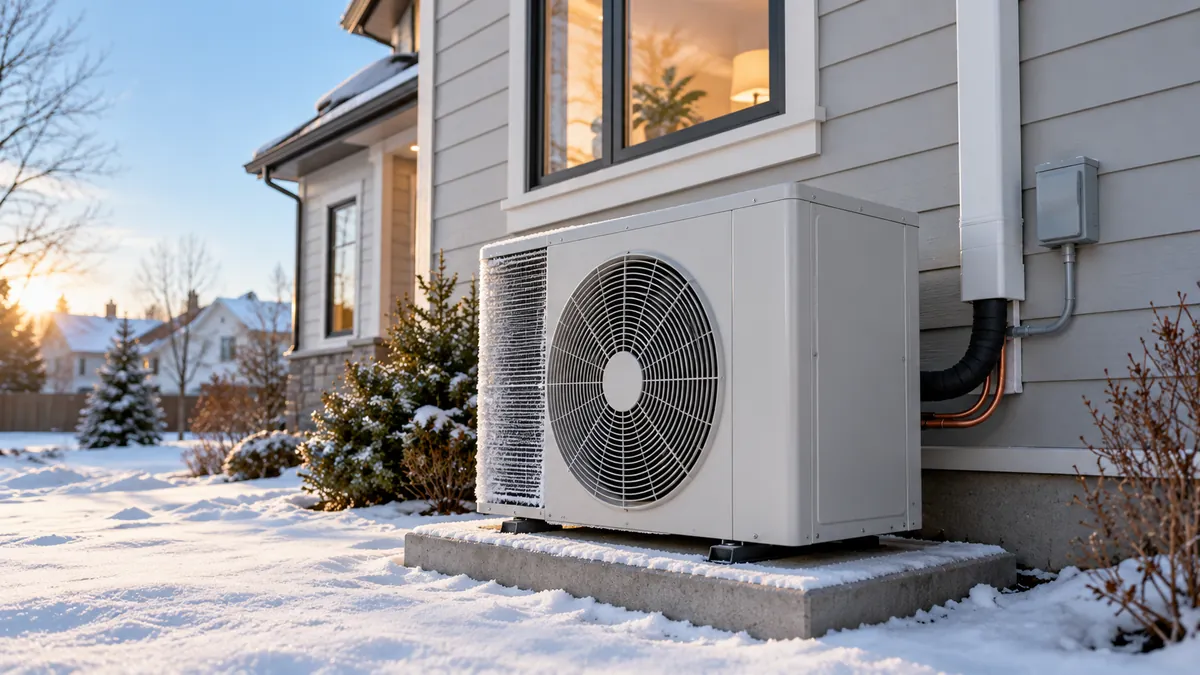
A heat pump is a two-way air conditioner. It uses a compressor and refrigerant to absorb heat from outdoor air or the ground and release it indoors in winter, then reverses the flow to remove heat from your home in summer. It moves heat rather than making it, so it uses far less energy than furnaces or electric baseboards.
Heat per unit of power
2–4×
Typical output vs. electricity used (COP 2–4)
U.S. shipments, 2025
3.6M
Heat pumps shipped vs. 3.25M gas furnaces
Typical lifespan
15 yrs
Often 10–20 years with regular maintenance
In this guide
- What is a heat pump?
- How does a heat pump work?
- The main parts of a heat pump
- Types of heat pumps
- How efficient is a heat pump?
- Do heat pumps work in cold weather?
- What does a heat pump cost to run?
- Heat pump vs furnace vs air conditioner
- Pros and cons
- Installation cost and incentives in 2026
- Is a heat pump right for your home?
- Maintenance and lifespan
- Frequently asked questions
What is a heat pump?
A heat pump is a single system that heats and cools your home using electricity and refrigerant. It is closely related to the air conditioner and the refrigerator: all three move heat from one place to another. The difference is that a heat pump can move heat in either direction.
That is the key idea to hold on to. A gas furnace burns fuel to create heat, and an electric baseboard heater turns electricity directly into heat through a resistance element. A heat pump does neither. It collects heat that already exists outside, concentrates it and delivers it indoors. Even air at 20°F still contains a large amount of heat energy, and a heat pump is designed to capture it.
Heat pumps have become the most common way to heat new homes across much of the South and Mid-Atlantic, and cold-climate models have opened up the northern states. U.S. manufacturers shipped about 3.6 million air-source heat pumps in 2025, compared with about 3.25 million gas furnaces, the fourth year in a row that heat pumps came out ahead.
How does a heat pump work?
A heat pump works by circulating refrigerant through a closed loop between an outdoor unit and an indoor unit. Refrigerant is a fluid that boils at very low temperatures, so it can absorb heat even from cold air. By changing the refrigerant’s pressure, the system controls where it absorbs heat and where it releases it.
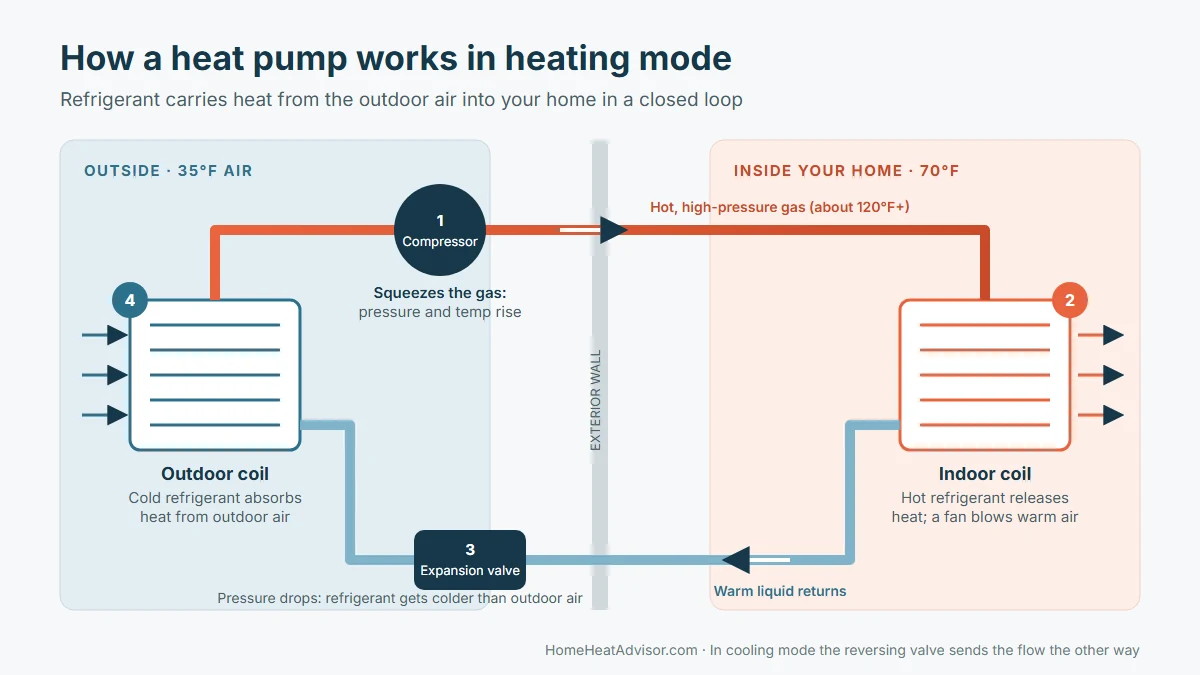
Heating mode, step by step
- The outdoor coil absorbs heat. Cold, low-pressure liquid refrigerant flows through the outdoor coil. Because it is colder than the outdoor air, heat flows into it and the refrigerant evaporates into a gas.
- The compressor raises the temperature. The compressor squeezes that gas into a much smaller volume. Compressing a gas heats it up, so the refrigerant leaves the compressor as a hot, high-pressure gas, often well above 100°F.
- The indoor coil releases heat. The hot gas travels through the refrigerant lines to the indoor coil. A blower pushes your home’s air across the coil; the air warms up and the refrigerant cools and condenses back into a liquid.
- The expansion valve resets the cycle. The liquid passes through an expansion valve, which drops its pressure suddenly. The refrigerant becomes very cold again, colder than the outdoor air, and returns to the outdoor coil to repeat the loop.
The electricity a heat pump uses goes mainly to the compressor and fans. The heat itself comes from outside. That is why the heat delivered can be several times larger than the electrical energy consumed.
Cooling mode
In summer, the same loop runs backward. The indoor coil becomes the cold side: it absorbs heat and moisture from your home’s air, and the outdoor coil becomes the hot side that dumps that heat outside. This is exactly how a central air conditioner works, which is why a heat pump can replace both your furnace and your AC.
The reversing valve
The part that makes switching possible is the reversing valve, a small valve in the outdoor unit that changes the direction the refrigerant flows. Your thermostat tells it which way to go. You may hear a brief “whoosh” when it shifts, especially at the start and end of a defrost cycle. That sound is normal.
The main parts of a heat pump
Most homes with a central heat pump have a split system: one unit outside, one inside, connected by copper refrigerant lines and wiring. These are the parts that matter when you are reading quotes or talking to a technician:
- Outdoor unit (condenser). Houses the compressor, the outdoor coil, a large fan, the reversing valve and the defrost controls.
- Compressor. The heart of the system. Single-stage compressors run at full speed or off; two-stage models have a high and a low setting; variable-speed (inverter) compressors adjust continuously, which improves comfort, efficiency and cold-weather output.
- Indoor unit. In a ducted system this is an air handler with the indoor coil, a blower and usually backup electric heat strips. In a ductless system it is a wall, ceiling or floor unit in each room.
- Refrigerant lines (line set). A pair of insulated copper pipes that carry refrigerant between the two units.
- Expansion valve. Meters refrigerant and drops its pressure. Better systems use an electronic expansion valve (EEV) that adjusts in real time.
- Thermostat or controls. Heat pumps work best with a thermostat designed for them, one that understands auxiliary heat and doesn’t call for backup heat unnecessarily.
- Backup heat. Electric resistance strips in the air handler, or a gas furnace in a dual-fuel system, for the coldest hours or during defrost.
Types of heat pumps
All heat pumps use the same cycle. They differ in where they get their heat and how they deliver it to your rooms.
| Type | Heat source | How it delivers heat | Best for |
|---|---|---|---|
| Ducted air-source | Outdoor air | Existing ductwork | Homes that already have central air or a furnace with ducts |
| Ductless mini-split | Outdoor air | Wall, ceiling or floor units per room | Homes without ducts, additions, garages, single rooms |
| Geothermal (ground-source) | Ground or well water | Ducts or radiant floors | Owners staying long term with land or a well; the highest efficiency |
| Dual-fuel (hybrid) | Outdoor air + gas furnace | Ductwork | Cold climates with cheap natural gas |
| Air-to-water | Outdoor air | Radiators or radiant floors | Homes with hot-water heating (common in the UK and Europe) |
Ducted air-source heat pumps
This is the most common type in the U.S. and the direct replacement for a central AC plus furnace. The outdoor unit sits where your AC condenser would be, and an air handler inside uses your existing ducts. If your ducts are in good shape and sized properly, this is usually the simplest whole-home option.
Ductless mini-splits
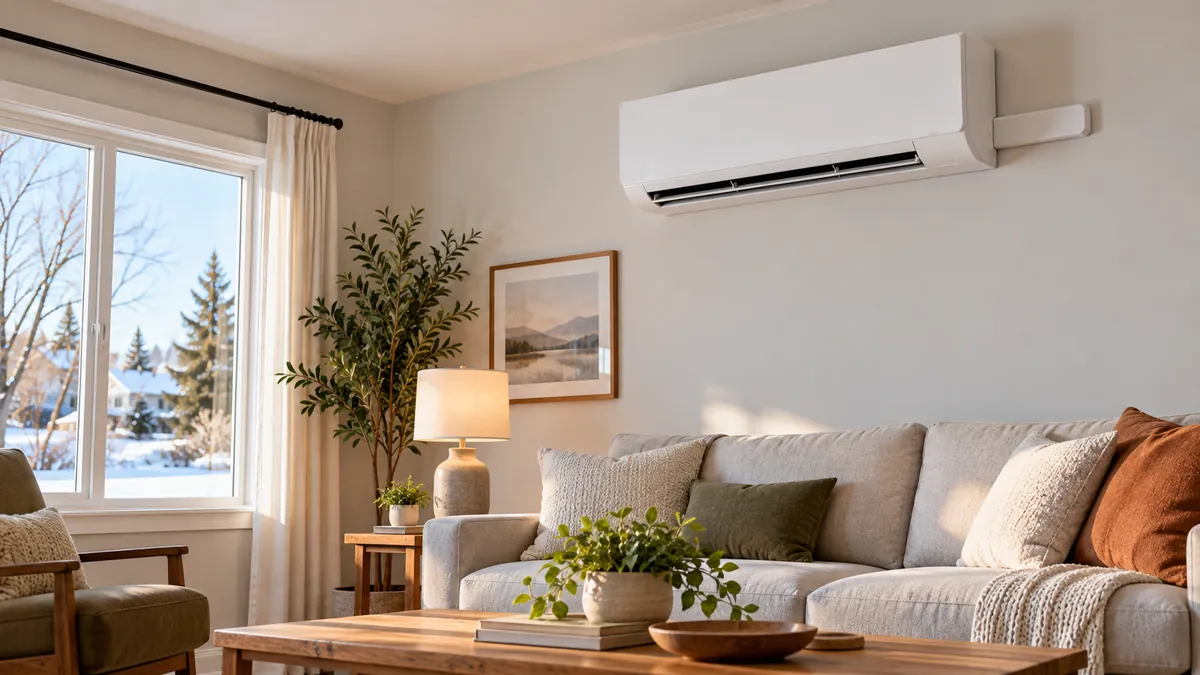
A ductless mini-split connects one outdoor unit to one or more indoor “heads” through a small hole in the wall. Each head is its own zone with its own temperature. Mini-splits are often the most efficient air-source option and avoid the energy lost through leaky ducts. They are a common choice for older homes with radiators or baseboards, for additions, and for rooms that never get comfortable.
Geothermal heat pumps
A geothermal (ground-source) heat pump exchanges heat with the earth through buried pipe loops or well water. A few feet down, the ground stays at roughly 45–75°F year-round depending on where you live, so the system works from a much more stable source than winter air. The result is the highest efficiency of any heat pump, but installation costs much more because of the drilling or excavation.
Dual-fuel (hybrid) systems
A dual-fuel system pairs an air-source heat pump with a gas or propane furnace. The heat pump handles most of the year, and the furnace takes over when it gets so cold that burning fuel is cheaper or more comfortable. It is a practical choice if you already have a good furnace and live somewhere with long, hard winters.
Air-to-water heat pumps
Air-to-water units heat water instead of air and send it to radiators or radiant floor loops. They are the standard in the UK and much of Europe but still uncommon in the U.S. Note that a heat pump water heater is a different appliance: it uses the same principle to heat your domestic hot water, not your home.
How efficient is a heat pump?
Heat pump efficiency is measured in a few different ways. You will see all of them on spec sheets and quotes, so it helps to know what each one means. Our efficiency guides go deeper on each rating.
- COP (coefficient of performance). Heat delivered divided by electricity used, at a specific moment and temperature. A COP of 3 means 3 kWh of heat for every 1 kWh of electricity. Electric baseboard heat has a COP of 1.
- HSPF2 (Heating Seasonal Performance Factor). Heating efficiency averaged over a typical season, in BTUs of heat per watt-hour of electricity. The federal minimum for split-system heat pumps is 7.5 HSPF2; high-efficiency models reach 9 to 10 or more.
- SEER2 (Seasonal Energy Efficiency Ratio). Cooling efficiency over a typical season. The federal minimum for split-system heat pumps is 14.3 SEER2; premium variable-speed models exceed 20.
The “2” in SEER2 and HSPF2 refers to updated U.S. Department of Energy test procedures that took effect in 2023. They better reflect real ductwork conditions, so the numbers are lower than the older SEER and HSPF ratings for the same equipment. When you compare quotes, make sure you are comparing SEER2 to SEER2.
In practice, a modern air-source heat pump averages a seasonal COP of roughly 2.5 to 3.5, depending on your climate and the equipment. According to the U.S. Department of Energy, today’s air-source heat pumps can cut electricity use for heating by about 50% compared with furnaces and baseboard heaters that use electric resistance.
Do heat pumps work in cold weather?
Yes. Modern heat pumps keep heating well below freezing, and cold-climate models are built to run below 0°F. What changes as the temperature drops is how much heat they can produce and how efficiently they do it. The colder the air, the harder the compressor has to work to pull heat out of it.
To earn ENERGY STAR’s cold-climate designation, a heat pump must still deliver a COP of at least 1.75 at 5°F and keep at least 70% of its heating capacity at 5°F compared with 47°F. Even at 5°F, that is 75% more heat per kWh than electric baseboard heat.
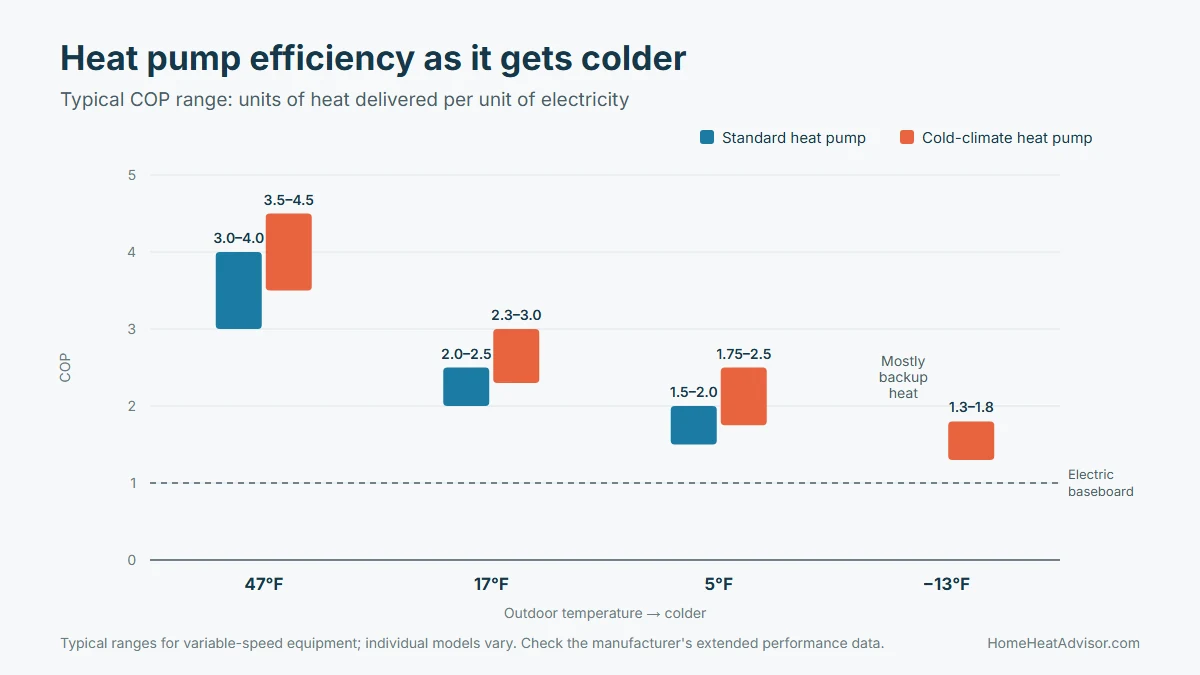
| Outdoor temperature | Typical COP, standard heat pump | Typical COP, cold-climate heat pump |
|---|---|---|
| 47°F | 3.0–4.0 | 3.5–4.5 |
| 17°F | 2.0–2.5 | 2.3–3.0 |
| 5°F | 1.5–2.0 (capacity drops sharply) | 1.75–2.5 |
| -13°F | Often relies on backup heat | About 1.3–1.8 on many models |
Defrost cycles
When the outdoor coil is colder than freezing and the air is humid, frost builds up on it. The heat pump clears it by briefly switching into cooling mode, sending hot refrigerant to the outdoor coil for a few minutes. You may see steam rising from the unit and feel cooler air from the vents. Both are normal. Backup heat often switches on during defrost to keep the air coming out of your vents warm.
Auxiliary heat vs. emergency heat
Auxiliary heat turns on automatically when the heat pump can’t keep up on its own, for example on very cold mornings or when you raise the thermostat several degrees at once. Emergency heat is a setting you switch on manually; it shuts off the heat pump and runs only the backup heat. Use it only if the heat pump has failed, because running on resistance heat alone can make heating cost two to three times more.
The outdoor temperature where a heat pump can no longer carry the whole load by itself is called the balance point. A correctly sized cold-climate system pushes the balance point low enough that backup heat runs only a few hours a year.
What does a heat pump cost to run?
Running cost depends on three things: your electricity price, how efficient the heat pump is in your climate, and how much heat your home needs. The fairest way to compare fuels is the cost to deliver the same amount of heat. The table below uses one million BTUs of delivered heat, roughly what an average home uses over a few cold winter days.
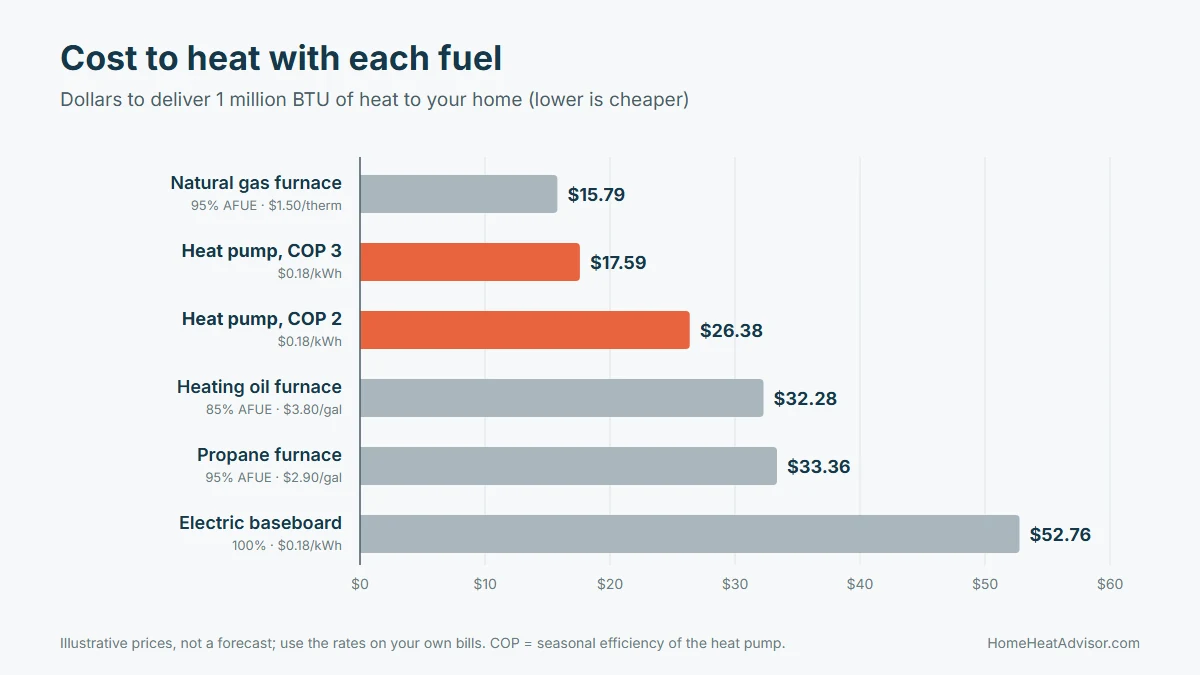
| Heating system | Efficiency assumed | Example price | Cost per million BTU of heat |
|---|---|---|---|
| Heat pump, seasonal COP 3 | 300% | $0.18/kWh | $17.59 |
| Heat pump, seasonal COP 2 | 200% | $0.18/kWh | $26.38 |
| Natural gas furnace | 95% AFUE | $1.50/therm | $15.79 |
| Heating oil furnace | 85% AFUE | $3.80/gallon | $32.28 |
| Propane furnace | 95% AFUE | $2.90/gallon | $33.36 |
| Electric baseboard or furnace | 100% | $0.18/kWh | $52.76 |
Three takeaways from the math:
- Against electric resistance, oil and propane, a heat pump almost always wins, often cutting heating costs by half or more.
- Against natural gas, it depends on your local rates. Here is a quick rule of thumb: with a seasonal COP of about 3 and a 95% gas furnace, a heat pump is cheaper to run when your electricity price per kWh is below your gas price per therm divided by about 9.3. At $1.50 per therm, that break-even point is about $0.16 per kWh.
- Cooling is included. A heat pump replaces your AC, and a new heat pump is usually more efficient at cooling than the old air conditioner it replaces.
Time-of-use electricity rates, solar panels and good insulation all shift the math further in a heat pump’s favor.
Heat pump vs furnace vs air conditioner
| Heat pump | Gas furnace | Central AC | |
|---|---|---|---|
| Heats | Yes | Yes | No |
| Cools | Yes | No | Yes |
| Energy source | Electricity | Natural gas or propane | Electricity |
| Heating efficiency | 200–400% (COP 2–4) | 80–98% AFUE | n/a |
| Burns fuel on site | No | Yes (needs venting and a CO detector) | No |
| Typical lifespan | 10–20 years | 15–25 years | 12–20 years |
If you are replacing an AC that is at the end of its life, a heat pump usually costs only a little more than a comparable air conditioner and adds efficient heating at the same time. Many homeowners keep their furnace as a backup and move to a dual-fuel setup.
Heat pump pros and cons
Pros
- Very efficient. Delivers 2 to 4 times more heat than the electricity it uses.
- One system for heating and cooling. Replaces a furnace and an AC.
- No combustion. No flame, no flue gases and no carbon monoxide risk from the heating system.
- Steady comfort. Variable-speed models run long, gentle cycles with fewer temperature swings and better dehumidification in summer.
- Lower emissions. Uses electricity that gets cleaner as the grid adds more renewable power.
Cons
- Higher upfront cost than a like-for-like furnace or AC replacement, especially for cold-climate or geothermal systems.
- Output drops in extreme cold. Standard models may need backup heat on the coldest days.
- Warmer, not hot, air. Supply air is often around 90–100°F instead of the 120°F+ a furnace delivers, which some people notice at first.
- Installation quality matters a lot. Poor sizing, a bad refrigerant charge or leaky ducts can wipe out the efficiency advantage.
- Possible electrical upgrades. Some homes need a new 240-volt circuit or a panel upgrade.
What does a heat pump cost to install in 2026?
Installed prices vary widely with home size, climate, the type of equipment and whether you need new ductwork or electrical work. As a rough guide, typical U.S. quotes look like this:
| System | Typical installed range |
|---|---|
| Single-zone ductless mini-split | $3,000–$6,000 |
| Multi-zone ductless mini-split | $8,000–$20,000 |
| Ducted air-source heat pump (whole home) | $8,000–$18,000 |
| Cold-climate ducted heat pump | $12,000–$22,000 |
| Geothermal heat pump | $20,000–$40,000+ |
Incentives changed in 2026. The federal 25C Energy Efficient Home Improvement Credit, which covered 30% of the cost up to $2,000, ended for equipment placed in service after December 31, 2025. What remains is a patchwork of state programs, including federally funded HEAR rebates of up to $8,000 for income-qualified households in states that have launched them, plus utility rebates and low-interest loans. Our heat pump cost guides break down pricing and incentives in more detail.
There is also a refrigerant change to be aware of. New heat pumps built since January 1, 2025 use lower-impact refrigerants, mainly R-454B and R-32, instead of R-410A. In May 2026 the EPA finalized a rule, effective July 27, 2026, that lets contractors keep installing R-410A equipment manufactured before 2025 until existing stock runs out, though some states, including New York, still ban it. R-410A remains available to service existing systems, but its price is rising as production is phased down.
Is a heat pump right for your home?
A heat pump is usually a strong choice if several of these are true:
- Your air conditioner or furnace is 12 to 15 years old or needs a major repair.
- You currently heat with electric resistance, oil or propane.
- You want to add cooling to a home that doesn’t have it, or fix rooms that are always too hot or too cold.
- Your home is reasonably well insulated and air-sealed, or you plan to improve it.
- You have, or plan to add, solar panels or a time-of-use electricity plan.
Think harder, or consider dual-fuel, if you have very cheap natural gas and a newer furnace, or if you live in a very cold area and your installer can’t show you a cold-climate model sized for your home’s heat loss at your local design temperature.
Whatever you choose, insist on a proper room-by-room load calculation (known in the industry as Manual J) rather than a rule of thumb based on square footage. An oversized heat pump short-cycles and dehumidifies poorly; an undersized one leans on expensive backup heat. For model comparisons, see our heat pump reviews.
Heat pump maintenance and lifespan
Heat pumps run year-round, so a little upkeep goes a long way:
- Check the filter monthly and clean or replace it every one to three months.
- Keep 2 feet of clearance around the outdoor unit, and clear snow, leaves and ice from it.
- Rinse dust off mini-split filters every few weeks during heavy use.
- Book a professional service once a year to check the refrigerant charge, electrical connections, defrost operation and coils.
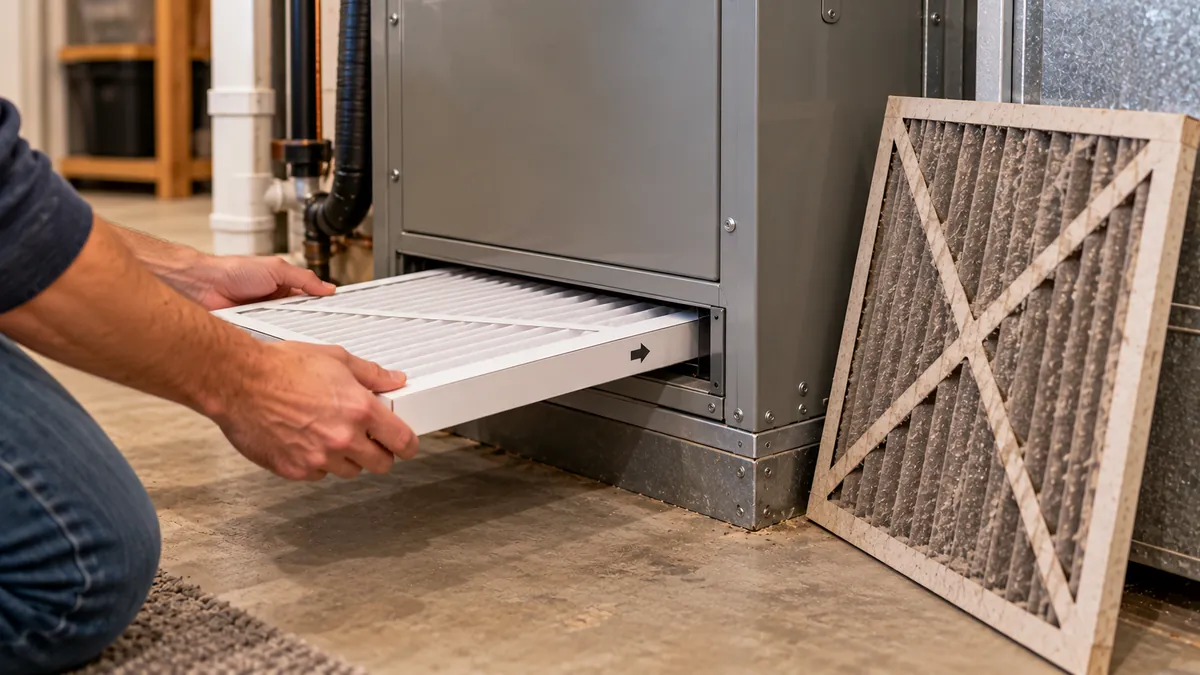
A well-maintained air-source heat pump typically lasts about 15 years, with a common range of 10 to 20. Geothermal indoor components often last 20 years or more, and their underground loops can last 50 years or longer.
Frequently asked questions
Can a heat pump heat a whole house?
Yes. A correctly sized ducted heat pump, or a multi-zone mini-split system, can heat an entire home on its own in most U.S. climates. In very cold regions, a cold-climate model or a dual-fuel setup with a furnace for the coldest days keeps the whole house comfortable.
At what temperature does a heat pump stop working?
A heat pump does not simply stop at a set temperature. Its output and efficiency fall as it gets colder. Many standard models lean heavily on backup heat below about 25°F, while cold-climate models keep producing useful heat down to around -13°F to -22°F, depending on the model.
Do heat pumps use a lot of electricity?
A heat pump uses more electricity than a gas furnace, because it replaces the gas, but much less than electric resistance heat for the same warmth. Moving from baseboard or an electric furnace to a heat pump can cut heating electricity use roughly in half.
Is a heat pump the same as an air conditioner?
In cooling mode, it works exactly like a central air conditioner. The difference is the reversing valve, which lets a heat pump run the cycle backward to heat your home in winter. An air conditioner can only cool.
Why does my heat pump blow cool air in winter?
Heat pump air is usually 90–100°F, which feels cooler than furnace air even though it is warming the house. Short bursts of cool air can also happen during a defrost cycle. If the air stays cool and the house doesn’t warm up, have the system checked.
How long does a heat pump last?
Most air-source heat pumps last 10 to 20 years, and about 15 years is typical. Regular filter changes, a clear outdoor unit and annual service help it reach the upper end of that range.
Sources
- U.S. Department of Energy: Heat Pump Systems
- U.S. Department of Energy: Geothermal Heat Pumps
- ENERGY STAR: How Does a Heat Pump Work?
- ENERGY STAR Version 6.2 Central AC and Heat Pump Specification (cold-climate criteria)
- AHRI: 2023 Energy Efficiency Standards (SEER2 and HSPF2 minimums)
- Canary Media: Heat pump sales dipped in 2025, they still beat gas furnaces (AHRI data)
- NAHB: EPA finalizes refrigerant rule update to allow older HVAC unit installation (May 2026)
- IRS: Energy Efficient Home Improvement Credit