
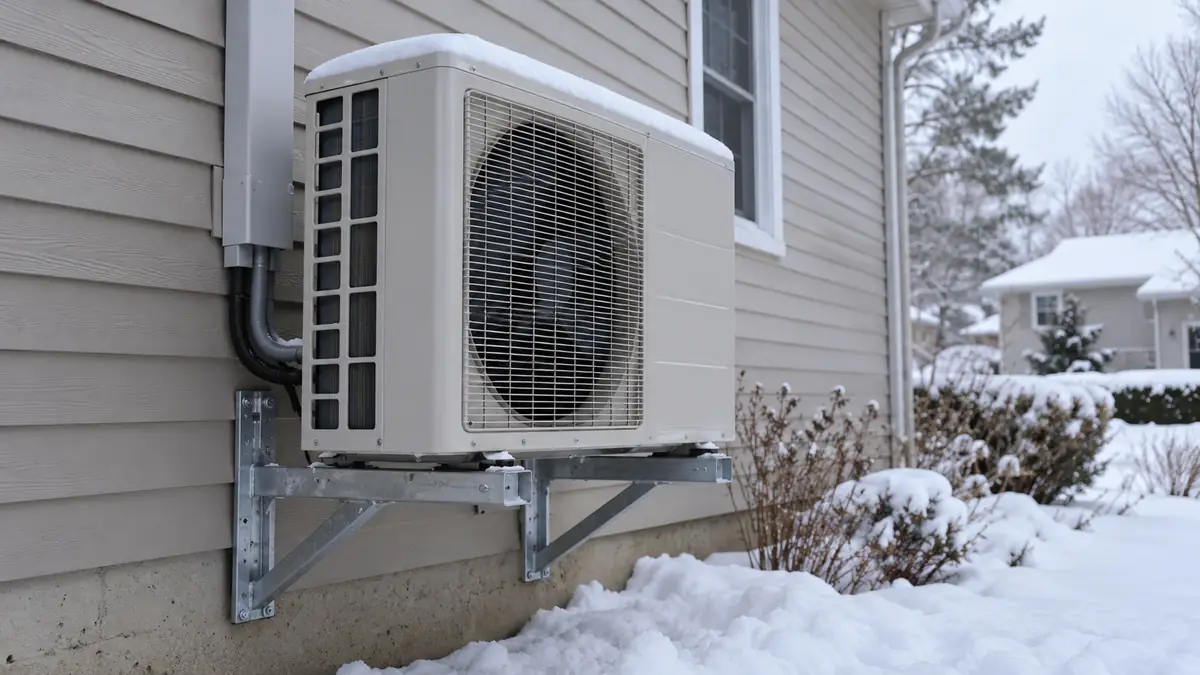
A heat pump in an ice storm faces a harder job than one on an ordinary cold day. Lennox says that prolonged freezing rain, sleet or heavy wet snow can overwhelm the defrost system (Lennox, February 2026). Most owners then ask the same thing: do you leave the unit running, or switch it off until the weather passes?
This guide answers that for a heat pump in heavy snow and for a heat pump in an ice storm. It covers what to check from a window, what to do before, during and after a storm, what never to do, and what a power cut changes. For why units freeze in the first place, read our heat pump frozen guide. More fixes are in our heat pump troubleshooting section.

Leave a heat pump in snow running while the outdoor fan turns and the coil is visible. Brush light snow off the top and keep two feet clear on all sides. If ice has covered the fan or coil, Lennox says to switch to off at the thermostat; PickHVAC says to turn off outdoor power and run Emergency heat. No manufacturer page we read says “leave it on” outright, so that half is our reading. Call a licensed HVAC technician if ice stays 6 to 8 hours.
Clear space, Lennox
2 ft
Clear at least two feet on all sides of the outdoor unit (Lennox, February 2026)
Ice that stays, Lennox
6–8 hours
Call a Lennox dealer if the ice has not melted or refreezes quickly (Lennox, February 2026)
Snow deflector penalty
2–4%
One estimate of the heating and cooling efficiency lost to a diverting snow deflector (NY Clean Heat, April 2025)
In this guide
- The short answer: leave a heat pump in snow on or off?
- What a heat pump in heavy snow has to deal with
- What happens to a heat pump in an ice storm
- Before the storm: get a heat pump in snow country ready
- During the storm: checking a heat pump in an ice storm
- After the storm: clearing a heat pump in heavy snow
- What not to do
- How much clearance and height does a heat pump need in snow?
- Snow protection that is built in
- Power cuts and generators
- When to call a technician
- Frequently asked questions
The short answer: leave a heat pump in snow on or off?
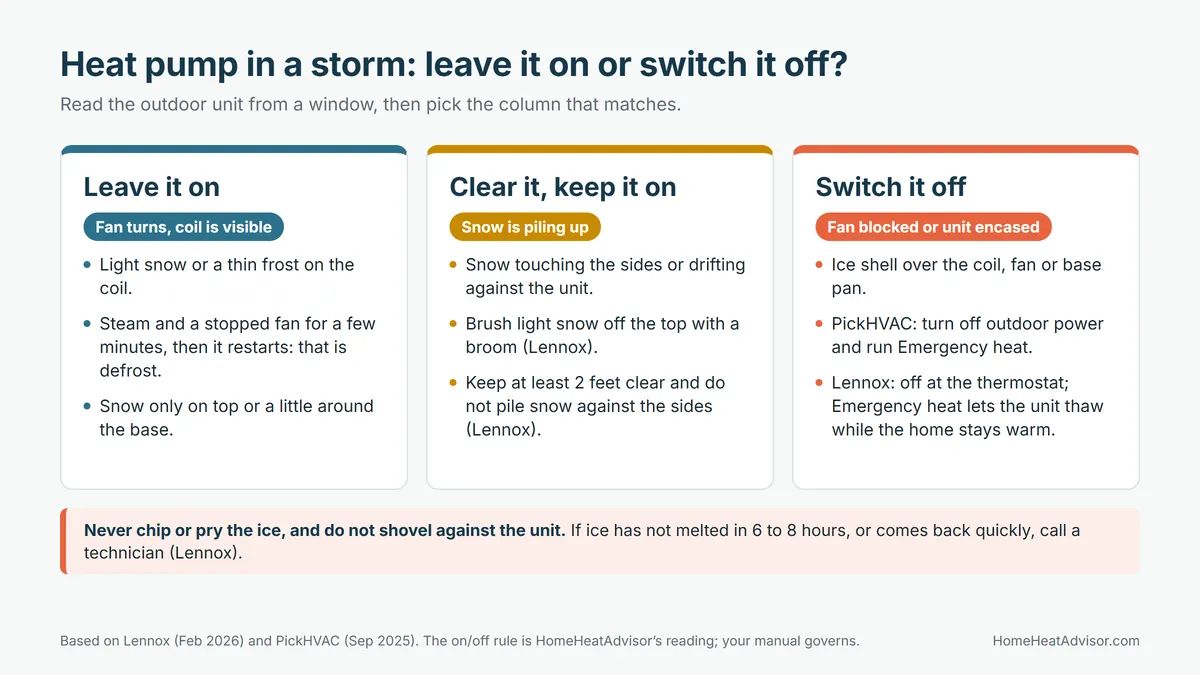
We found no manufacturer page that says to leave a heat pump running through a storm, and none that says to shut it off before one starts. What the sources do say is what to do once the unit is in trouble. Lennox says that if the unit is frozen, the first step is to switch to off at the thermostat. PickHVAC, a contractor resource, says that if the fan is blocked or the unit is encased in ice, you turn off outdoor power and run Emergency heat (PickHVAC, September 2025).
Put together, that gives a simple rule, and it is our reading of those two sources, not a manufacturer rule: while the fan turns and you can see the coil, leave the heat pump in snow running. When the fan is blocked or the unit is encased, switch it off. In between, clear the snow and keep the heat pump in heavy snow running.
| What you see on the unit | What to do | Where it comes from |
|---|---|---|
| Light snow on top, fan turns, coil visible | Leave it on. Brush the top with a broom when the snow stops. | Our reading; Lennox for the broom |
| A short pause with steam, then the fan restarts | Leave it on. That is a normal defrost cycle (see our defrost mode guide). | Trane and CEE on normal defrost, covered there |
| Snow touching the sides or drifting against the unit | Clear it and keep the system on. Do not pile snow against the sides. | Lennox; PickHVAC |
| Ice shell over the coil, fan or base pan | Switch to off, then use Emergency heat for the house. | Lennox (off); PickHVAC (outdoor power off, Emergency heat) |
| Ice still there 6 to 8 hours after thawing starts, or it refreezes quickly | Call a licensed HVAC technician. | Lennox |
Emergency heat runs the electric backup instead of the heat pump, so it keeps the house warm while the outdoor unit sits idle. Our emergency heat vs auxiliary heat guide explains the setting and what it costs to run.
What a heat pump in heavy snow has to deal with
PickHVAC says a heat pump in heavy snow can be smothered, because heavy snow and drifting block airflow (PickHVAC, September 2025). Lennox adds that heavy wet snow can overwhelm the defrost system (Lennox, February 2026). Our reading is that defrost is designed to clear frost, not a steady load of snow.
The best field description we found is a 2015 article on mini-split heat pumps by Marc Rosenbaum for Green Building Advisor. He writes that wind-driven snow can coat the coil and trigger defrost, and that in the worst case the heat pump shuts down. During one blizzard he saw defrost cycles slightly over once per hour on his own installs, and he suggests checking units during a bad storm (Green Building Advisor, February 2015). That is one observation on mini-splits, not a rule for every heat pump.
So the main risk to a heat pump in heavy snow is the snow itself, in our reading: a buried or smothered unit cannot move air across its coil. That is why the sources focus on clearance and on keeping the fan and coil open.
What happens to a heat pump in an ice storm
A heat pump in an ice storm has a harder time than one in plain snow. PickHVAC says freezing rain or sleet can glaze the coil and fan guard in minutes (PickHVAC, September 2025). Lennox says prolonged freezing rain, sleet or heavy wet snow can overwhelm the defrost system (Lennox, February 2026).
That is the case where a heat pump in an ice storm needs attention. A thin glaze on the grille is one thing. PickHVAC treats ice that coats the coil, blocks the fan or encases the base pan as not normal, and says not to chip, pry or hammer it. If the unit is encased, the decision is the third column of the chart above: switch off and heat the house another way. Our guide to defrosting a frozen heat pump has the thaw steps.
Before the storm: get a heat pump in snow country ready
If a forecast gives you a day or two, a few minutes of preparation lowers the risk for a heat pump in snow. All of it is outside work you can do safely.
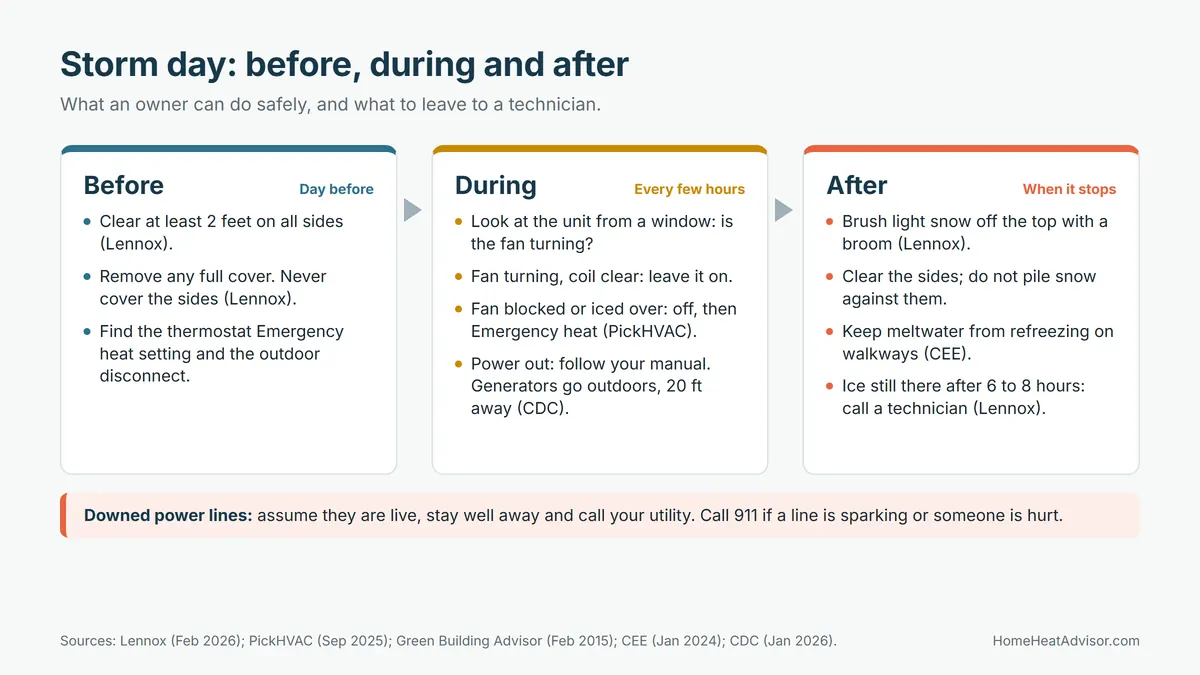
- Clear at least two feet on all sides. That is Lennox’s figure (Lennox, February 2026). Cut back shrubs, move bins and brush leaves out of the gap.
- Take any full cover off. PickHVAC says never to cover an operating unit, because covers trap moisture and can freeze the fan and coil. Lennox allows a snow guard on the top only and says never to cover the sides, which blocks airflow.
- Look at where drifts form. Trane’s 2009 installation manual for packaged units says to avoid locating a unit where snow drifts, and to consider a snow drift barrier (Trane manual 18-BB33D6-9, April 2009).
- Find the Emergency heat setting on your thermostat and the outdoor disconnect. If you cannot find the disconnect, do not guess; leave the unit alone and call a technician.

During the storm: checking a heat pump in an ice storm
The check during a storm is short: look at your heat pump in snow from a window every few hours. Do not go out in an ice storm for this. Ask three questions: is the fan turning, can you see the coil, and is anything packed against the sides?
- Fan turning and coil visible: leave it on. A stopped fan with steam for a few minutes is normal defrost.
- Snow piling against the sides: when it is safe, clear it by hand or with a soft broom. Lennox says not to pile snow against the sides.
- Fan blocked or unit encased in ice: switch to off at the thermostat, then use Emergency heat. PickHVAC puts it as turning off outdoor power and running Emergency heat.
Do not shovel into the unit, chip ice off the coil or pour water on it. If you have to go near the fan guard for any reason, switch off the outdoor disconnect first. That is our precaution, because a fan can restart without warning.
After the storm: clearing a heat pump in heavy snow
Once the snow stops, open the heat pump in heavy snow back up. Lennox says to gently remove light snow from the top with a broom, never with sharp tools, and to clear snow away from the unit after storms without piling it against the sides (Lennox, February 2026).

- Keep meltwater moving. The CEE owner guide says to keep melt from refreezing where people walk (CEE, January 2024). Our guide to heat pump leaking water outside explains normal drip.
- Watch the steam. Steam after a storm is usually defrost clearing melted snow. Our heat pump steam guide shows how to tell it from smoke.
- Give ice time. Lennox says to call a dealer if ice has not melted in 6 to 8 hours or comes back quickly. Until then, follow the thaw steps in our defrost guide.
What not to do
Most damage to a heat pump in an ice storm comes from owners trying to help. The sources agree on these.
| Mistake | Verdict | What the sources say |
|---|---|---|
| Covering the whole unit | Never | PickHVAC says covers trap moisture and can freeze the fan and coil. Lennox allows a snow guard on the top only. |
| Chipping or prying ice off | Never | Lennox says to use no sharp tools. PickHVAC says not to chip, pry or hammer ice. |
| Shoveling snow against the sides | Avoid | Lennox says not to pile snow against the sides after clearing. |
| Hot water on the unit | Never | Lennox warns that hot water can crack components. Runoff can also refreeze (CEE). |
| Adding a snow deflector without checking | Ask first | NY Clean Heat says an unapproved attachment could void the warranty, and one estimate puts the efficiency loss at 2% to 4%. |
How much clearance and height does a heat pump need in snow?
The sources quote four different numbers, and they measure different things for a heat pump in snow country. That is why owners find the advice confusing.
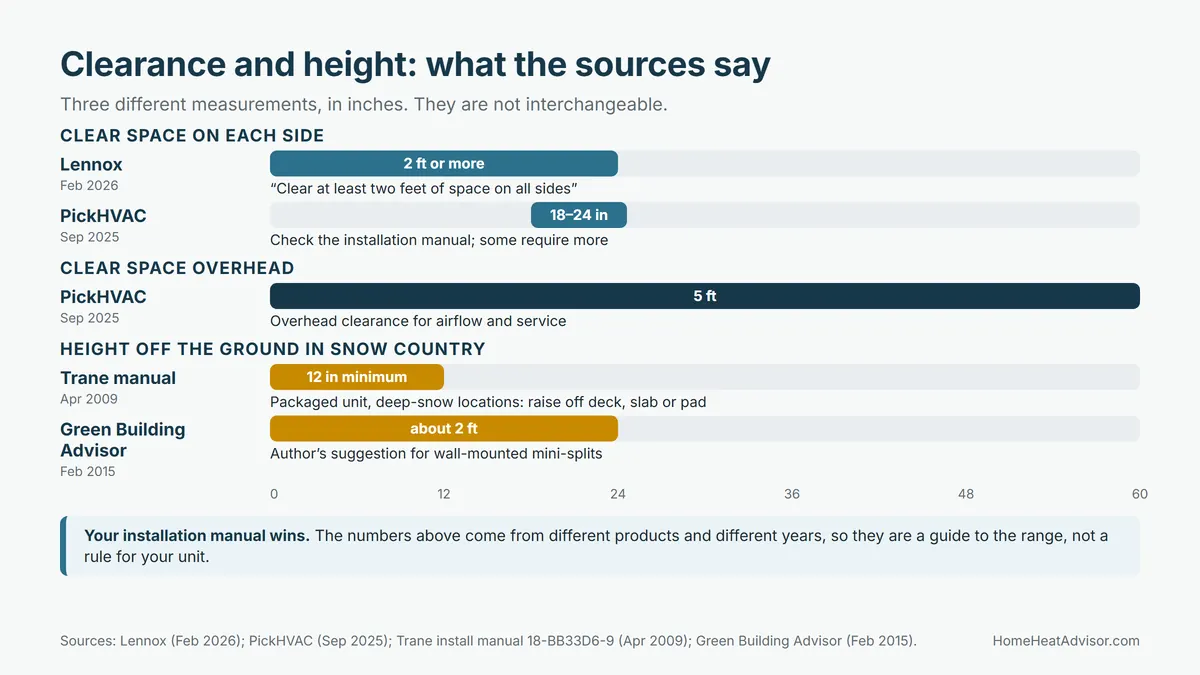
- Clear space on each side. Lennox says at least two feet on all sides. PickHVAC says 18 to 24 inches, and adds that some units need more, so read the installation manual (PickHVAC, September 2025).
- Clear space overhead. PickHVAC gives 5 feet overhead for airflow and service.
- Height off the ground. Trane’s 2009 manual for single-package units says to raise the unit a minimum of 12 inches off the deck, slab or pad in locations with deep snow. Rosenbaum suggests raising a wall-mounted mini-split condenser above the snow line (Green Building Advisor, February 2015).
Our reading: use the larger side figure, two feet, as your clear zone, and use your installation manual for height and overhead. The Trane number is from a 2009 packaged-unit manual, so treat it as one manufacturer’s example, not a rule for split systems. No source we found gives a snow depth at which a heat pump should be switched off.
Snow protection that is built in
If a heat pump in heavy snow is a yearly event where you live, the better fix is in how the unit is installed. A technician can look at your site; here is what the sources say.
- Stand or bracket. The CEE owner guide recommends a snow stand in cold climates (CEE, January 2024). Our cold climate guide shows one.
- Gable end, not under the eave. NY Clean Heat says a unit under an eave drip line or a wide-slat deck risks a snowslide or water that can clog or ice up the unit, and prefers the gable end (NY Clean Heat, April 2025).
- Snow deflectors. The same fact sheet quotes one estimate of a 2% to 4% loss of heating and cooling efficiency from a diverting deflector. It says to consult the manufacturer for approved options, because an unapproved attachment could void the warranty, and that Carrier has approved one product on its units with extra clearances.
- A top-only snow guard. Lennox allows a snow guard over the top, never the sides.
Ask the installer for the manufacturer’s own snow guidance before buying any accessory. If you are replacing a unit in snow country, put the stand and the drift location on the quote.
Power cuts and generators
A heat pump in an ice storm often loses power too. We looked for a manufacturer rule on how long to wait before restarting a heat pump after an outage, and for how long to run Emergency heat afterward. We found none we could quote. The only numbers we saw were secondhand, so we are not repeating them. Follow your unit’s manual, and call the manufacturer or a licensed HVAC technician if the manual is silent.
- Generators outdoors only. The CDC says to run a portable generator outdoors, more than 20 feet from windows, doors and vents, never in a home or garage even with the doors open (CDC, January 2026). Ready.gov gives the same 20 feet, and adds an attached garage (Ready.gov, March 2026).
- Carbon monoxide detectors. The CDC says to have a battery-powered detector, and Ready.gov says to have detectors on every level.
- Connecting a generator to the house. Have a licensed electrician install the connection.
- Downed lines. University of Illinois Extension says to assume any low, dangling or downed wires are energized and dangerous, and that a line need not be sparking to be live (Illinois Extension, undated). Stay well away, call your utility, and call 911 if a line is sparking or someone is hurt.
Heat first
Ready.gov notes that winter storms can cut off heat and power. Plan a warm room and a safe way to heat it before the storm, and never run a generator indoors.
When to call a technician
Call a licensed HVAC technician for a heat pump in an ice storm or after one if any of these apply (Lennox, February 2026; PickHVAC, September 2025):
- Ice has not melted in 6 to 8 hours, or it refreezes quickly (Lennox).
- Ice coats the coil, blocks the fan or encases the base pan (PickHVAC).
- The fan does not turn after the ice has melted.
- The unit does not restart after a power cut and your manual has no reset steps.
- You hear grinding, squealing or banging.
Refrigerant work needs a technician with EPA Section 608 certification (U.S. EPA), and wiring needs a licensed electrician. If you smell burning, switch the system off at the thermostat and the outdoor disconnect. If you see smoke or flames, call 911.
Frequently asked questions
Should I turn off my heat pump in a snowstorm?
Not by default. Leave it on while the fan turns and the coil is visible. Switch it off if ice has covered the fan or coil: Lennox says to switch to off at the thermostat, and PickHVAC says to turn off outdoor power and run Emergency heat. That on/off rule is our reading of both.
Is it OK for a heat pump in heavy snow to be covered?
Light snow on top is common. Heavy snow and drifts that block airflow are not: PickHVAC says they smother the unit. Brush the top gently with a broom, clear the sides, and keep two feet around it (Lennox, February 2026).
Can a heat pump in an ice storm keep working?
It can run, but freezing rain can glaze the coil and fan guard within minutes (PickHVAC), and Lennox says prolonged freezing rain or sleet can overwhelm the defrost system. Check the fan from a window and switch off if the unit is encased.
Should I cover my heat pump in winter?
Not fully. PickHVAC says never to cover an operating unit, and Lennox says never to cover the sides. Lennox does allow a snow guard on the top only. NY Clean Heat says to consult the manufacturer for approved accessories.
What should I do with my heat pump after a power outage?
Follow your manual. We found no manufacturer wait time or Emergency heat duration to quote, so we do not give one. Call the manufacturer or a licensed HVAC technician if the manual is silent or the unit does not restart.
How much space does a heat pump need in snow?
Lennox says at least two feet on all sides, PickHVAC says 18 to 24 inches and 5 feet overhead, and a 2009 Trane manual for packaged units says to raise the unit at least 12 inches in deep-snow locations. Your installation manual governs.
Sources
- Lennox: What to Do If Your Heat Pump Is Frozen (February 2026)
- PickHVAC: Ice on Heat Pump in Winter: Causes, Fixes, and Prevention (September 2025)
- Trane: Installation, Operation and Maintenance 18-BB33D6-9, single-package heat pump (April 2009)
- Green Building Advisor: Minisplit Heat Pumps and Blizzards (February 2015)
- NY State Clean Heat: Snow Deflectors fact sheet (April 2025)
- Consortium for Energy Efficiency: You Installed an Air Source Heat Pump. Now What? (January 2024)
- CDC: Carbon Monoxide Poisoning Basics (January 2026)
- Ready.gov: Winter Weather (March 2026)
- University of Illinois Extension: Winter Storm Safety (undated, checked October 2026)
- U.S. EPA: Section 608 Technician Certification
About this guide
Published by HomeHeatAdvisor. This guide is based on manufacturer, efficiency-program and public-safety sources, checked in October 2026; each figure names its source and date, and our own readings are labeled as ours. Use a licensed HVAC technician for anything beyond the owner checks above. Our editorial policy explains how we research, fact-check and update our guides. Spotted an error? Let us know. More troubleshooting guides.