

Emergency heat vs auxiliary heat is one of the most common questions from first-winter heat pump owners, because both settings use the same backup heater and both can show up on the thermostat. The difference is simple. Auxiliary heat (AUX) switches on automatically to help the heat pump on the coldest days. Emergency heat (EM HEAT) is a mode you choose yourself, and it shuts the heat pump off completely.
That difference matters for your electric bill. This guide explains what each setting does, when to use emergency heat, what it costs to run and when aux heat that never turns off is a warning sign. If you are new to these systems, start with our guide to how a heat pump works.

Auxiliary heat and emergency heat usually use the same backup heater, most often electric heat strips in the indoor air handler. Aux heat runs automatically alongside the heat pump when it can’t keep up, during defrost or after a big jump in the thermostat setting. Emergency heat is a mode you switch on by hand. It turns the outdoor heat pump off and heats the house with the backup alone, so it costs much more to run. Use it only while the heat pump is broken, iced in or waiting for a repair.
Efficiency (COP)
1 vs 3+
Backup heat strips vs a heat pump in mild weather
Electricity, per kWh
18.2¢
2026 U.S. average residential price, EIA forecast
Emergency heat costs
About 3x
As much as the heat pump for the same heat in mild weather
In this guide
- Emergency heat vs auxiliary heat at a glance
- What is aux heat?
- What is emergency heat?
- What emergency heat costs to run
- Aux heat running all the time? 6 things to check
- Thermostat settings that keep aux heat in check
- Dual fuel: when the backup is a furnace
- Repair costs in 2026
- Repair or replace?
- Frequently asked questions
Emergency heat vs auxiliary heat at a glance
Most heat pumps in colder parts of the U.S. have a second source of heat built in. In an all-electric system it is a bank of resistance heat strips inside the indoor air handler. In a dual fuel system it is a gas or oil furnace. Honeywell Home notes that the emergency heat and the auxiliary or backup heat are commonly the same source. What changes between the two settings is whether the heat pump runs too, and who switches the backup on.
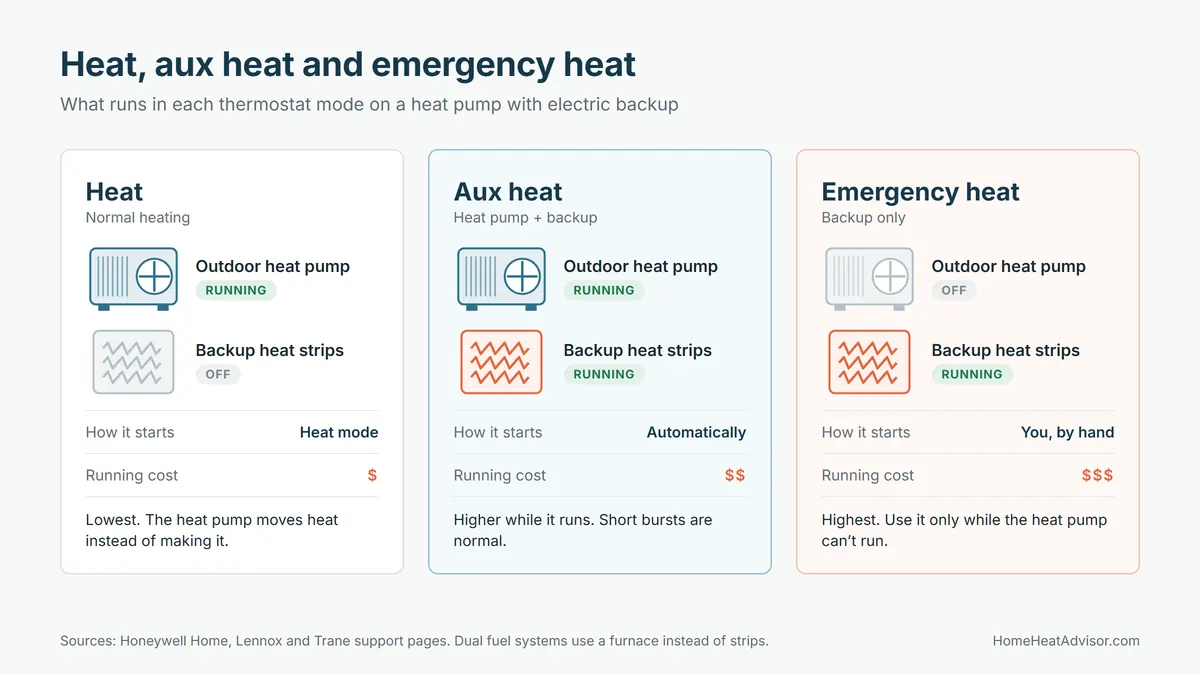
| Aux heat | Emergency heat | |
|---|---|---|
| What runs | Heat pump and backup heat together | Backup heat only. The outdoor unit is off |
| Who turns it on | The thermostat, automatically | You, by switching the thermostat to EM HEAT |
| Who turns it off | The thermostat, once it catches up | You. It stays on until you switch back to Heat |
| When it is normal | Cold snaps, defrost cycles, recovering from a setback | Only while the heat pump can’t run |
| Running cost | Higher while it runs | Highest, about 3 times the heat pump in mild weather |
| Thermostat display | AUX, AUX HEAT ON or a backup heat icon | EM HEAT, EMER or a red light |
In short, aux heat is a helper you rarely need to think about, and emergency heat is a manual override you should rarely need at all.
What is aux heat?
Auxiliary heat is the second stage of heating on a heat pump system. Lennox describes it as the backup that comes on when the first stage, the heat pump, cannot keep up with the heating demand and the thermostat calls for more heat. On an all-electric system the heat pump keeps running while the heat strips add warmth on top, so you get the best of both.
You do not have to do anything to use aux heat. The thermostat brings it on and switches it off again, and on most systems the only sign is a small AUX label or icon on the display.

When aux heat turns on
- On the coldest days. A heat pump’s output drops as the outdoor temperature falls. Below a certain point, often called the balance point, it can no longer replace the heat the house loses, and aux heat fills the gap.
- After a big jump in the setting. Trane notes that aux heat comes on when the demand is large, such as raising the setpoint several degrees at once. The thermostat sees a big gap and brings in the backup to close it quickly.
- During defrost. When the outdoor coil defrosts, the heat pump briefly runs in reverse. The owner guide hosted by the U.S. Department of Energy notes that supplemental heat may come on during defrost so the air from the vents doesn’t feel cold. See how the heat pump defrost cycle works.
- Below a lockout temperature. Many thermostats let the installer set an outdoor temperature for the backup. Lennox gives the example of an aux lockout of 40°F, which means aux heat is only allowed below 40°F. Some systems also lock the heat pump out in extreme cold.
Is it normal to see aux heat?
Yes, in short bursts. Seeing AUX for a while on a frigid morning, during a defrost cycle or after you raise the thermostat is the system doing its job. It is also normal for aux heat to run more in a cold snap than it does in mild weather, because the heat pump’s capacity falls as the temperature drops.
What is not normal is aux heat showing all day in mild weather. The DOE-hosted owner guide lists an auxiliary heating mode that is constantly displayed as a warning sign. It calls electric strip heat costly and inefficient and advises you to consult an HVAC professional if you see frequent use. We cover the usual causes below.
Good to know
Trane states that aux heat cannot be disabled on its thermostats, because it protects comfort when the heat pump falls behind. What an installer can change is when it is allowed to come on, through the lockout and staging settings.
What is emergency heat?
Emergency heat is the backup heat running by itself. Lennox defines it as using the supplemental, second stage heat without the heat pump. Honeywell Home confirms that the compressor does not run in emergency heat mode. The outdoor unit sits idle and the backup heater does all the work.
You choose emergency heat yourself, usually by moving the system switch to EM HEAT or picking it from the thermostat menu. It stays on until you switch it off. Trane notes that the emergency heat option only appears when the thermostat is set up for a heat pump, and that an installer can enable or disable it. Emergency heat is a system mode, not a fan setting; our guide to heat pump fan auto or on explains the difference.

When to use emergency heat
Switch to emergency heat only when the heat pump itself can’t or shouldn’t run:
- The outdoor unit is encased in ice that defrost isn’t clearing. Turning the heat pump off lets the ice melt without straining the fan or coil. Follow our steps for what to do if your heat pump is frozen.
- The outdoor unit is damaged or buried, for example by a fallen branch, flood water or a snowdrift you can’t safely clear yet.
- The heat pump has failed and is blowing cold air or not running, and you are waiting for a technician.
- A technician tells you to, for example while a part is on order.
When not to use emergency heat
- Just because it’s cold outside. Aux heat already handles cold snaps automatically, while letting the heat pump do as much of the work as it can.
- To warm the house faster. Emergency heat isn’t hotter, it is only more expensive. Raise the setting a degree or two at a time instead.
- As a long-term fix. If you need emergency heat for more than a few days, get the heat pump repaired. Running on backup heat alone all winter can cost a lot more.
Remember
Switch back to normal Heat as soon as the outdoor unit is clear or repaired. Emergency heat does not turn itself off.
What emergency heat costs to run
Backup heat strips turn one unit of electricity into one unit of heat, a coefficient of performance (COP) of 1. A heat pump moves heat instead of making it. The DOE-hosted owner guide puts a typical COP above 3, and still above 1.75 at 5°F. That is why emergency heat costs so much more than the heat pump for the same warmth. The strips also draw far more current than the blower, which is why a breaker that trips only on aux or emergency heat is covered in our guide to why a heat pump keeps tripping the breaker.
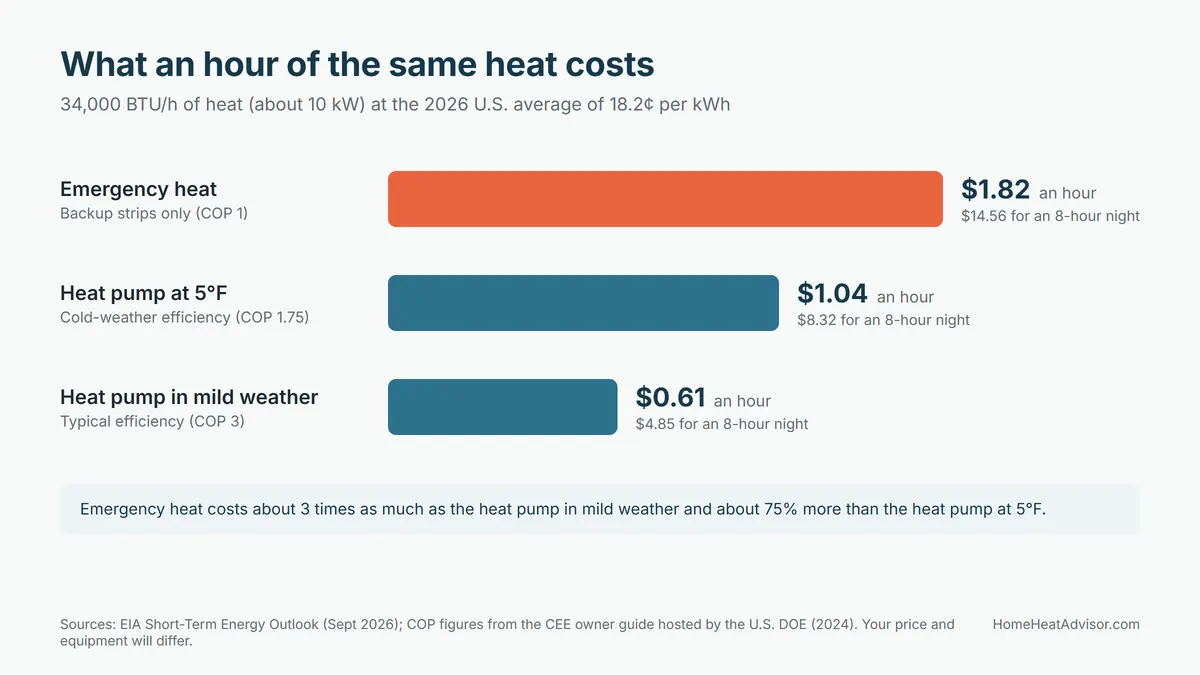
Here is the math behind the chart. We took 34,000 BTU per hour of heat, about 10 kW, and the EIA’s 2026 forecast for the average U.S. residential electricity price of 18.2¢ per kWh:
- Emergency heat (COP 1): 10 kWh × $0.182 = $1.82 an hour, or $14.56 for an 8-hour night.
- Heat pump at 5°F (COP 1.75): 5.7 kWh × $0.182 = $1.04 an hour, or $8.32 a night.
- Heat pump in mild weather (COP 3): 3.3 kWh × $0.182 = $0.61 an hour, or $4.85 a night.
A week on emergency heat while you wait for a repair, with the backup running about 12 hours a day, works out to roughly $150 in this example. A heat pump in mild weather would supply the same heat for about $50. Aux heat sits in between, because the heat pump keeps contributing while the strips help.
Money-saving tip
Deep nightly setbacks can backfire with a heat pump. Turning the thermostat up 5°F or more in the morning is exactly the kind of large demand that brings on aux heat. The DOE-hosted guide recommends keeping a heat pump’s thermostat steady and saving setbacks for absences of more than a day. Our guide on whether to turn down a heat pump at night has the numbers.
Your own cost depends on your electricity rate, the size of your backup heater and how cold it is. For a wider look at running costs, see our heat pump running cost guide and the winter downsides of heat pumps.
Aux heat running all the time? 6 things to check
If your thermostat shows AUX for hours in mild weather, or your bill has jumped, the heat pump is probably not pulling its weight. Work through these checks in order. The first three you can do yourself.
1. A clogged air filter
A dirty filter chokes airflow, so the heat pump delivers less heat and the thermostat calls for backup to make up the difference. ENERGY STAR recommends checking the filter every month and changing it at least every three months.
Fix: Replace the filter, then watch whether AUX shows up less over the next day.
2. Big temperature jumps
Programmed setbacks, smart schedules and people turning the dial up a lot all create a big gap between the room and the setpoint. The thermostat closes it fast by bringing in aux heat.
Fix: Hold a steady temperature, or raise it 1–2°F at a time. If your schedule uses deep setbacks, make them shallower. The best heat pump temperature for winter guide lists the settings to use.
3. Thermostat setup or the lockout setting
A thermostat that isn’t configured for your heat pump, or a backup lockout temperature set too high, can bring on aux heat far more often than needed. The DOE-hosted guide advises confirming with your contractor whether backup heat is programmed and at what setpoint.
Fix: Check that the thermostat is set to Heat, not EM HEAT. Then ask your installer to check the configuration and the aux lockout temperature.
4. An iced-up outdoor unit
If the outdoor coil is covered in ice, the heat pump can barely collect heat and aux heat takes over. Frost that clears every hour or so is normal, but ice that stays is not. Our guide to a frozen heat pump explains how to thaw it safely.
Fix: Clear snow from around the unit and let the ice melt. Never chip at it or pour hot water on it. Call a technician if it keeps coming back.
5. Low refrigerant or a failing compressor
A refrigerant leak or a compressor that is wearing out leaves the heat pump running but delivering little heat. The house stays warm only because aux heat is doing the work, which is why a bill shock is often the first sign.
Fix: This needs a licensed technician. Refrigerant work requires EPA certification, so don’t attempt it yourself.
6. A system that is too small for the house
If the heat pump was undersized, or the house loses heat quickly through drafts and thin insulation, aux heat will run on every cold day. That isn’t a fault, but it is expensive. Our page on heat pump cold-weather performance explains what to expect.
Fix: Ask for a load calculation (Manual J) to see whether the system matches the house. Sealing air leaks and adding insulation can help too.
If the heat pump is blowing cold air or not running at all, go to our heat pump not heating guide, which covers 12 causes in the order to check them.
Thermostat settings that keep aux heat in check
A few settings decide how often the backup runs. You can change some yourself; others are installer settings.
- Keep a steady setpoint. The DOE-hosted guide recommends leaving a heat pump’s thermostat alone rather than setting it back each night.
- Use adaptive or smart recovery. The DOE Building America Solution Center says a heat pump thermostat should have adaptive recovery, which brings the temperature back up gradually and minimizes costly auxiliary heating. Its example: setting back to 62°F and returning to 68°F by 5 p.m.
- Raise it in small steps. Going up 1–2°F at a time lets the heat pump catch up on its own.
- Ask about the aux lockout and staging. Your installer can set the outdoor temperature above which the backup isn’t allowed, and how long the thermostat waits before calling for it.
- Leave EM HEAT alone. Make sure nobody in the house uses it as a “boost” setting.
Ask your installer
“What is my aux heat lockout temperature, and is the thermostat configured for a heat pump with electric backup?” Those two answers explain most aux heat problems.
Dual fuel: when the backup is a furnace
In a dual fuel system the backup is a gas or propane furnace instead of heat strips. Lennox explains that in this setup the heat pump turns off when the furnace starts, so the two don’t heat at the same time. Aux heat therefore means the furnace has taken over, usually below a changeover temperature the installer sets. Emergency heat still means the heat pump is locked out and the furnace does all the heating. The cost gap depends on your local gas and electricity prices rather than the 3-to-1 ratio above.
Repair costs in 2026
If aux heat is covering for a heat pump problem, these are the typical repair costs from Fixr’s 2026 cost data. Fixr puts the average heat pump repair at about $400.
| Repair | Typical cost |
|---|---|
| Service call / diagnosis | $75–$250 |
| Thermostat replacement | $85–$300 |
| Capacitor | $100–$400 |
| Refrigerant recharge | $100–$600 |
| Circuit board | $150–$700 |
| Reversing valve | $350–$700 |
| Blower motor | $300–$1,000 |
| Compressor | $800–$2,500 |
| Air handler replacement | $1,500–$3,500 |
Ask for a written quote that separates parts, labor and refrigerant. Our page on how we research costs explains where these figures come from.
Repair or replace?
If aux heat is running because of a filter, a thermostat setting or ice, the fix is cheap. The decision gets harder when it is covering for a major fault in an older system.
| Your situation | Usually |
|---|---|
| Aux heat from setbacks, a dirty filter or thermostat setup | Adjust or fix. The heat pump itself is fine. |
| Failed capacitor, sensor or board | Repair. These are moderate, one-off costs. |
| Compressor or major leak on a system over 12–15 years old | Get replacement quotes before paying for the repair. |
| Aux heat on every cold day because the system is undersized | Consider replacing with a correctly sized cold-climate model. |
Fixr puts the average cost of a new heat pump at about $8,350. To compare a repair quote with the price of a new system, see our heat pump installation cost breakdown.
Frequently asked questions
What is the difference between emergency heat and auxiliary heat?
Both usually use the same backup heater. Auxiliary heat runs automatically together with the heat pump when it needs help. Emergency heat is switched on by hand and runs the backup alone, with the heat pump off, so it costs more per hour of heat.
Is it bad to run emergency heat?
It won’t harm the system, but it is expensive. In our example it costs about 3 times as much as the heat pump in mild weather. Use it only while the heat pump can’t run, and switch back to Heat once it is fixed.
Why does my thermostat say aux heat?
The backup heat is helping the heat pump. That is normal on very cold days, during defrost and after you raise the setting. If AUX shows for hours in mild weather, check the filter, your schedule and the outdoor unit, then call a technician.
At what temperature should I switch to emergency heat?
There is no temperature at which you should switch. Aux heat already brings in the backup automatically in the cold. Emergency heat is for when the heat pump is broken, iced in or damaged, whatever the weather.
Can I turn off aux heat?
Usually not from the thermostat. Trane, for example, states that aux heat cannot be disabled. An installer can change when it is allowed to run with the aux lockout temperature and staging settings.
Is emergency heat more expensive than aux heat?
Yes, for the same amount of heat. With aux heat the heat pump still supplies part of the warmth, and even at 5°F it delivers about 1.75 units of heat per unit of electricity. On emergency heat all of it comes from the backup at a COP of 1.
Does aux heat mean my heat pump is broken?
No, not on its own. Short periods of aux heat are part of normal operation. Aux heat running almost constantly, especially above freezing, is the warning sign the DOE-hosted owner guide lists.
Sources
- Lennox: What is the difference between emergency heat and auxiliary heat?
- Trane Home support: Aux heat and emergency heat
- Honeywell Home support: Prestige HD thermostat, Aux Heat and Em Heat
- Consortium for Energy Efficiency, hosted by the U.S. Department of Energy: You Installed an Air Source Heat Pump. Now What? (2024)
- U.S. DOE Building America Solution Center: Thermostat controls
- U.S. Energy Information Administration: Short-Term Energy Outlook, electricity (September 2026)
- ENERGY STAR: Maintenance checklist
- Fixr: Heat pump repair cost (2026)
About this guide
Published by HomeHeatAdvisor. The figures in this guide come from the sources listed above, checked in October 2026. The running cost example is our own calculation from those sources and is shown in full above. This guide is general information: for anything beyond the owner checks, use a licensed HVAC technician. Our editorial policy explains how we research, fact-check and update our guides. Spotted an error? Let us know.