
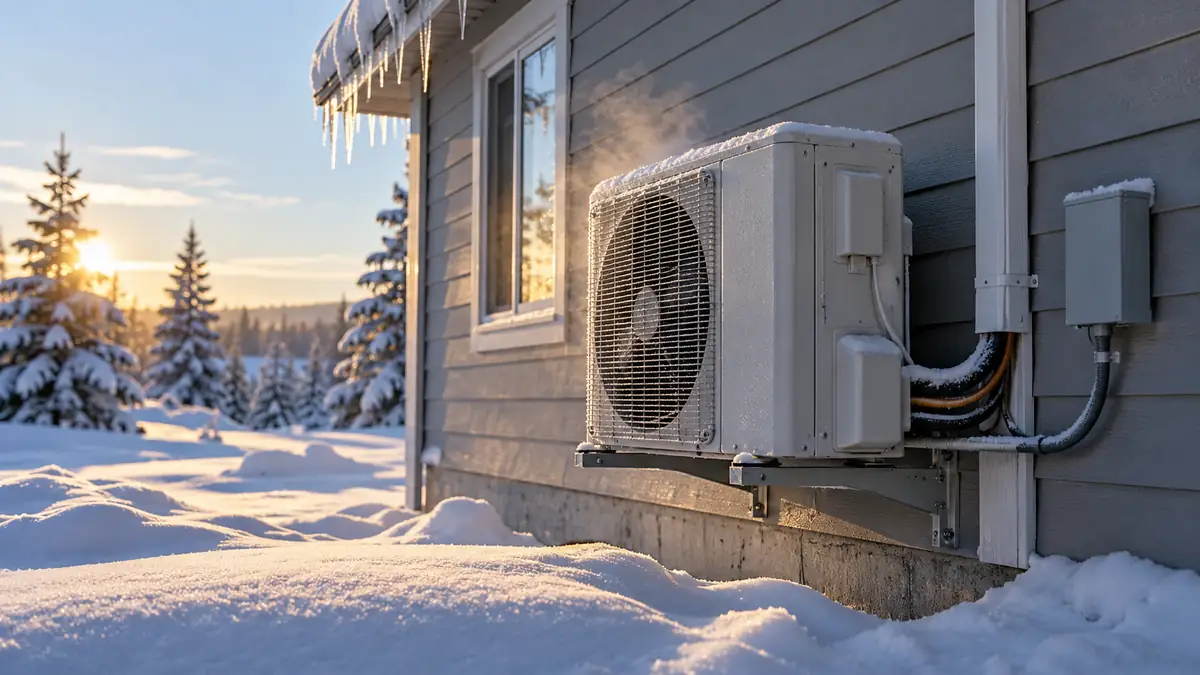
Yes, heat pumps in cold climates work, and the field data now proves it. Units tested by the U.S. Department of Energy in real homes kept heating efficiently on nights between 0 and 5°F, using about half the electricity a baseboard heater would need for the same heat. What changes in the cold is how much heat a unit can deliver, and that depends heavily on which model you buy.
This guide puts the manufacturers’ published capacity data next to independent field measurements, shows how often backup heat really runs, and tells you how cold your city actually gets. New to the technology? Start with how a heat pump works.

Heat pumps do work in cold climates, if you choose a cold climate heat pump and size it for your area. In DOE field tests, these units had a median efficiency (COP) of 1.9 between 0 and 5°F, meaning 1.9 units of heat per unit of electricity. One cold climate model keeps running to −13°F, while a standard unit of the same size is not designed to run below 5°F. Most homes still keep backup heat for the coldest nights.
Median efficiency at 0 to 5°F
COP 1.9
DOE Challenge units in homes (PNNL, Jan 2025)
Heat at 17°F vs 47°F rating
142% vs 64%
Cold climate vs standard 1-ton (manufacturer data)
Heat from backup at 5°F
About 11%
Median, DOE Challenge field units (PNNL, Jan 2025)
In this guide
- Why cold makes a heat pump work harder
- Cold climate heat pump vs standard heat pump
- Real performance below 0°F
- How cold does it get where you live?
- Do you need backup heat?
- Installing for snow and ice
- Running costs of heat pumps in cold climates
- Rebates and tax credits in 2026
- How to choose a cold climate heat pump
- Frequently asked questions
Why cold makes a heat pump work harder
A heat pump does not burn fuel. It moves heat that already exists in the outdoor air into your home, and there is still usable heat in air at 0°F. The colder it gets, though, the harder the compressor has to work to collect that heat, which affects a heat pump in cold weather in two ways.
- Capacity falls. The unit can deliver fewer Btu per hour, just as your home needs more.
- Efficiency falls. Each unit of electricity buys less heat. Efficiency is measured as the coefficient of performance (COP): a COP of 2 means two units of heat for every unit of electricity. Electric baseboard heat is always a COP of 1.
PNNL notes that a conventional heat pump’s heating capacity drops below its rated capacity once outdoor temperatures fall below 40°F (PNNL, January 2025). Frost also builds on the outdoor coil in cold, damp air, and the unit has to pause to melt it. In the DOE field tests, defrost used a median 5 to 8% of heating energy between 5 and 35°F. Our guide to how the defrost cycle works explains what normal frost looks like.
Good to know
Cold climate models fight both losses with variable-speed compressors that can spin faster when it is cold, plus refrigerant circuits designed for low temperatures. That is why two heat pumps of the same size can behave very differently at 5°F.
Cold climate heat pump vs standard heat pump
There is an official definition. Under ENERGY STAR Version 6.2, a cold climate heat pump must reach a COP of at least 1.75 at 5°F and keep at least 70% of its 47°F heating capacity at 5°F (EPA ENERGY STAR, February 2026). Standard ENERGY STAR heat pumps have no low-temperature test at all.
| Requirement | Standard ENERGY STAR | ENERGY STAR Cold Climate |
|---|---|---|
| Efficiency at 5°F | Not tested | COP of 1.75 or higher |
| Heat output at 5°F | Not tested | At least 70% of 47°F capacity |
| Heating rating (HSPF2), split systems | 7.8 or higher | 8.5 ductless, 8.1 ducted |
| Cooling rating (SEER2), split systems | 15.2 or higher | 15.2 or higher |
Two other lists matter. The Northeast Energy Efficiency Partnerships (NEEP) keeps a cold-climate product list built on a specification for climate zone 4 and colder, now at Version 4.0 (NEEP). NEEP now sources its data through AHRI, the industry certification body. The DOE Cold Climate Heat Pump Challenge set an even higher bar for ducted units: a COP of 2.1 to 2.4 at 5°F and as much heating capacity at 5°F as at 47°F (DOE, October 2021). Bosch, Carrier, Daikin, Johnson Controls, Lennox, Midea, Rheem and Trane passed its lab and field validation (PNNL, January 2025).
What the spec sheets show
The clearest way to see the difference is to compare two 1-ton ductless units from their own submittals. The Mitsubishi Hyper-Heat MUZ-FS12NA is a cold climate model; the Daikin RX12AXVJU is a standard one (Mitsubishi Electric, 2021; Daikin, August 2020).
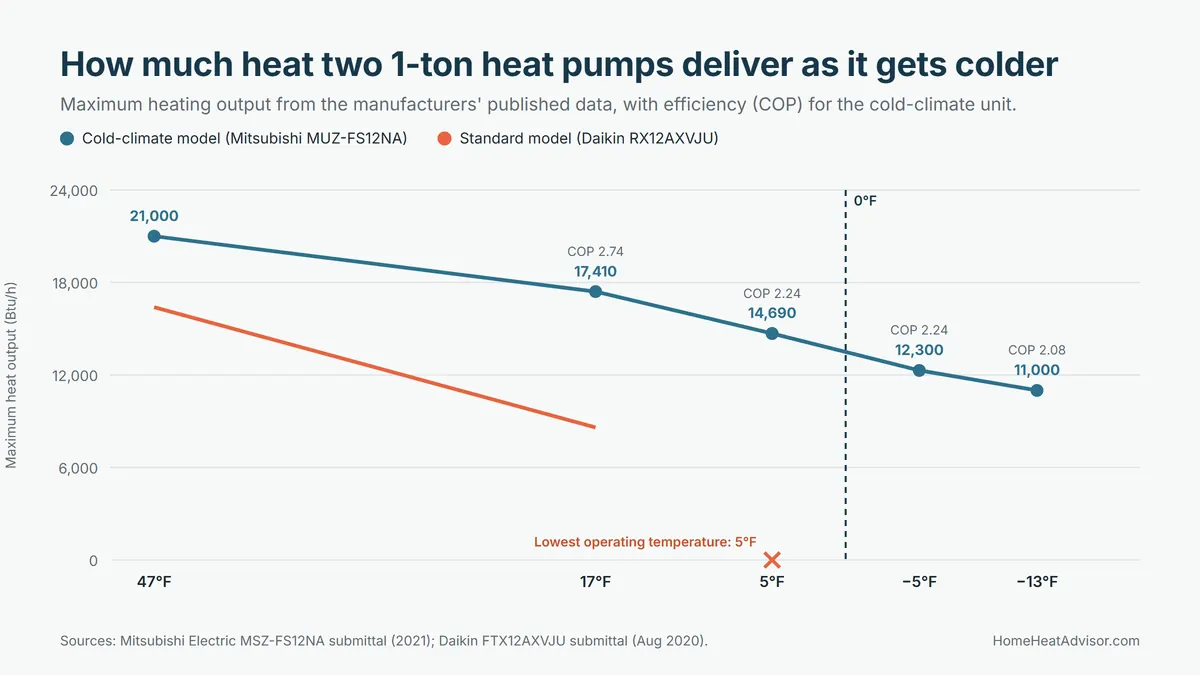
| Outdoor temperature | Cold-climate 1-ton | Standard 1-ton |
|---|---|---|
| 47°F (maximum) | 21,000 Btu/h | 16,400 Btu/h |
| 17°F | 17,410 Btu/h (COP 2.74) | 8,600 Btu/h |
| 5°F | 14,690 Btu/h (COP 2.24) | Lowest operating temperature |
| −5°F | 12,300 Btu/h (COP 2.24) | Not designed to operate |
| −13°F | 11,000 Btu/h (COP 2.08) | Not designed to operate |
At 17°F the Mitsubishi delivers 142% of its 12,300 Btu/h rated capacity, while the Daikin delivers 64% of its 13,500 Btu/h rating. Mitsubishi advertises 100% heating capacity at −5°F, and its table matches that: 12,300 Btu/h, the same as the rating.
Read the fine print
Manufacturers usually quote cold-weather output as a share of the rated capacity, not the maximum. Measured against its own 47°F maximum of 21,000 Btu/h, the same Mitsubishi keeps 70% at 5°F and 52% at −13°F. Ask your installer which number a brochure uses.
Real performance below 0°F: what field studies measured
Spec sheets come from labs. Field studies measure heat pumps in occupied homes, with real defrost cycles, wind and thermostat habits. Here is what independent studies of heat pumps in cold climates found.
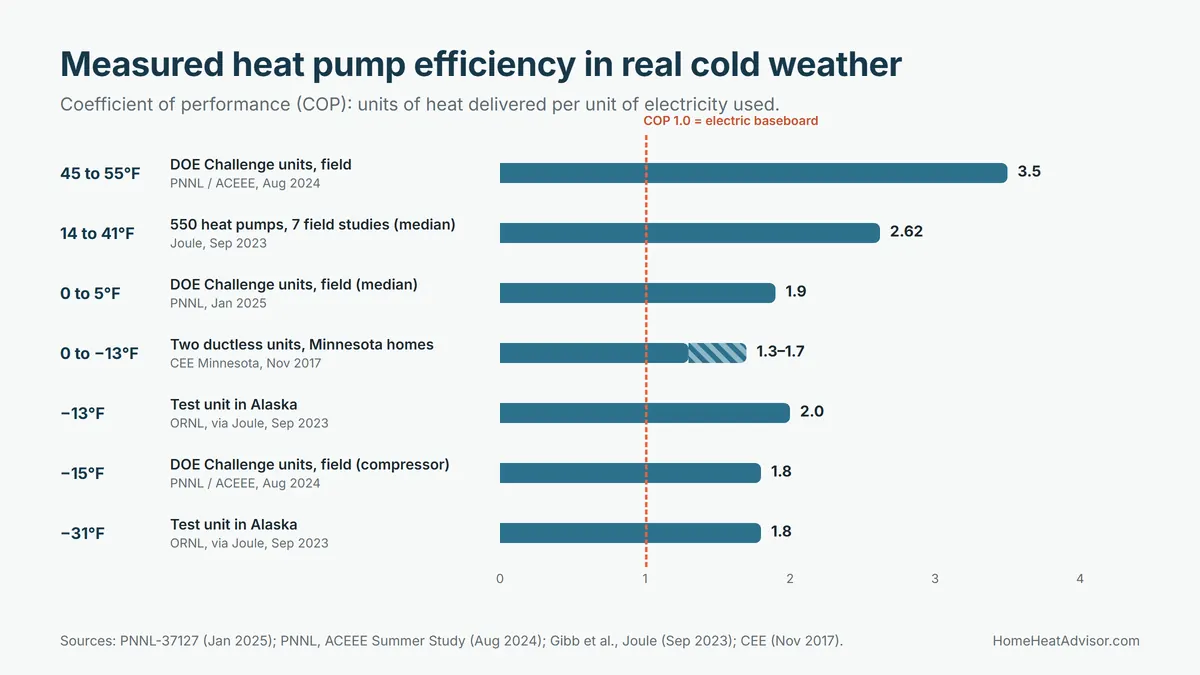
The DOE Challenge field tests. PNNL monitored 22 cold climate heat pumps in homes from winter 2022 to early fall 2024. In the 0 to 5°F range the median COP was 1.9 (PNNL-37127, January 2025). A companion paper by PNNL researchers reports compressor efficiency from 1.8 at −15°F to 3.5 at 45 to 55°F (ACEEE Summer Study, August 2024). The sample below 0°F was small: only eight of the 22 sites logged 10 or more hours there.
Minnesota homes. The Center for Energy and Environment monitored ductless units through a Minnesota winter. Between 0 and −13°F, one site averaged a daily COP of 1.7 and another 1.3, and one unit still had a COP above 1.0 at −19°F (CEE for the Minnesota Department of Commerce, November 2017). Those were older units than today’s DOE Challenge models.
International data. A review of about 550 heat pumps across seven field studies found a median COP of 2.62 between 14 and 41°F. It also reports an Oak Ridge National Laboratory test unit in Alaska reaching a COP of 2.0 at −13°F and 1.8 at −31°F (Gibb et al., Joule, September 2023).
Cold countries have already made the switch. Norway has about 630 heat pumps for every 1,000 households and Finland just over 520 (European Heat Pump Association, July 2025).
What a COP of 1.9 means
At 0 to 5°F, a typical DOE Challenge heat pump used roughly half the electricity an electric baseboard heater or electric furnace would need for the same heat. Efficiency drops in deep cold, but it stays well above resistance heat.
How cold does it get where you live?
Most cold-climate winters have far fewer below-zero nights than people expect. NOAA’s climate normals count how many nights a year the temperature falls below 0°F, and the ENERGY STAR design guide lists the 99% design temperature: the cold an installer sizes the system for.
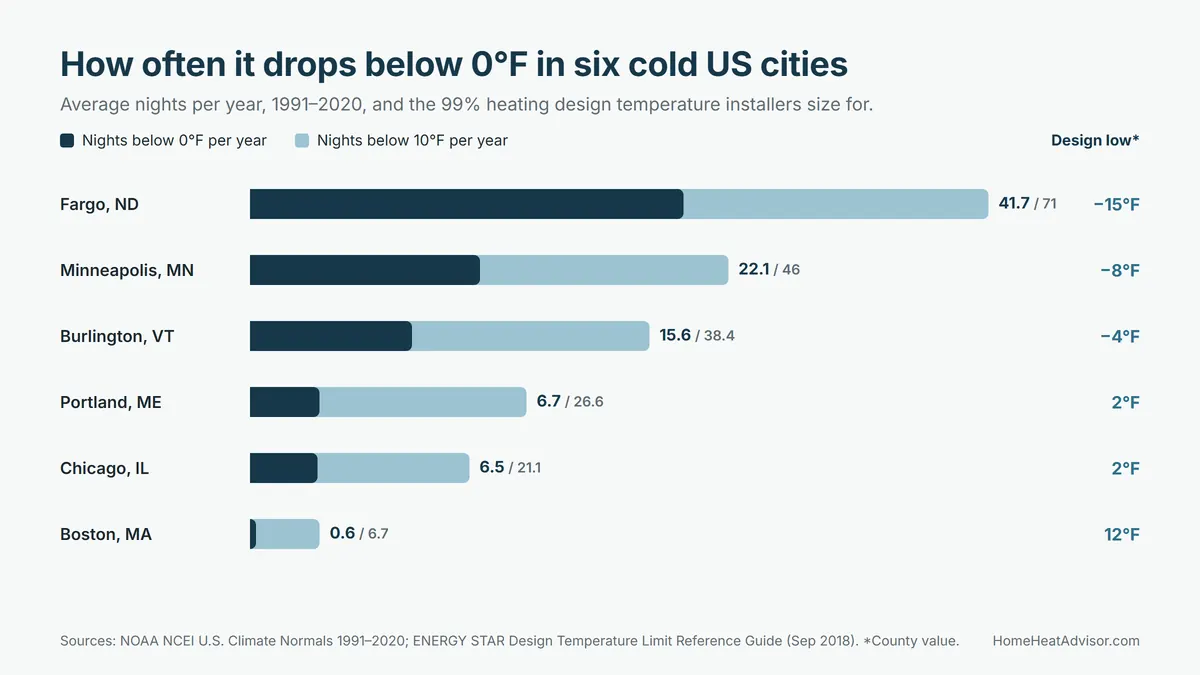
| City | Nights below 0°F | Nights below 10°F | Design low |
|---|---|---|---|
| Fargo, ND | 41.7 | 71 | −15°F |
| Minneapolis, MN | 22.1 | 46 | −8°F |
| Burlington, VT | 15.6 | 38.4 | −4°F |
| Portland, ME | 6.7 | 26.6 | 2°F |
| Chicago, IL | 6.5 | 21.1 | 2°F |
| Boston, MA | 0.6 | 6.7 | 12°F |
The design low is the number that matters for sizing. A cold climate unit like the Mitsubishi above still delivers its rated capacity at −5°F, which already covers the design low in Burlington, Portland, Chicago and Boston. In Fargo or Minneapolis, a heat pump in cold weather needs more careful sizing, a larger unit, or backup heat for the coldest few nights.
Do you need backup heat with a heat pump in a cold climate?
Usually yes, but it runs less than most people think. In the DOE field tests, backup (auxiliary) heat supplied a median of about 11% of the heating energy at 5°F, falling to zero in milder weather. In the coldest range, −10 to 0°F, the backup elements were switched on 25% of the time (PNNL, January 2025).
PNNL also found something you can control. Backup heat often came on at 30 to 35°F, far warmer than needed, because of thermostat setbacks and setpoint changes. A heat pump recovers slowly from a deep setback, so many thermostats call for backup heat to catch up. See whether you should turn down a heat pump at night for how much setback is safe.
- Keep setbacks small or skip them on very cold nights.
- Set an outdoor lockout. NEEP’s cold-climate installation guide recommends locking out central backup heat above a cutout between 20 and 35°F, adjusted for comfort (NEEP installation guide).
- Know your thermostat. Auxiliary heat is automatic; emergency heat is a manual setting. Our guide to emergency heat vs auxiliary heat explains when to use each.
Backup comes in two main forms: electric resistance strips in the air handler, or a gas or propane furnace in a dual-fuel setup. If you already have a furnace in good shape, our comparison of a heat pump vs furnace covers when keeping it makes sense. For what a full switch or a dual-fuel setup costs, see the cost to replace a furnace with a heat pump.

Installing a heat pump for snow and ice
Where the outdoor unit sits matters more in a cold climate than almost anywhere else. NEEP’s guide to installing air-source heat pumps in cold climates sets out these rules (NEEP):
- Mount the unit with enough clearance above the historical average maximum snow depth for your area, on a stand, riser or wall brackets.
- Keep it out of roof drip lines, or use a drip cap or shield the manufacturer approves, so falling ice and meltwater do not land on it.
- Do not put it where defrost meltwater can drain and refreeze across a walkway, which is a slip hazard.
- Plan for the meltwater. Every defrost cycle sends water out of the base, and it needs somewhere to drain away.

Clearing snow from around the unit is a safe owner job. Anything inside the cabinet is not. Electrical work belongs to a licensed electrician, and any refrigerant work requires an EPA 608 certified technician.
Running costs of heat pumps in cold climates
Whether a heat pump in a cold climate saves money depends on what it replaces. The Minnesota study modeled bills against common heating systems (CEE, November 2017):
| Heat pump replacing | Region | Heating bill cut |
|---|---|---|
| Electric resistance heat (ductless heat pump) | Twin Cities | 56% |
| Electric resistance heat (ductless heat pump) | Northern Minnesota | 53% |
| Older 82% propane furnace (ducted) | Twin Cities | 40% |
| Condensing propane furnace (ducted) | Twin Cities | 30% |
| Condensing propane furnace (ducted) | Northern Minnesota | 26% |
National modeling agrees. NREL and Lawrence Berkeley National Laboratory found heat pumps cost-effective without subsidies in 59% of U.S. households, and wrote that per-household savings are generally higher in cold climates. The catch: minimum-efficiency equipment could raise energy bills in 39% of households, compared with 5% for higher-efficiency units (Wilson et al., Joule, April 2024).
Upfront cost is the other side. At the DOE Challenge field sites, electrical upgrades alone ran $3,750 to $8,970 (PNNL, January 2025). Our heat pump installation cost guide breaks down full project prices.
Rebates and tax credits in 2026
The federal 25C tax credit is gone for new installs. The IRS says it is not allowed for any property placed in service after December 31, 2025 (IRS, August 2025). Our guide to what replaced the 25C credit covers what is left.
State programs increasingly require a cold climate rating. Minnesota’s HEAR rebate program requires an ENERGY STAR certified and cold-climate rated heat pump, with limits of $8,000 for incomes under 80% of area median income and $4,000 from 80 to 150%; the state page says the program has not launched yet (Minnesota Commerce, December 2025). Maine shows what long-running programs can do: Efficiency Maine says over 200,000 heat pumps have been installed in Maine homes and businesses (Efficiency Maine). Check your state energy office and utility before you sign a contract.
How to choose a cold climate heat pump
Bring this checklist to every quote:
- Cold climate listing. ENERGY STAR Cold Climate or the NEEP list, which also keeps the door open to state rebates.
- COP at 5°F. The ENERGY STAR minimum is 1.75; the DOE Challenge target for ducted units was 2.1 to 2.4.
- Capacity at your design temperature. Ask for the maximum Btu/h at your city’s design low, not only at 47°F.
- Lowest operating temperature. Some standard units stop at 5°F. Cold climate models run well below 0°F.
- A room-by-room load calculation. Ask for an ACCA Manual J calculation, not a size based on your old furnace.
- A backup heat plan. Strips or furnace, and the outdoor lockout temperature it will use.
- Snow-safe placement. Height above typical snow depth, out of drip lines and away from walkways.
Before you sign
Ask the installer to show the submittal table for the exact outdoor and indoor model pair. Cold-weather numbers change between pairings, and the brochure figure may belong to a different combination.
Frequently asked questions
Do heat pumps work at 0°F?
Yes. In DOE field tests, cold climate heat pumps had a median COP of 1.9 between 0 and 5°F (PNNL, January 2025). A cold climate model such as the Mitsubishi FS12 is rated to keep heating down to −13°F. Standard units are often not designed to run below about 5°F.
What is a cold climate heat pump?
It is a heat pump certified to keep working efficiently in deep cold. ENERGY STAR requires a COP of at least 1.75 at 5°F and at least 70% of its 47°F heating capacity at 5°F. NEEP keeps a separate list of qualifying models for climate zone 4 and colder.
At what temperature does a heat pump stop working?
It depends on the model. The standard Daikin unit in this guide lists 5°F as its lowest heating temperature. The cold climate Mitsubishi is rated to −13°F. Even below 0°F, field units measured by PNNL and ORNL stayed well above the efficiency of electric baseboard heat.
Do I still need a furnace with a cold climate heat pump?
Not always, but most homes in very cold areas keep some backup. PNNL found backup heat supplied about 11% of heating energy at 5°F. If your furnace is in good shape, a dual-fuel setup can cover the coldest nights while the heat pump does most of the work.
Is a heat pump cheaper than propane or oil in a cold climate?
Often. A Minnesota study modeled 26 to 40% lower heating bills versus propane furnaces and 53 to 56% versus electric resistance heat (CEE, November 2017). NREL and LBNL found savings are generally higher in cold climates, but local fuel and electricity prices decide the result.
How do I keep a heat pump from being buried by snow?
Mount the outdoor unit above your area’s typical maximum snow depth on a stand or wall brackets, keep it out of roof drip lines, and clear snow from around it after storms. Turn the power off at the disconnect before working near the unit.
Sources
- PNNL: Performance results from DOE Cold Climate Heat Pump Challenge field validation, PNNL-37127 (January 2025)
- PNNL researchers, ACEEE Summer Study: Rising up to the challenge, cold climate heat pumps in the field (August 2024)
- U.S. DOE: Residential Cold Climate Heat Pump Technology Challenge fact sheet (October 2021)
- EPA ENERGY STAR: Program requirements for heat pumps, Version 6.2 (February 2026)
- EPA ENERGY STAR: Design temperature limit reference guide (September 2018)
- NEEP: Cold climate air source heat pump specification and product list
- NEEP: Guide to installing air-source heat pumps in cold climates
- Center for Energy and Environment: Cold climate air source heat pump, for the Minnesota Department of Commerce (November 2017)
- Gibb, Rosenow, Lowes and Hewitt: Coming in from the cold, Joule (September 2023)
- Wilson et al., NREL and LBNL: Heat pumps for all? Joule (April 2024)
- Mitsubishi Electric: MSZ-FS12NA / MUZ-FS12NA submittal (2021)
- Daikin: FTX12AXVJU / RX12AXVJU submittal (August 2020)
- NOAA NCEI: U.S. Climate Normals 1991–2020
- European Heat Pump Association: Market report 2025, executive summary (July 2025)
- IRS: FAQs on the modification of section 25C, FS-2025-05 (August 2025)
- Minnesota Commerce: Home Electrification and Appliance Rebates (December 2025)
- Efficiency Maine: Heat pumps
About this guide
Published by HomeHeatAdvisor. This guide to heat pumps in cold climates is based on national laboratory field studies, ENERGY STAR and DOE requirements, manufacturers’ published submittal data and NOAA climate normals, checked in October 2026; each figure names its source and date. Sizing and backup heat design should be done by a licensed HVAC contractor, and electrical work by a licensed electrician. No installer, manufacturer or utility pays to be included. Our editorial policy explains how we research, fact-check and update our guides. Spotted an error? Let us know.