
The heat pump fan auto or on question comes down to one choice: should the indoor blower run only while the system is heating or cooling (Auto), or run all the time (On)? For most homes, Auto is the better default. It costs nothing extra and it lets the coil drain after cooling. On is worth considering only when you have a specific reason, such as better filtering or smoother room-to-room temperatures.
This guide settles the heat pump fan on or auto debate by explaining what each setting does, what the blower costs to run, and how the answer changes between winter and summer. It also covers the Circulate mode and the common mix-up between the fan setting and the system mode. New to the equipment? Start with how a heat pump works, or browse all heat pump guides.

On the heat pump fan auto or on question, set the thermostat fan to Auto unless you have a reason to change it. Auto runs the blower only while the system heats or cools, so it adds no extra fan hours. Choose On or Circulate if you want more air filtering or more even temperatures, and expect a higher bill: about $10 a month for a modern ECM blower, and about $66 for an older PSC blower at 500 watts, in our arithmetic below.
ECM blower, fan only
80 W
Power of an efficient blower motor on continuous low speed (PNNL, Oct 2022)
Older PSC blower
500–550 W
Roughly six times the ECM figure, at any fan speed (PNNL, Oct 2022)
Humidity with fan on
70% vs 58–59%
Average indoor humidity, fan on vs Auto, in one condo in August 2014 (Energy Vanguard, Sept 2014)
In this guide
- What Auto, On and Circulate do
- Heat pump fan auto or on: what the fan costs
- Winter: should heat pump fan be on auto or on?
- Summer: humidity and the heat pump fan on or auto
- Air filtering and the fan setting
- Which setting should you pick: heat pump fan auto or on?
- Circulate and smart thermostat settings
- Fan setting vs system mode
- Ductless mini-splits
- Try a two-week test
- Frequently asked questions
What Auto, On and Circulate do
Many thermostats give you the same three choices. Lennox, for example, says its current thermostats offer On, Auto and Circulate, found under the Fan menu (Lennox FAQ, March 2026). The names differ by brand, so check yours.
Lennox’s owner guide for its Elite thermostats describes them plainly. On runs the fan continuously, and the guide recommends it for better air circulation or more efficient central air cleaning. Auto runs the fan only when the heating or cooling system is on. Circulate runs the fan about 35 percent of the time (Lennox Elite owner guide, undated).
| Setting | What the blower does | Best for |
|---|---|---|
| Auto | Runs only while the system is heating or cooling | Lowest running cost; most homes |
| On | Runs continuously, 24 hours a day | Constant filtering; steady air movement |
| Circulate | Runs about 35% of the time on Lennox systems, in short cycles | A middle path between Auto and On |
Whatever you choose for heat pump fan on or auto, the fan setting is separate from the system mode (Heat, Cool, Auto or Emergency Heat). We come back to that mix-up later, because it trips up a lot of owners.
Heat pump fan auto or on: what the fan costs
The cost depends almost entirely on the blower motor. Pacific Northwest National Laboratory (PNNL) says older permanent split capacitor (PSC) motors draw about 500 to 550 watts when heating or cooling, while an efficient electronically commutated motor (ECM) draws about 400 watts in cooling and roughly 80 watts when it runs the fan alone on continuous low speed. PNNL also says annual operating costs for ECMs can be 25 to 75 percent lower (PNNL Building America Solution Center, October 2022).
Multiply those watts by the hours and by the average residential rate. The U.S. Energy Information Administration puts the 2026 average at 18.21 cents per kWh (EIA Short-Term Energy Outlook, October 2026). Over a 30-day month, an ECM running the fan nonstop uses 57.6 kWh, or $10.49. A PSC motor at 500 watts uses 360 kWh, or $65.56. At the Lennox Circulate share of about 35 percent, the same motors cost $3.67 and $22.94.
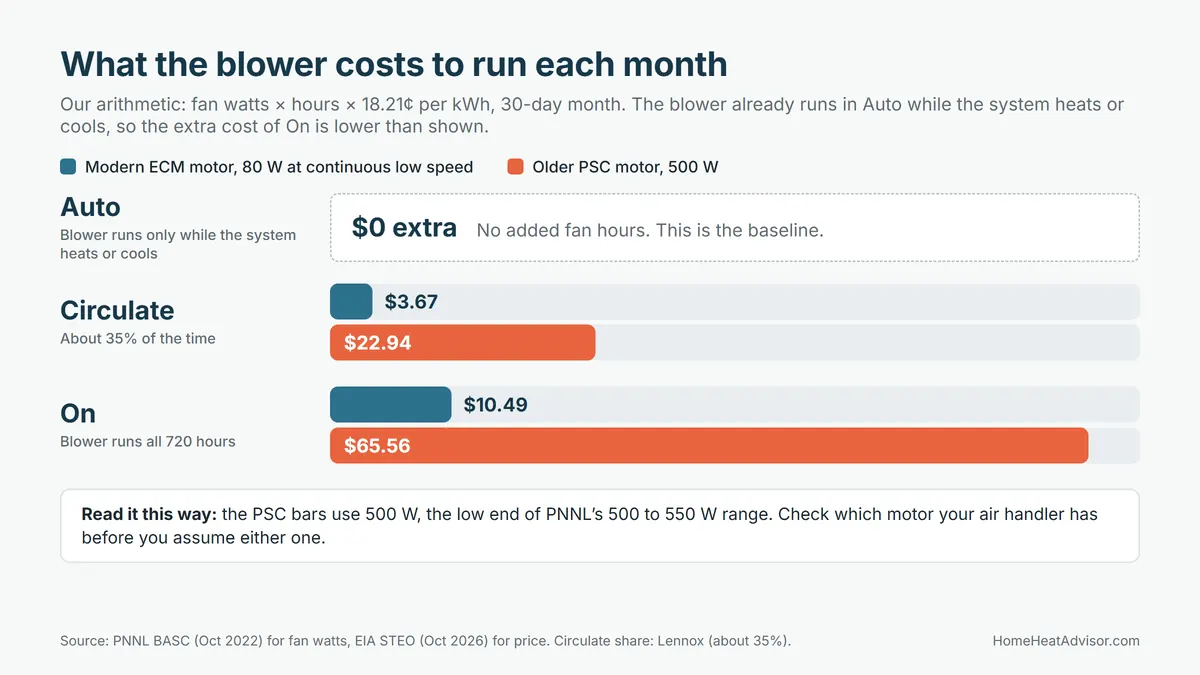
Two cautions apply to any heat pump fan auto or on cost comparison. First, these are upper bounds for the extra cost. In Auto the blower already runs whenever the system heats or cools, and you pay for those hours anyway, so the real extra cost of On is lower than the full-month figure. Second, the figures use a single average rate. Your own rate, motor and duct system will move the result, so treat the chart as a way to compare settings, not as a quote.
How to tell which motor you have
Check the air handler’s model number and manual, or ask a licensed HVAC technician at your next visit. A variable-speed blower is normally an ECM. If you cannot find out, assume the higher cost and use Auto.
Winter: should heat pump fan be on auto or on?
A heat pump delivers gentler heat than a furnace. Carrier’s owner’s manual for a variable-speed heat pump says the air from the registers is about 95 to 105 degrees Fahrenheit (Carrier OM25VNA-02, September 2019). That is warm, but it is below body temperature on a cold day, so it can feel lukewarm to a hand held at the vent. That shapes the heat pump fan auto or on decision in winter.
Here is why that matters for the heat pump fan on or auto choice, in our reading. With the fan on Auto, air moves only while the system is delivering heat. With the fan on, the blower keeps pushing air through the ducts between cycles, when the air is no longer being warmed. In a cold climate with ducts in an unheated attic or crawlspace, that moving air can feel cooler than you expect and can read as a draft.
The upside of running the fan is smoother temperatures. Constant airflow mixes the air in a house with a hot room and a cold room, and it keeps the thermostat reading closer to what the rest of the house feels. If your problem is uneven rooms rather than a draft, Circulate is the gentler way to try it.
If the air feels cool
A heat pump that is heating normally still sounds and feels different from a furnace. If air from the vents is cool while the system is supposed to be heating, see our guides on a heat pump not heating and on a heat pump running constantly before you change the fan setting.
Summer: humidity and the heat pump fan on or auto
Cooling is where the heat pump fan on or auto choice matters most for comfort. A cooling coil collects water as it cools the air. In a test reported by Allison Bailes of Energy Vanguard, a building-science writer, a humidity logger in one condo showed an average indoor humidity of 70 percent with the fan on, against 58 to 59 percent with the fan on Auto, during one stretch in August 2014 (Energy Vanguard, September 2014).

The author’s explanation is that when the compressor stops and the fan keeps running, the airflow carries water from the wet coil back into the house. That is one writer’s account of one home, so do not read the numbers as a law of physics. But the mechanism is easy to follow, and it fits the common advice to use Auto in humid weather.
So, should heat pump fan be on auto or on in a humid summer? Auto. In any home that already feels clammy in July, leave the fan on Auto. If you want air movement in summer, try Circulate and watch the indoor humidity. If the house stays damp, that is a job for a licensed HVAC technician to look at, not something to fix with the fan switch.
Air filtering and the fan setting
This is the best argument for leaving the fan on. The U.S. EPA’s archived guidance on running a home HVAC system, written for the COVID-19 period, says to run the system fan for longer times, or continuously, because HVAC systems filter the air only while the fan is running (U.S. EPA, January 2021 archive).

ASHRAE Journal puts numbers on how little filtering most systems do. Harriman, Stephens and Brennan report that residential fans run less than 25 percent of the hours in a year, and that a 2018 study of about 7,000 systems found run times under 20 percent. They recommend filters rated MERV 13 or higher, and they note that more hours of operation mean better filtration but also more fan energy cost (ASHRAE Journal, September 2019).
For filtering, the heat pump fan auto or on answer flips toward On. In plain terms, if you have allergies, pets, smoke from outside, or a high-rated filter you want to put to work, a fan on On or Circulate does filter more air. The price is a bigger electric bill, and a filter that clogs sooner. A higher-rated filter also restricts airflow more than a basic one, so check your air handler’s manual, or ask a licensed HVAC technician, before you switch to a denser filter.
- Change the filter on schedule. A dirty filter blocks airflow and hurts any fan setting.
- Match the filter to the system. The manual lists what your blower can handle.
- Pair the setting with the filter. Running the fan nonstop with a poor filter wastes the extra energy.
Which setting should you pick: heat pump fan auto or on?
Use your situation to settle heat pump fan auto or on, not a rule of thumb. The chart below is our editorial summary of the sources in this guide. It is a starting point, not a diagnosis.
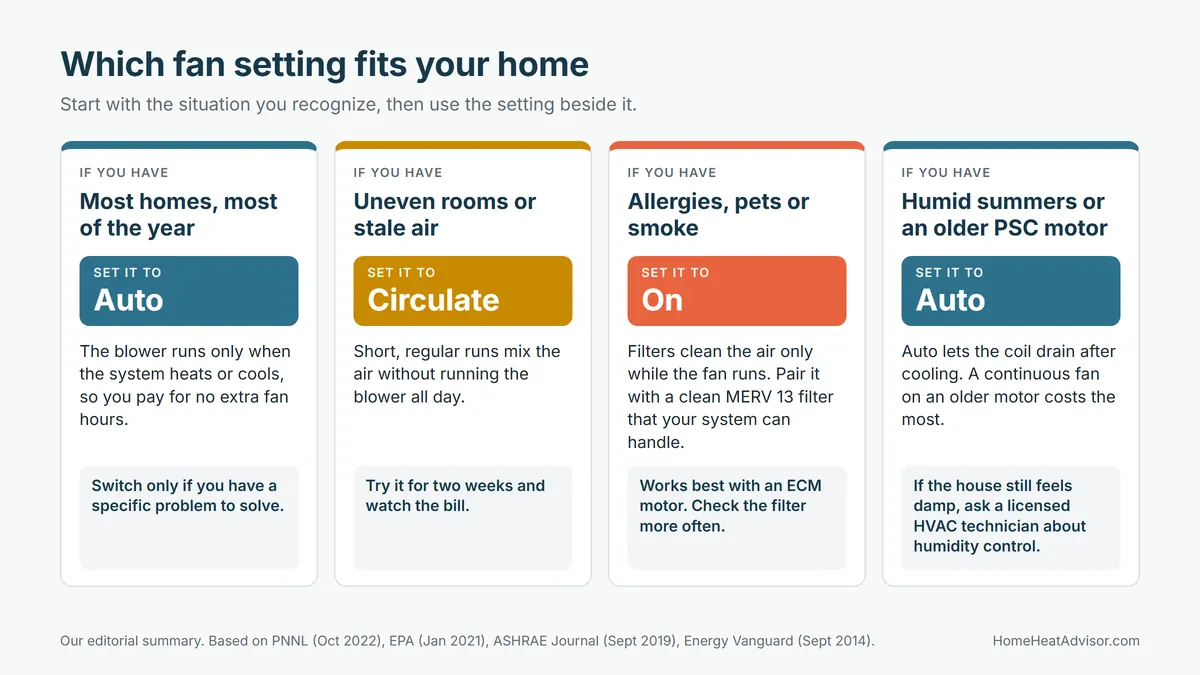
If you cannot decide between heat pump fan on or auto, start with Auto, because it is the cheapest to be wrong about. If the home feels stuffy or uneven after a few weeks, move one step to Circulate before you move to On.
Circulate and smart thermostat settings
Circulate is the middle option in the heat pump fan auto or on debate. On Lennox thermostats it runs the blower about 35 percent of the time, in short cycles, instead of all day (Lennox Elite owner guide). Other brands call it something like “Circulate”, “Smart fan” or a fan schedule. Check your thermostat’s manual for the exact behavior, because the share of time varies.
Our reading is that Circulate costs roughly a third of what On does on the same motor, and still keeps air moving and passing through the filter. That is why it is the best first experiment for a home with uneven rooms.
Fan setting vs system mode
The heat pump fan auto or on switch controls the blower only. The system mode (Heat, Cool, Auto or Emergency Heat) controls what the equipment does. A thermostat can be in Auto mode with the fan on On, or in Heat mode with the fan on Auto. They are different settings, and mixing them up causes a lot of confusion.
The one to watch is Emergency Heat. Lennox’s owner guide says that in EM HEAT the heat pump compressor is not operational (Lennox Elite owner guide). That is a system mode, not a fan setting, and it can raise your bill sharply. Our guide to emergency heat vs auxiliary heat explains when to use it, and our piece on a high winter heat pump electric bill covers where the money goes.
Ductless mini-splits
In a ductless mini-split, the heat pump fan on or auto question becomes a fan speed question. There is no thermostat fan switch, only a fan speed setting on the remote, and Auto lets the unit pick the speed. Fan speed can change how much power the indoor unit draws. The Pragmatic Steward, a homeowner’s blog, reported that his Mitsubishi mini-splits used 40 to 50 percent less power on a high fixed fan speed than on Auto, and noted a tradeoff with temperature control (The Pragmatic Steward, December 2023).
That is one owner’s measurements on one brand, so it is a reason to experiment rather than a rule. If you run a mini-split, change one setting at a time, give it a few days, and compare your daily use before you keep it.
Try a two-week test
If you are still torn on heat pump fan auto or on, a short test settles it better than any rule. It takes two weeks and costs nothing.
- Pick two similar weeks. Match outdoor temperatures as closely as you can.
- Change only the fan. Leave the temperature setting, schedule and filter alone.
- Write down daily use. Most utility apps and smart meters show daily kWh.
- Note comfort too. Draft, stale air, damp feel and noise count as much as cost.
- Keep the winner. If the change did not help, go back to Auto.
Anything beyond the thermostat is for a licensed HVAC technician: a blower that does not start, a motor that hums or a fan that runs with the system off. Our guides on heat pump noises and heat pump short cycling cover the common symptoms, and a breaker that trips is covered in our guide to why a heat pump keeps tripping the breaker.
Frequently asked questions
Should heat pump fan be on auto or on for most homes?
For heat pump fan auto or on, most homes should use Auto. It runs the blower only while the system heats or cools, so it adds no extra fan hours and lets the coil drain after cooling. Choose On or Circulate for a reason, such as filtering or uneven rooms, and expect a higher bill. Lennox describes Auto this way in its owner guide.
Should heat pump fan be on auto or on in winter?
Auto is usually better in winter. A heat pump’s air is about 95 to 105°F, per Carrier, so moving it between cycles can feel cool or drafty. If rooms are uneven, try Circulate for two weeks and compare comfort and your electric bill before moving to On.
Should heat pump fan be on auto or on in summer?
Auto, especially in humid weather. Energy Vanguard logged 70% average humidity with the fan on and 58 to 59% on Auto in one condo, and explains that a running fan can carry water off the wet coil. That is one home, but it supports leaving the fan on Auto when it is damp.
How much does it cost to run a heat pump fan all the time?
In our arithmetic, a modern ECM blower at about 80 watts costs about $10.49 a month at 18.21 cents per kWh, and an older PSC blower at 500 watts about $65.56. Both are upper bounds, because the blower runs in Auto anyway while the system heats or cools.
What does the Circulate setting do?
Circulate runs the blower in short cycles for a share of the time, instead of all day. Lennox says its Circulate setting runs the fan about 35 percent of the time. It keeps air moving and passing through the filter at roughly a third of the cost of On on the same motor, in our reading.
Why is the fan running but my heat pump is not heating?
With the fan on On, the blower runs even when the system is not heating, so you can feel air without warmth. If the system should be heating and the air stays cool, check the filter and the mode, then see our heat pump not heating guide. A licensed HVAC technician can test the rest.
Sources
- PNNL Building America Solution Center: ECM air handler fans (October 2022)
- U.S. Energy Information Administration: Short-Term Energy Outlook, Table 2 (October 2026)
- Lennox: Elite Series programmable touch screen thermostats owner guide (undated)
- Lennox: What are my fan options and where do I change the fan mode? (March 2026)
- U.S. EPA: Can running my HVAC system in my home help protect me from COVID-19? (archived January 2021)
- ASHRAE Journal: New guidance for residential air cleaners (September 2019)
- Energy Vanguard: This thermostat setting can cost you money and make you sick (September 2014)
- Carrier: Infinity 25VNA variable-speed heat pump owner’s manual, OM25VNA-02 (September 2019)
- The Pragmatic Steward: Heat pump energy strongly depends on fan speed setting (December 2023)
About this guide
Published by HomeHeatAdvisor. This guide is based on manufacturer manuals, government and laboratory publications and building-science writing, checked in October 2026; each figure names its source and date, and our own arithmetic and explanations are labeled as ours. The thermostat changes here are for homeowners only. For a blower that will not start, motor noise, wiring, a tripping breaker or humidity problems, use a licensed HVAC technician or a licensed electrician, and call 911 for smoke, sparks or fire. Our editorial policy explains how we research, fact-check and update our guides. Spotted an error? Let us know. More heat pump guides.