
Heat pump short cycling means the unit starts, runs for a few minutes and shuts off, then starts again, over and over. A heat pump that turns on and off every few minutes is wasting energy and wearing out its compressor, and it is almost always fixable. Some of the causes cost nothing to check, and a few need a technician.
This guide explains what a normal cycle looks like, why heat pump short cycling in heat mode costs you money, nine common causes with the fix for each, and what repairs cost in 2026. If you are new to the equipment, start with how a heat pump works. For other winter faults, see our heat pump troubleshooting guides.

Heat pump short cycling is a run of a few minutes followed by a stop, repeated again and again. A healthy compressor on a typical thermostat default starts about three times an hour, with a protective delay of about five minutes before a restart. Common causes of heat pump short cycling are thermostat settings, a poorly placed sensor, a dirty filter or blocked registers, an oversized system, a blocked outdoor coil, low refrigerant and failing electrical parts. Check the filter, registers, outdoor unit and thermostat first. Call a licensed HVAC technician for anything else.
Typical compressor default
3 cycles an hour
Recommended rate for most compressors (Resideo, Jul 2021)
Compressor restart delay
5 minutes
Default off time before the compressor restarts (Resideo, Jul 2021)
Efficiency penalty
Up to 25%
Possible loss during low-load cycling (NYSERDA, Jul 2023)
In this guide
- What heat pump short cycling is, and what a normal cycle looks like
- Not heat pump short cycling: defrost pauses
- Why heat pump short cycling costs you
- 9 causes of heat pump short cycling in heat mode, and the fix for each
- Quick checks for heat pump short cycling in 10 minutes
- When to call a pro, and what repairs cost in 2026
- Frequently asked questions
What heat pump short cycling is, and what a normal cycle looks like
Heat pump short cycling is when the compressor shuts off before the house has had a real run of heat, then restarts soon after. There is no official minute count, so the useful test is how often it happens. A heat pump will always start and stop, because a thermostat holds a temperature by turning the equipment on and off. What matters is whether the pauses are long enough to be normal.
Thermostat makers give us a baseline. Resideo’s FocusPRO guide lists a compressor default of 3 cycles per hour, which it describes as recommended for most compressors. The same guide lists 5 cycles per hour for a gas or oil furnace under 90% efficiency, and 9 for an electric furnace (Resideo FocusPRO guide, July 2021). Honeywell Home explains that the cycle rate is the maximum number of times the system will run in an hour at 50% capacity (Honeywell Home support, September 2025).
| Setting | Cycles per hour | Run and off time at a 50% load |
|---|---|---|
| Compressor (default) | 3 | About 10 minutes on, 10 off |
| Gas or oil furnace under 90% | 5 | About 6 minutes on, 6 off |
| Electric furnace | 9 | About 3.3 minutes on, 3.3 off |
Heat pump short cycling looks different. Instead of a run of 10 minutes or so, you hear the outdoor fan start, run for a few minutes, stop, and start again soon after. If the system turns on and off every few minutes, that is a sign, not proof, and the fix depends on the cause. The chart below shows the difference over one hour.
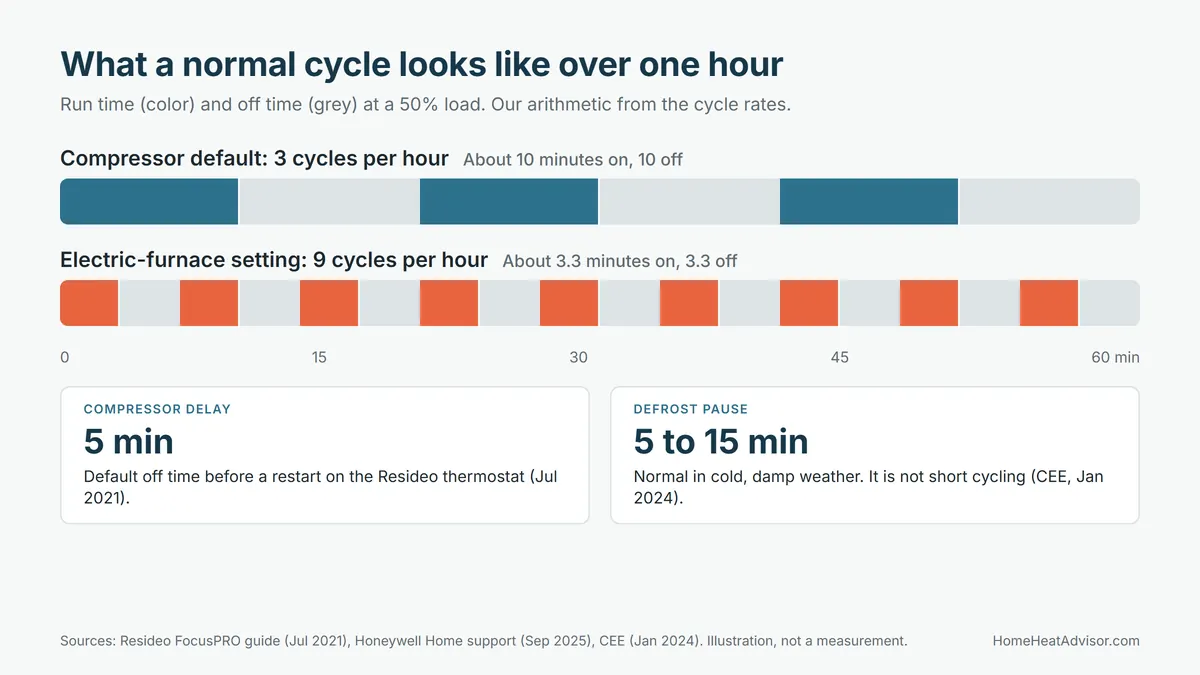
Two protections slow every restart. Resideo’s default compressor off time is 5 minutes, and “Heat On” flashes during the wait. A co-op installation guide for an ecobee thermostat lists a 600-second (10-minute) compressor minimum off time (Advanced Energy / Berkeley Electric, August 2020). Older equipment has a similar timer: one 2005 Rheem manual describes a protective delay of about five minutes (Rheem Use & Care manual, August 2005). That is an old example, so check your own manual. Never bypass the delay, because it protects the compressor.
Not heat pump short cycling: defrost pauses
Before you assume heat pump short cycling, rule out defrost. In cold, damp weather the outdoor coil frosts over, and the heat pump briefly reverses to melt it. The Consortium for Energy Efficiency (CEE) says defrost can last 5 to 15 minutes, and that frequently cycling off and on is a warning sign (CEE, January 2024). During defrost you may see steam and hear a whoosh, and the indoor air can run cooler for a few minutes.
A defrost pause is a normal break in heating, and it is different from heat pump short cycling, where the unit stops and restarts without a clear reason. If the outdoor unit is buried in ice, that is a different problem. See our guide to a frozen heat pump.
Why heat pump short cycling costs you
Short runs waste energy. The federal test procedure in 10 CFR 430 Appendix M builds this in as a degradation coefficient, with a default of 0.25 (10 CFR 430, Appendix M). Using that default, the loss at each load level is 0.25 × (1 − load). That is our calculation from the federal formula, and it applies to a single-stage unit.
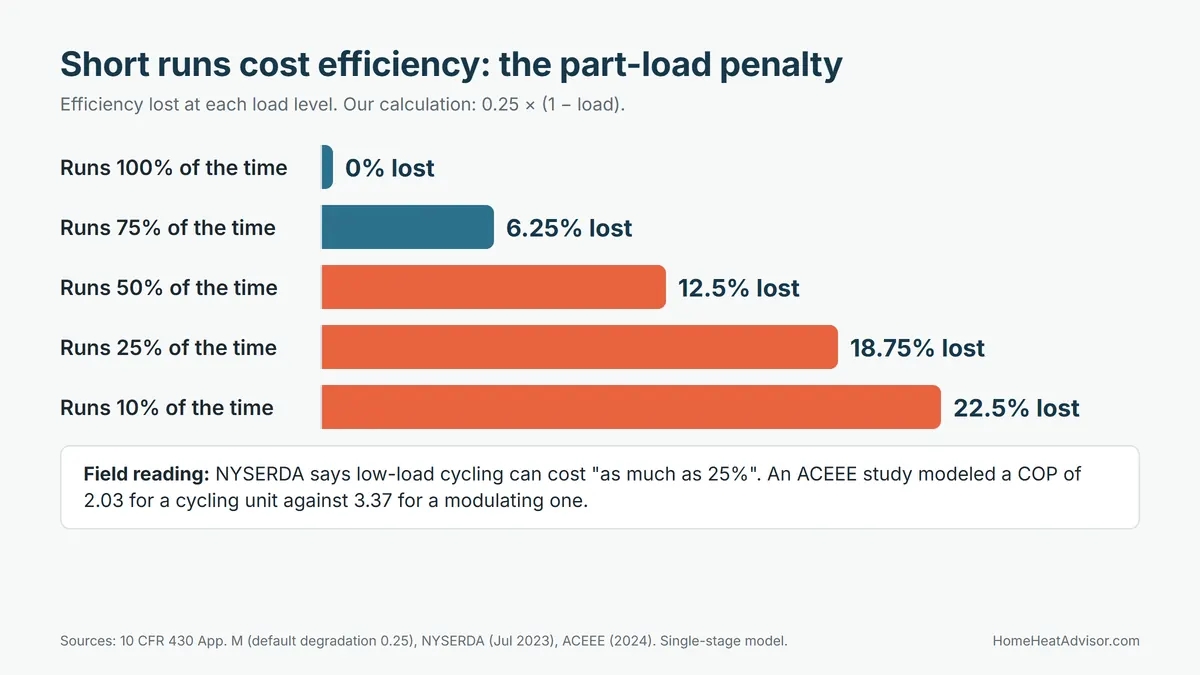
Field sources point the same way. NYSERDA says low-load cycling can cost as much as 25% in efficiency, and that constant cycling stresses the equipment and increases wear and tear (NYSERDA Clean Heat Connect, July 2023). In an ACEEE Summer Study paper, a unit that cycled measured a COP of 2.03, against 3.37 for a version that modulated smoothly (ACEEE, 2024). The bill suffers, and so does the compressor.
9 causes of heat pump short cycling in heat mode, and the fix for each
Start with the cheap ones. The first five causes of heat pump short cycling in heat mode are owner checks or things a thermostat or installer can change. The last four usually need a technician.
1. Thermostat set up wrong
The thermostat decides when to stop the compressor, so a wrong setting is the first suspect in heat pump short cycling. A cycle rate set too high, a narrow temperature swing or the wrong system type can all cause heat pump short cycling in heat mode. For heat pump short cycling in heat mode, check the basics first. Resideo’s default is 3 cycles per hour for compressors, and the ecobee guide above lists a 1.0°F heat differential, so a thermostat left at the electric furnace rate of 9 cycles an hour is set for a different kind of equipment.
Fix: Check that the thermostat is configured for a heat pump with the right stages, and compare its cycle rate and compressor delay with your manual. Do not shorten the compressor delay.
2. Thermostat or sensor in the wrong spot
A thermostat sees only the air around it. NYSERDA warns that warm air at the sensor can make the unit turn off the heat pump prematurely (NYSERDA, July 2023). Direct sun, a supply register, a lamp or a kitchen wall can all fool it. The room reads warm, the unit stops, and the rest of the house is still cold, which looks like heat pump short cycling.
Fix: Move anything hot away from the thermostat, shade it from direct sun and keep supply air from blowing on it. If the location is the problem, a technician can relocate it or add a remote sensor.
3. Dirty filter or closed registers
Restricted airflow is one of the most common causes of heat pump short cycling, and one of the cheapest to fix. CEE advises checking filters about every 90 days on ducted systems and monthly on ductless ones (CEE, January 2024). A clogged filter or closed supply registers can make the system run hot and stop early.

Fix: Replace or wash the filter and open every supply register. Move rugs, furniture and drapes away from vents, and do not close off more than a few rooms.
4. Oversized system
An oversized heat pump heats the house too fast and shuts off before the thermostat is happy. NYSERDA says problems begin when capacity reaches about 120% of the home’s load and become severe above 150%, and recommends ACCA Manual J, S and D sizing (NYSERDA, July 2023). Sizing errors are common. A Bonneville Power Administration field study found that only 42% of sites met its sizing specification, though that was a 2019 Pacific Northwest study (BPA, December 2019).
Fix: There is no quick fix for a unit that is too big. A licensed HVAC technician can run a proper load calculation, adjust fan and control settings or advise on a replacement. See heat pump installation cost before deciding.
5. Inverter or mini-split cycling at low load
Variable-speed units can still short cycle. NYSERDA says low-load cycling occurs when the unit’s minimum capacity is above the home’s load, and puts the typical modulating range at about 40 to 80% of capacity. NEEA’s low-load study found typical turndown limits of around 4:1 to 5:1, and one lab unit cycled with a 1.2:1 turndown against a claimed 5:1 (NEEA, December 2025). In mild weather, a large mini-split can simply be bigger than the room needs, and heat pump short cycling follows.
Fix: Mild-weather cycling on a correctly sized inverter unit can be normal. If it cycles hard in all weather, ask the installer to check the unit size and settings against the room’s heating load.
6. Blocked outdoor coil
The outdoor coil has to shed or pick up heat, so a coil choked with leaves, grass clippings or snow can make the unit trip and restart. Heat pump short cycling from a blocked coil often shows up in fall, when leaves pile against the grille.

Fix: Turn the unit off at the thermostat, clear leaves and debris from around the cabinet, and keep plants trimmed back. Do not pry at the coil fins, and leave cleaning inside the unit to a technician.
7. Low refrigerant
A low charge means a leak, because refrigerant is not used up. A unit that is low on refrigerant cannot work as designed, and it may shut down on a safety and restart. Fixr lists leak repair at $200 to $1,500 and a refrigerant recharge at $100 to $600 (Fixr, January 2026).
Fix: This is a job for an EPA Section 608 certified technician (EPA, March 2026). Do not add refrigerant yourself. Ask the technician to find and fix the leak, not just top it up.
8. Failing capacitor, contactor or control board
Electrical parts wear out, and heat pump short cycling is a common symptom. A weak capacitor can make the compressor or fan struggle to start, a worn contactor can chatter, and a faulty control board can stop the unit at random. You may also hear clicking or humming, as covered in our guide to heat pump noises.
Fix: Switch off power at the breaker and call a licensed technician. These parts hold charge or carry line voltage, so leave them to a licensed professional.
9. A safety switch tripping
Heat pumps have pressure and temperature safeties that stop the compressor when something is wrong, and heat pump short cycling can result. A unit that keeps tripping one is telling you about a problem, such as poor airflow, a bad fan motor or a charge issue, and each trip can be a short cycle.
Fix: Never bypass or jump a safety switch. Have a licensed HVAC technician find out why it trips.
Quick checks for heat pump short cycling in 10 minutes
Before you pay for a service call, spend ten minutes on these owner checks for heat pump short cycling. They cover the cheapest causes first.
- Look at the thermostat. Is it set to Heat, with the setpoint a few degrees above the room? Check the batteries.
- Check where it hangs. Is it in sun, near a vent or on a wall that is warmer than the rest of the house?
- Replace or inspect the filter. A dirty filter is the quickest fix.
- Open the registers. Move rugs and furniture off every vent.
- Walk to the outdoor unit. Clear leaves, snow and debris from all sides.
- Time a few cycles. Note how long it runs and how long it stays off. A few minutes on and a few off, repeated for an hour, is heat pump short cycling.
- Check for defrost. A 5 to 15 minute pause with steam from the outdoor unit is normal.
Do not bypass the delay
The compressor delay protects the compressor. Shortening or bypassing it can cause damage, so do not change it to stop heat pump short cycling.
When to call a pro, and what repairs cost in 2026
Call a licensed HVAC technician if the owner checks do not stop the heat pump short cycling, if you hear clicking, humming or grinding, if the breaker trips, if you see ice that does not clear, or if you suspect a refrigerant leak. Switch the system off at the thermostat while you wait if it sounds unhealthy. Heat pump short cycling is not an emergency, but repeated starts add wear. Do not open the electrical panel on the outdoor unit yourself.
| Repair | Typical cost (Fixr, Jan 2026) | Who does it |
|---|---|---|
| Service call | $75 to $250 | Licensed HVAC technician |
| Thermostat replacement | $85 to $300 | Technician or electrician |
| Capacitor | $100 to $400 | Licensed HVAC technician |
| Refrigerant recharge | $100 to $600 | EPA 608 certified technician |
| Circuit board | $150 to $700 | Licensed HVAC technician |
| Refrigerant leak repair | $200 to $1,500 | EPA 608 certified technician |
| Blower motor | $300 to $1,000 | Licensed HVAC technician |
| Compressor | $800 to $2,500 | Licensed HVAC technician |
If the repair bill climbs toward the cost of a new system, our installation cost guide helps with the comparison. If the unit is running but not warming the house, see heat pump not heating.
Frequently asked questions
How often should a heat pump cycle?
A thermostat default for a compressor is 3 cycles an hour (Resideo, July 2021), which at a 50% load works out to about 10 minutes on and 10 off. Very mild or very cold weather changes this. If yours starts and stops every few minutes for an hour, that is heat pump short cycling.
Why does my heat pump turn on and off every 5 minutes?
Common causes are thermostat settings, a poorly placed sensor, a dirty filter, blocked registers or an oversized unit. A 5-minute pattern can also be the compressor restart delay, which defaults to about 5 minutes on some thermostats. Check the owner items first.
Why does my heat pump turn on and off every few seconds?
Heat pump short cycling that fast is more serious than every few minutes. It may point to an electrical fault, a bad contactor or a safety switch tripping. Turn the system off at the thermostat and call a licensed HVAC technician.
Is heat pump short cycling bad?
Yes. Heat pump short cycling wastes energy, with NYSERDA citing up to 25% efficiency loss during low-load cycling, and it stresses the equipment. NYSERDA says constant cycling increases wear and tear.
Why does my heat pump short cycle only in heat mode?
Heat mode has its own look-alikes and causes: defrost pauses, a blocked outdoor coil when leaves fall, and a thermostat heat setting that is configured wrong. An oversized unit can also satisfy a small winter load too fast. Compare it with cooling mode to narrow the cause.
Can an oversized heat pump cause short cycling?
Yes. NYSERDA says impacts begin at 120% of the home’s load and are severe above 150%. A unit that is too big heats the house quickly and shuts off. A licensed HVAC technician can run a load calculation to check.
Sources
- Resideo: FocusPRO TH6000 Series installation and user guide (July 2021)
- Honeywell Home support: What is a cycle rate? (September 2025)
- Advanced Energy / Berkeley Electric: ecobee4 single-stage installation guide (August 2020)
- Rheem: Heat pump Use & Care manual 708105-C (August 2005)
- CEE: You Installed an Air Source Heat Pump. Now What? (January 2024)
- Cornell LII: 10 CFR 430, Subpart B, Appendix M
- NYSERDA Clean Heat Connect: Don’t Oversize (July 2023)
- NEEA: Low-Load Efficient Heat Pump Investigation summary report (December 2025)
- ACEEE Summer Study: Low-Load Efficient Heat Pumps (2024)
- Bonneville Power Administration: 2019 Heat Pump Field Study (December 2019)
- Fixr: Heat Pump Repair Cost (January 2026)
- U.S. EPA: Section 608 Technician Certification (March 2026)
About this guide
Published by HomeHeatAdvisor. This guide is based on thermostat manufacturer guides, federal regulations, efficiency-program and utility studies and published repair-cost data, checked in October 2026; each figure names its source and date, and calculations are labeled as ours. The checks here are for homeowners only. Use a licensed HVAC technician for anything beyond them, an EPA Section 608 certified technician for refrigerant, and a licensed electrician for electrical work. Our editorial policy explains how we research, fact-check and update our guides. Spotted an error? Let us know. More troubleshooting guides.