

The best heat pump temperature for winter is the one that keeps your home comfortable at a steady setting, and for most U.S. homes that starts near 68°F. It is a starting point rather than a rule. Heat pumps do not behave like furnaces, so the number on the thermostat matters less than how you use it: one steady setting, the right mode and small changes.
This guide pulls together what NYSERDA, CEE, Efficiency Vermont, DOE and the World Health Organization say about heat pump thermostat settings. It also shows an original calculation of what each extra degree adds to the load. If you are new to the equipment, start with how a heat pump works. For problems, see our heat pump troubleshooting guides.

Start at 68°F, the typical winter set point NYSERDA cites, then adjust a degree at a time over a few days until the room feels right. Set the mode to Heat, not Auto. Avoid sudden changes of 3°F or more. On a ductless unit, allow 1 to 2°F more than you used with a furnace. If anyone at home is very young, elderly or unwell, aim warmer than the minimums.
Typical winter set point
68°F
For maintaining comfort (NYSERDA, Sep 2022)
Change to avoid
3°F or more
Sudden changes can trigger an inefficient catch-up mode (NYSERDA, Sep 2022; CEE, Jan 2024)
Health minimum
64.4°F (18°C)
For general populations in colder climates (WHO, 2018)
In this guide
- Best heat pump temperature for winter: the short answer
- Why 68°F is a starting point for your heat pump temperature
- What each degree costs on a heat pump thermostat
- Heat pump thermostat settings that matter more than the number
- The best heat pump temperature for winter by system type
- Ductless heat pumps: the number is not the room
- How to find your best heat pump temperature in three steps
- When the house will not reach your heat pump temperature
- Frequently asked questions
Best heat pump temperature for winter: the short answer
There is no single best heat pump temperature for winter, and none of the sources we checked claims one. What they share is a method. Pick a comfortable number, hold it, and change it slowly. A furnace delivers heat in short, hot bursts, so turning it up costs little. A heat pump puts out slower, steadier heat, so it works best when the setting stays put.
In practice the heat pump temperature that works for most people lands between 68 and 70°F. Below that, comfort drops for people who sit still. Above it, the heating load climbs, and the extra warmth is rarely worth the bill. The rest of this guide shows where those numbers come from and when to move off them.
Where this fits
This post is about the number you set. How far to drop it overnight is a separate question, covered in should you turn down a heat pump at night.
Why 68°F is a starting point for your heat pump temperature
NYSERDA’s operating tips for air source heat pumps say that set points of 68°F in winter and 75°F in summer are typical (NYSERDA, September 2022). The key word is typical. The same sheet tells ductless owners to expect a different number, which we cover below.
There is also a floor from public health. The World Health Organization’s Housing and Health Guidelines describe 18°C, which is 64.4°F, as a safe and well-balanced indoor temperature for general populations in temperate or colder climates. WHO adds that a higher minimum may be needed for vulnerable groups such as older people, children and people with chronic illness, especially heart and lung disease (WHO, Housing and Health Guidelines, 2018). That is a minimum to stay above, not a target.
| Source | What it says about the number | Kind of evidence |
|---|---|---|
| NYSERDA (Sep 2022) | 68°F is a typical winter set point; ductless owners may need 1 to 2°F more | Program guidance |
| WHO (2018) | 18°C (64.4°F) is a safe minimum for general populations; higher for vulnerable groups | Health guideline |
| Efficiency Vermont (Oct 2025) | Do not focus on the exact number; set a comfortable temperature and adjust over a few days | Program guidance |
Notice what is missing. None of these sources sets a required number for a heat pump. They treat comfort as the goal and 68°F as the usual place to begin. That is why the best heat pump temperature for winter is partly personal.
What each degree costs on a heat pump thermostat
Every degree you add widens the gap between inside and outside, and the heating load follows that gap. DOE’s Energy Saver guide says you can save up to 10% a year by turning a thermostat down 7 to 10°F for 8 hours a day (DOE, August 2022). That works out to roughly 1.0 to 1.4% per degree, our calculation from DOE’s figures.
We can show the physics with simple arithmetic. If the load scales with the difference between indoor and outdoor temperature, then raising the setting from 68 to 70°F adds 7.1% to the load when it is 40°F outside, 4.2% at 20°F and 2.9% at 0°F (our calculation). The same two degrees is a larger share of a smaller gap.
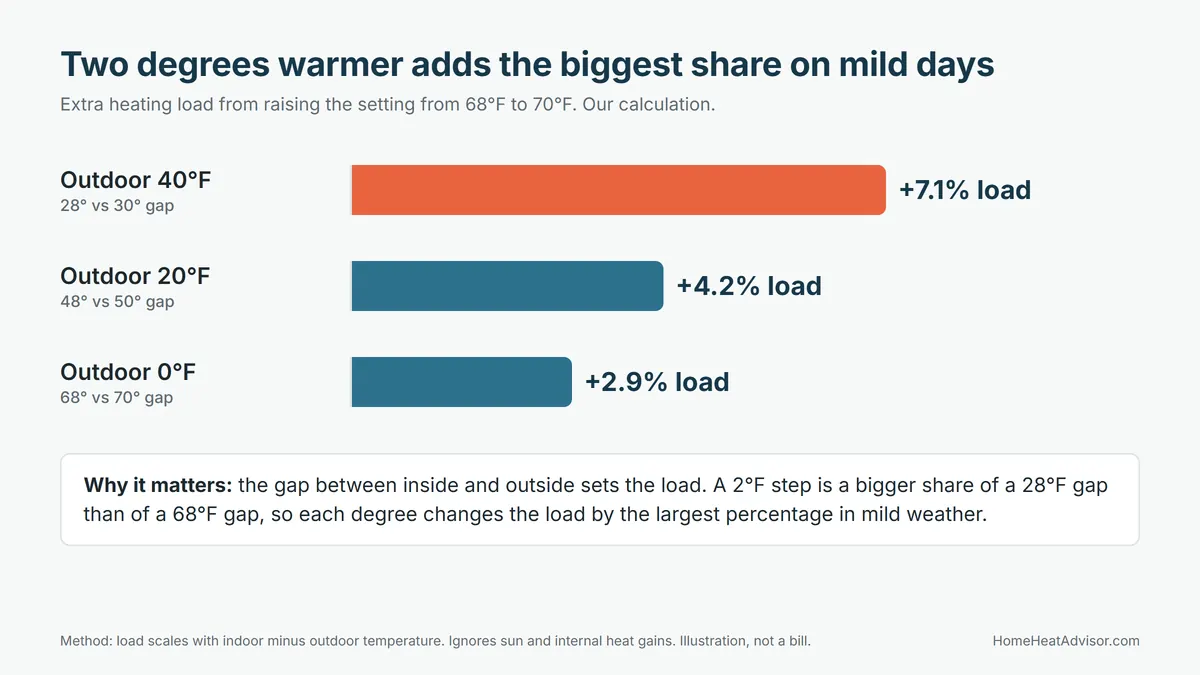
Two cautions. This is load, not dollars, and real homes gain heat from sun, people and appliances, which changes the true percentages. And a heat pump’s efficiency changes with the weather. Treat the chart as a way to see direction: a warmer setting always costs more. The same heat pump thermostat settings affect the bill. For what drives the rest of it, see why a heat pump electric bill is high in winter.
Heat pump thermostat settings that matter more than the number
Three heat pump thermostat settings can matter as much as the temperature itself. NYSERDA, CEE and Efficiency Vermont cover all three.
Use Heat in winter, not Auto
NYSERDA and Efficiency Vermont both advise Heat mode rather than Auto in winter. Auto mode switches between heating and cooling on its own, which can lead to the system fighting itself. Auto is a mode setting. It is separate from the fan setting below (NYSERDA; Efficiency Vermont).
Start with Auto fan
NYSERDA says continuous indoor fan operation can degrade heat pump performance, and suggests starting with Auto fan. Efficiency Vermont’s mini-split guide says AUTO FAN is fine, and also suggests using the highest fan speed you are comfortable with (Efficiency Vermont, October 2025). The two sheets differ on the best speed, so treat fan speed as a comfort setting and keep the fan mode on Auto.
Hold it steady
NYSERDA says heat pumps are most efficient when the thermostat holds a steady temperature, and that setting back or changing the temperature by 3°F or more could trigger an inefficient catch-up mode. CEE repeats the 3°F line (CEE, January 2024), and NYSERDA says to raise the setting slowly, a few degrees at a time. Backup electric heat is what a large jump tends to call on, which is explained in our guide to emergency heat vs auxiliary heat.
Do not crank it
Raising the setting does not make a heat pump heat the house faster. A big step up asks for a catch-up the heat pump may not deliver alone, and the thermostat can bring in backup heat instead. Raise it a degree or two and wait. Good heat pump thermostat settings are patient ones.
The best heat pump temperature for winter by system type
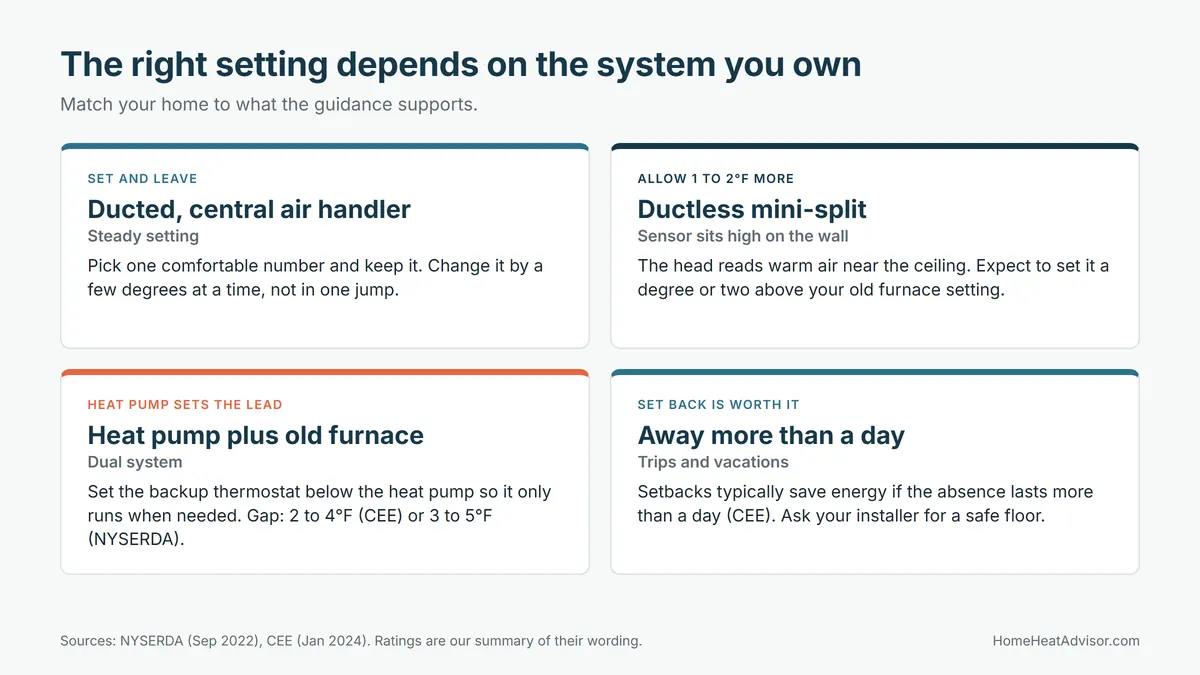
The right heat pump temperature depends on what is connected to the thermostat. A ducted system with one wall thermostat is the simplest case: choose one heat pump temperature and leave it. The other cases are where owners go wrong.
If you kept an old furnace as backup
Keep the heat pump as the lead system and set the backup thermostat lower, so it runs only when the heat pump cannot hold the set point. The sources agree on the idea and differ on the gap, so ask your installer which number fits your equipment.
| Source | Backup thermostat setting | Kind of evidence |
|---|---|---|
| CEE (Jan 2024) | 2 to 4°F below the heat pump setpoint | Program guidance |
| NYSERDA (Sep 2022) | 3 to 5°F below the heat pump setpoint | Program guidance |
| Efficiency Vermont (Oct 2025) | 5°F lower than before; for example 63°F if you used 68°F | Program guidance |
If you have a gas or oil furnace paired with the heat pump, our heat pump vs furnace guide covers how the two compare.
If you are away
CEE says temperature setbacks typically save energy if the absence lasts more than a day, and Efficiency Vermont says setting back is fine if you are away more than 24 hours. In cold weather do not let the house get too cold: the American Red Cross advises keeping the heat on and not setting it below 55°F when you are away (American Red Cross). Our night-setback guide covers the numbers.
Ductless heat pumps: the number is not the room

On a ductless system the thermostat sensor is in the indoor unit. NYSERDA notes that these units are mounted high on the wall, so you may need to set the thermostat a little higher to be comfortable. It says to set it at most 1 to 2 degrees higher than what you used with a previous furnace or boiler (NYSERDA).
Efficiency Vermont goes one step further: do not focus on the exact temperature, because the sensor is inside the unit and does not necessarily reflect the room. Set a comfortable heat pump temperature, then adjust up or down over a few days until it feels right (Efficiency Vermont, October 2025). That advice works for ducted systems too. A bedroom, a hallway and a basement can sit several degrees apart while the thermostat reads exactly what you asked for.
If one room is always cooler than the thermostat room, change the setting by a degree for a few days before you decide the heat pump is undersized.
How to find your best heat pump temperature in three steps
Because the numbers above are starting points, test your own heat pump temperature. This costs nothing and takes about a week.
- Start at 68°F in Heat mode with Auto fan, and leave it for two days.
- Adjust by one degree if the room feels off, then wait a day or two before changing it again. Efficiency Vermont suggests tuning it over a few days.
- Watch the thermostat for an AUX or emergency label. If backup heat runs often at your chosen setting, drop the setting a degree or ask a licensed HVAC technician to check the backup heat settings.

When you find a number that works, stop touching it. A thermostat that is adjusted every evening is the opposite of what these sources recommend for a heat pump.
When the house will not reach your heat pump temperature
Efficiency Vermont notes that cold-climate heat pumps can keep working at temperatures as low as −15°F and below (Efficiency Vermont, October 2025). If yours cannot hold the heat pump temperature you chose on the coldest days, it may be sized or set up poorly rather than set too high.
DOE adds one cheap helper: run ceiling fans clockwise in winter to push warm air down from the ceiling. It also warns that if you have a heat pump, you should not use deep thermostat setbacks without a smart or programmable thermostat designed for heat pumps (DOE, August 2022).
If the house still runs short of the setting, read our guides on a heat pump running constantly in cold weather, a heat pump not heating and how heat pumps perform in cold climates. If your heat pump turns on and off every few minutes, that is a different problem: read about heat pump short cycling. For anything involving refrigerant, wiring or breakers, use a licensed HVAC technician.
Frequently asked questions
What is the best heat pump temperature for winter?
NYSERDA calls 68°F a typical winter set point. Start there, then adjust a degree at a time over a few days. Keep the mode on Heat and avoid sudden changes of 3°F or more, which CEE and NYSERDA both say can trigger an inefficient catch-up mode.
Is 72°F too high for a heat pump?
It is not harmful, but it costs more. In our calculation, going from 68 to 70°F adds 4.2% to the heating load at 20°F outdoors, so 72°F adds more. A higher setting also widens the gap the heat pump must close, which can make backup heat more likely on the coldest days.
Should I leave my heat pump at the same temperature all day?
For most homes, yes. NYSERDA says heat pumps are most efficient when the thermostat holds a steady temperature. A longer absence is the exception: CEE says setbacks typically save energy if you are gone more than a day. See our guide on whether to turn down a heat pump at night.
Why is my ductless heat pump set higher than my old furnace was?
The sensor is in the indoor unit, which is mounted high on the wall. NYSERDA says you may need to set it at most 1 to 2°F higher than you used with a furnace or boiler. Efficiency Vermont says to set a comfortable temperature and adjust over a few days.
Should my heat pump be on Auto or Heat in winter?
Heat. NYSERDA and Efficiency Vermont both advise Heat mode in winter rather than Auto, because Auto can switch between heating and cooling. Auto fan is a different setting and is fine to use.
What temperature should a home never go below?
For health, WHO describes 18°C (64.4°F) as a safe minimum for general populations, and says vulnerable groups may need more. If you are away in cold weather, the American Red Cross advises not setting the heat below 55°F. Ask your installer for a safe floor for your system.
Sources
- NYSERDA: Air Source Heat Pump Operating Tips (September 2022)
- CEE: You Installed an Air Source Heat Pump. Now What? (January 2024)
- Efficiency Vermont: How to use a mini-split heat pump (October 2025)
- U.S. DOE: Energy Saver Guide (August 2022)
- World Health Organization: Housing and Health Guidelines, Low indoor temperatures and insulation (2018)
- American Red Cross: Preventing and thawing frozen pipes
About this guide
Published by HomeHeatAdvisor. This guide is based on state energy office, efficiency-program, DOE and WHO sources, checked in October 2026; each figure names its source and date, and calculations are labeled as ours. The settings here are for homeowners only. For thermostat wiring, backup heat settings or anything that keeps tripping a breaker, use a licensed HVAC technician. Our editorial policy explains how we research, fact-check and update our guides. Spotted an error? Let us know. More troubleshooting guides.