

A heat pump not heating is a common winter complaint, and the cause is often a thermostat setting or a dirty filter. Before you book a technician, work through the checks below in order. They start with the quick, safe ones any owner can do and finish with the faults that need a licensed pro.
If you are new to these systems, our guide to how a heat pump works explains the parts mentioned here. For noises, error codes and other problems, see all our heat pump troubleshooting guides.

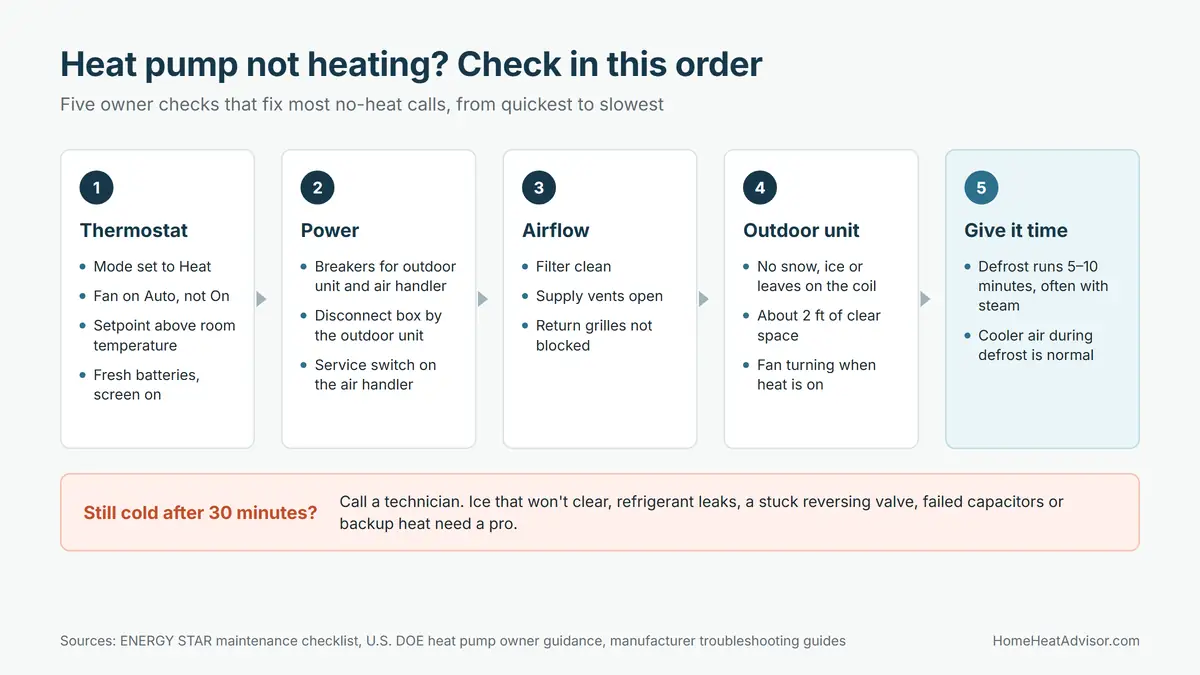
Start with the thermostat: it should be set to Heat, the fan to Auto and the temperature a few degrees above the room. Then check the breakers and the outdoor disconnect, replace a dirty filter, open the vents and clear snow or leaves from the outdoor unit. Warm rather than hot air at the vents (roughly 85–110°F) and short defrost pauses are normal. If the house is still cold after 30 minutes, or the unit is buried in ice, hums without starting or smells of burning, switch it off and call a technician.
Normal air at the vents
85–110°F
Cooler than a furnace’s roughly 125°F, but warmer than the room
Normal defrost cycle
5–15 min
The outdoor fan stops and the unit may steam, then heating resumes
Average repair bill
$400
Most heat pump repairs cost $150–650 in 2026
In this guide
Heat pump not heating? Check in this order
Good heat pump troubleshooting goes from quick to slow. The first checks take a minute and cost nothing; the later ones need more time, a flashlight and sometimes a ladder. The first three steps are the quickest to rule out.
Safety first
Only reset breakers and switches, change filters and clear debris. Never open the outdoor unit’s panels: capacitors can hold a dangerous charge even when the power is off. If a breaker trips again right after you reset it, leave it off and call an electrician or HVAC technician.
Heat pump not heating, or working normally?
Heat pumps behave differently from furnaces, and some of that behavior looks like a fault the first winter you own one. Rule out these three before you decide you have a heat pump not heating properly.
The defrost cycle
In cold, damp weather, frost builds up on the outdoor coil. Every so often the unit reverses for a few minutes to melt it: the outdoor fan stops, the coil may hiss or steam, and the vents can blow cooler air. Carrier puts a normal cycle at 5 to 10 minutes and the DOE-hosted guide at 5 to 15, and a thin layer of frost (under about ¼ inch) between cycles is expected. Ice that is still there after the cycle ends is not normal: see why a heat pump freezes up. Steam from the unit is covered in why a heat pump steams in winter.
Air that feels warm, not hot
Energy Vanguard puts heat pump supply air at 90 to 110°F, against roughly 125°F from a furnace’s vents. That is warmer than the room but cooler than a furnace’s air, so it can feel drafty near a vent. Trane quotes 85 to 93°F. If the house holds its temperature, the system is doing its job.

Backup heat on the coldest days
As temperatures drop, a heat pump produces less heat while the house needs more. Many systems switch on electric backup heat, shown as “Aux” on the thermostat, to fill the gap. That is by design; it only becomes a problem if the backup heat runs all the time in mild weather. Our guide to cold-weather performance explains why, and our heat pump pros and cons covers what owners say about defrost and backup heat.
Heat pump not heating: 7 causes you can check yourself
These are common causes of a heat pump not heating, and none of them needs tools or opening the equipment.
1. Thermostat set to the wrong mode or fan setting
After a summer of cooling, it is easy to leave the thermostat on Cool, Off or Auto. If the fan is set to On instead of Auto, it keeps blowing between heating cycles, so you feel the heat pump blowing cold air even when nothing is wrong with the equipment. Our guide to heat pump fan auto or on covers what each fan setting costs and does.
Fix: Set the mode to Heat and the fan to Auto, then raise the setpoint 3–4°F above the room temperature and wait 10 minutes. The DOE-hosted owner guide also recommends Heat rather than Auto mode in winter, and warns that running the fan continuously lowers performance.
2. Thermostat with no power or the wrong settings
A blank or flickering screen usually means dead batteries or a tripped circuit. A reading that is more than 2–3°F off from a separate thermometer points to a faulty or badly placed thermostat. A thermostat installed recently can also be set up for a furnace instead of a heat pump: if its reversing valve setting (often labeled O/B) is wrong, the heat pump cools when you ask for heat.
Fix: Replace the batteries and check the thermostat’s installer settings against the manual. If the thermostat was just replaced, ask the installer to confirm it is configured for a heat pump.
3. A tripped breaker or switched-off disconnect
Most systems have two circuits: one for the outdoor unit and one for the indoor air handler, which also powers the backup heat. There is usually a disconnect box on the wall next to the outdoor unit and a light-switch-style service switch near the air handler.
Fix: Check both breakers in the panel and switch any tripped one fully off, then on. Make sure the outdoor disconnect and the air-handler switch are on. A breaker that trips again is a warning sign, not something to keep resetting. Our guide to why a heat pump keeps tripping the breaker covers the usual causes and when to stop resetting.
4. A clogged air filter
A dirty filter starves the system of air, so it moves less heat into the house and can shut itself off to protect the equipment. ENERGY STAR notes that airflow problems can cut a system’s efficiency by up to 15 percent.
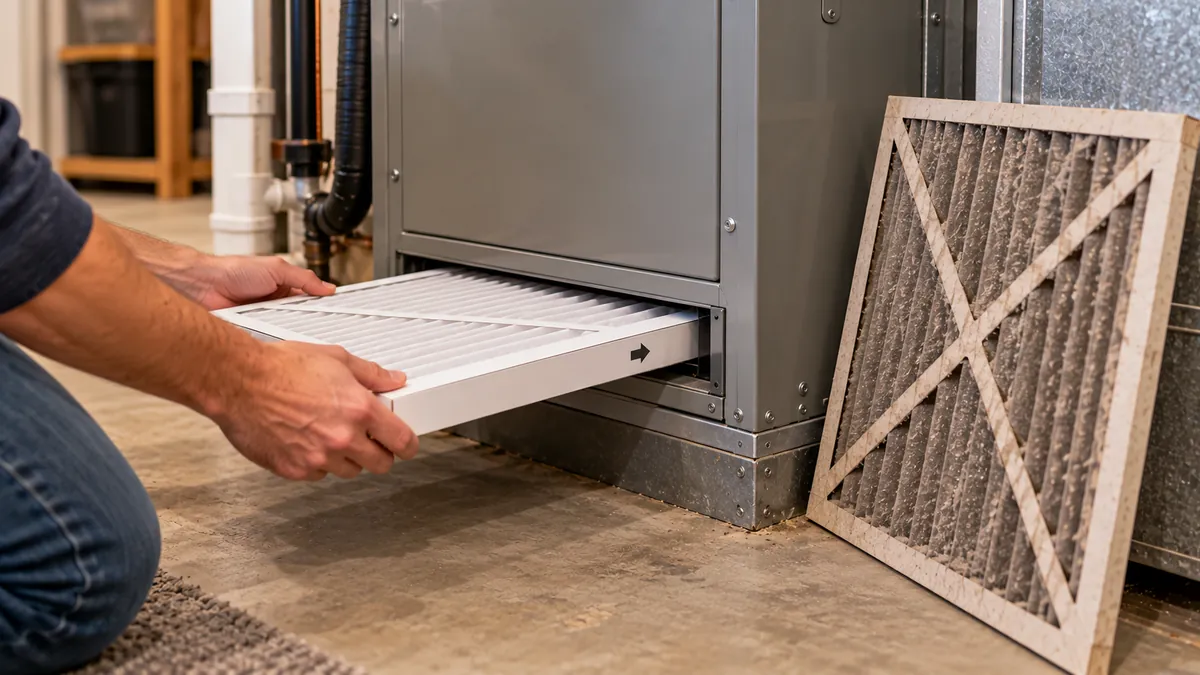
Fix: Check the filter monthly in winter and replace it when it looks gray. The DOE-hosted guide suggests about every 90 days for ducted systems and a monthly rinse for the washable filters in ductless indoor units.
5. Closed vents or blocked return grilles
Closing vents in unused rooms, or pushing furniture and rugs over the return grilles, restricts airflow in the same way as a dirty filter. Low airflow hurts a heat pump too: it cuts output and makes the system work harder.
Fix: Open all supply vents and clear at least a few inches around every return grille.
6. Outdoor unit blocked by snow, ice or leaves
The outdoor unit pulls heat from the air, so it needs air flowing freely across its coil. Drifted snow, ice from a roof drip line, leaves or a cover left on from summer all choke it. Carrier advises keeping at least 24 inches of open space around the unit and following your model’s clearance requirements. The DOE-hosted guide adds that you should avoid covering the unit in winter, while shielding it from heavy snow and water.

Fix: Switch the outdoor disconnect off first. Then brush snow and leaves off the top and sides and clear about 2 feet around the unit. Never chip ice off the coil with a tool, because the fins bend easily. If the whole unit is encased in ice, see cause 8.
7. Deep setbacks and schedules
Turning the temperature down 6–8°F at night works with a furnace, but a heat pump recovers slowly and often calls for expensive backup heat to catch up. The result can feel like a heat pump not heating in the morning. Smart thermostat eco modes and old schedules can cause the same thing. See whether to turn a heat pump down at night and the best winter temperature settings.
Fix: The DOE-hosted guide advises keeping setbacks under about 3°F. If you still have an old furnace as backup, set its thermostat 2–4°F below the heat pump’s so the heat pump runs first.
Still cold?
If none of the seven checks fixes a heat pump not heating within 30 minutes, write down what you see (fan running or not, ice, noises, thermostat messages) before you call. It shortens the visit and the bill.
5 causes that need a technician
If the owner checks did not solve it, the remaining causes involve refrigerant, high-voltage parts or controls inside the unit. Handling refrigerant requires EPA Section 608 certification, and electrical parts can injure you even with the power off.
8. Ice that won’t clear
A light frost that clears every hour or so is normal, and it is the most common false alarm for a heat pump not heating. A thick shell of ice over the whole coil that stays for hours is not. The usual culprits are a failed defrost control board or sensor, an outdoor fan that has stopped, poor drainage under the unit or low refrigerant. Our guide to a frozen heat pump goes into more detail.
Fix: Switch the thermostat to emergency heat to keep the house warm, and book a technician.
9. Low refrigerant from a leak
Refrigerant is not used up like fuel, so a low charge usually means a leak, or a charging problem from installation. Signs include lukewarm air, longer run times, frost on the indoor coil or refrigerant lines, a hissing sound, and backup heat running far more than usual.
Fix: A technician needs to find and repair the leak before recharging. Topping up without a repair just delays the next breakdown.
10. A stuck reversing valve
The reversing valve switches the heat pump between heating and cooling. If it sticks in cooling, the outdoor unit runs normally but you get a heat pump blowing cold air into the house. Rule out the thermostat setting from cause 2 first, since the symptoms look the same.
Fix: A technician can test the valve and its solenoid coil; sometimes only the coil needs replacing.
11. Failed capacitor, contactor or fan motor
If the outdoor unit hums but the fan does not spin, or nothing happens outside even though the thermostat is calling for heat and the breaker is on, an electrical part has usually failed. Capacitors are the most common, and among the cheapest repairs. If the indoor blower does not run, its motor may have failed. Unusual sounds are covered in heat pump noises.
Fix: Turn the system off at the thermostat, switch off the outdoor disconnect and book a heat pump repair visit. Running a unit with a failed fan can damage the compressor.
12. Backup heat that doesn’t work
If the heat pump keeps up in mild weather but the house gets cold during a deep freeze, the backup heat strips, their breaker or the relay that turns them on may have failed. It can also mean the heat pump was undersized for the home. If it runs nonstop without catching up, see why a heat pump runs constantly in winter.

Fix: Check the air handler’s breakers first, then call a technician to test the heat strips and review the system’s sizing.
Heat pump troubleshooting by symptom
Use this table to match what you are seeing to the most likely cause and who should fix it.
| What you notice | Likely cause | Who fixes it |
|---|---|---|
| Heat pump blowing cold air between cycles | Fan set to On (cause 1) | You |
| Cold air while running, settings correct | Reversing valve setting or valve, low refrigerant (causes 2, 9, 10) | You check the setting; then a technician |
| Blank thermostat screen | Dead batteries or a tripped breaker (causes 2, 3) | You |
| Outdoor unit silent | Breaker, disconnect, contactor or capacitor (causes 3, 11) | You check power; a technician replaces parts |
| Outdoor unit hums, fan still | Capacitor or fan motor (cause 11) | Technician |
| Frost and steam every hour or so | Normal defrost | Nobody |
| Solid ice for hours | Defrost fault, drainage or low refrigerant (causes 8, 9) | Technician |
| Weak airflow at the vents | Dirty filter, closed vents or blower (causes 4, 5, 11) | You, then a technician |
| Fine in mild weather, cold in a freeze | Backup heat fault or undersized system (cause 12) | Technician |
| “Aux heat” on constantly, high bill | Deep setbacks, low refrigerant or an outdoor unit fault (causes 7, 9) | You check settings; then a technician |
| Turns on and off every few minutes | Airflow problems (causes 4, 5) or a control fault; see heat pump short cycling | You check the filter and vents; then a technician |
How to keep it from happening again
Most causes of a heat pump not heating are cheaper to prevent than to fix. A short routine covers them:
- Check the filter monthly in winter and replace it when dirty.
- Keep the outdoor unit clear of snow, leaves and plants, with about 2 feet of space. A stand keeps it above the snow line and away from roof drip lines.
- Book a service visit each fall, before the heating season. ENERGY STAR’s checklist includes tightening electrical connections, checking the refrigerant charge and the condensate drain.
- Keep setbacks small and the thermostat on Heat with the fan on Auto.
- Watch for early warnings: a sudden jump in your electricity use, “Aux heat” showing most of the time, or rooms that never reach the setpoint (see why winter bills run high).
What heat pump repairs cost in 2026
According to Fixr’s 2026 cost data, the average heat pump repair costs about $400, and most jobs fall between $150 and $650. The service call alone is usually $75–250, and many companies credit it toward the repair.
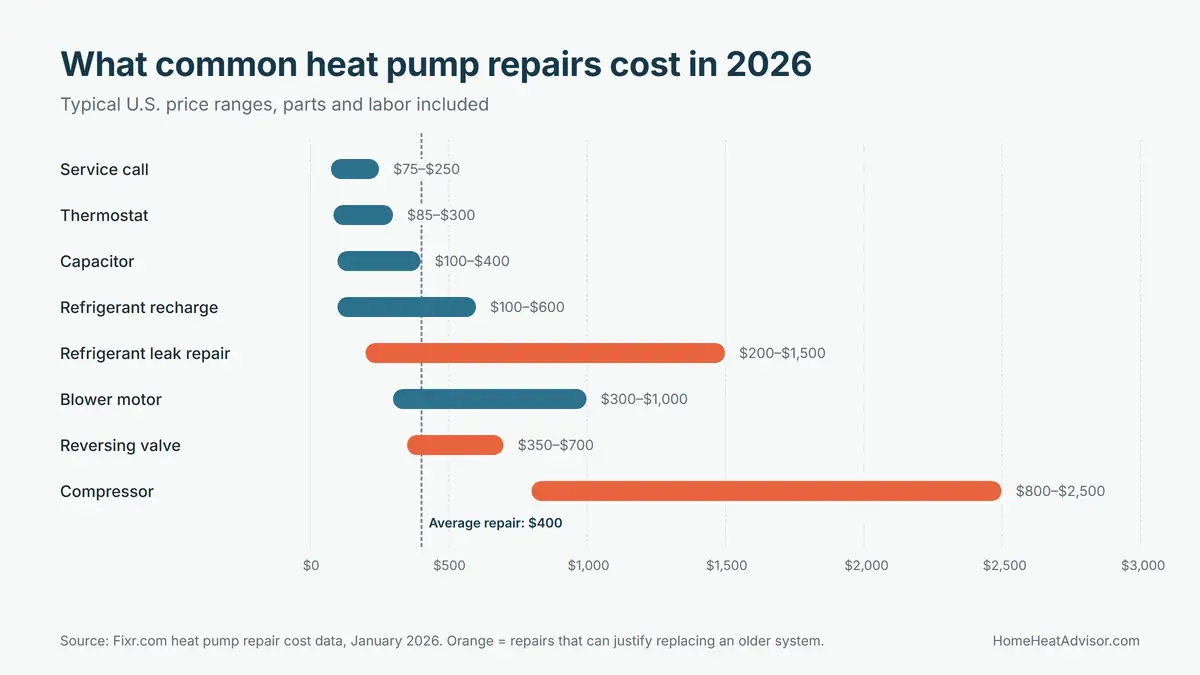
Refrigerant leaks ($200–1,500) and compressors ($800–2,500) are the expensive heat pump repair jobs, and they are the ones that make replacement worth considering. Ask for a written quote that separates parts, labor and refrigerant. Our page on how we research costs explains where these figures come from.
Repair or replace?
Most heat pump repairs are worth doing, even when a heat pump not heating turns out to have a failed part. Replacement starts to make sense when a big repair lands on an old system. These rules of thumb help:
| Your situation | Usually |
|---|---|
| Under about 10 years old, repair under $1,000 | Repair. Check whether the parts warranty still applies. |
| Repair costs more than half the price of a new system | Get replacement quotes before you approve it. |
| Over 12–15 years old and needs a compressor or a leak repair | Lean toward replacing. Other parts are near the end of their life too. |
| Older system that uses R-22 refrigerant | Replace. R-22 has not been produced or imported in the U.S. since 2020 (EPA), so leak repairs are costly. |
| Repeated breakdowns or rising bills every winter | Replace, ideally with a correctly sized cold-climate model. |
To weigh a repair quote against a new system, see our heat pump installation cost breakdown. A new, correctly sized heat pump is also more efficient, and our reliability guide shows how often heat pumps break down as they age.
Frequently asked questions
Why is my heat pump blowing cold air?
A heat pump blowing cold air usually has a simple cause. The most common reasons are a fan set to On instead of Auto, a defrost cycle, or a thermostat set to Cool or Auto. Air at 85–110°F can also feel cool compared with a furnace. If the air stays cold while the system runs and the settings are correct, the reversing valve setting, the valve itself or low refrigerant are the likely causes.
Why is my heat pump not heating when it is very cold outside?
Some drop in output is normal. As the temperature falls, a heat pump produces less heat, and backup heat takes over part of the load. Cold-climate models keep working well below 0°F. Our guide to heat pumps in cold climates shows how output changes with temperature. If your house cannot stay warm in weather your system should handle, have a technician check the backup heat and the system’s sizing.
How long should a heat pump take to warm up a house?
Longer than a furnace. Heat pumps are designed to run long, steady cycles rather than short bursts of hot air, so a large setback can take hours to recover. If the temperature keeps falling while the system runs, something is wrong.
Should I switch to emergency heat?
Only when the outdoor unit has a problem, such as heavy ice that won’t clear or a failed fan, and only until a technician arrives. Emergency heat uses the electric backup strips alone, which costs much more to run. Our guide to emergency heat vs auxiliary heat explains the difference between the two modes.
Can I add refrigerant to my heat pump myself?
No. Handling refrigerant requires EPA Section 608 certification, and a low charge usually means a leak that needs repairing first.
Sources
- Consortium for Energy Efficiency, hosted by the U.S. Department of Energy: You Installed an Air Source Heat Pump. Now What? (2024)
- ENERGY STAR: Maintenance checklist
- U.S. EPA: Phaseout of Class II ozone-depleting substances
- U.S. EPA: Section 608 of the Clean Air Act
- Fixr: Heat pump repair cost (January 2026)
- Carrier: Heat pump not heating? Common causes
- Trane: Heat pump not heating
- Energy Vanguard: Is heat pump supply air too cold for heating?
About this guide
Published by HomeHeatAdvisor. The figures in this guide come from the sources listed above, checked in October 2026. This guide is general information: for anything beyond the owner checks, use a licensed HVAC technician. Our editorial policy explains how we research, fact-check and update our guides. Spotted an error? Let us know.