
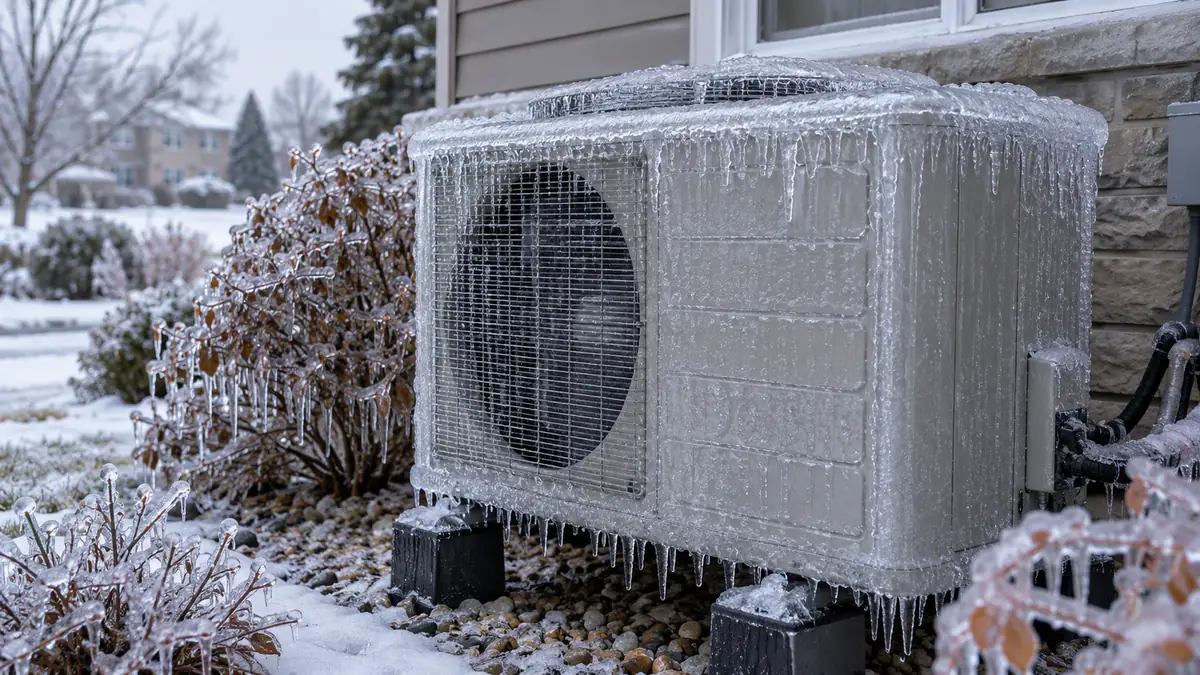
Finding your heat pump frozen on a winter morning is unsettling, but most of the time it is the system working as designed. In cold, damp weather the outdoor coil collects frost, and the unit melts it off with a short defrost cycle. A heat pump iced up for hours is a different story, and it needs attention before it damages the equipment.
This guide explains how the heat pump defrost cycle works, how to tell normal frost from a real problem and how to thaw the unit safely. If you are new to these systems, start with our guide to how a heat pump works. For other problems, see all our heat pump troubleshooting guides.

Light frost on the outdoor coil is normal. The heat pump defrosts itself every 30 to 90 minutes in cold, damp weather, usually for 5 to 15 minutes, and you may see steam and hear a whoosh while the outdoor fan stops. Solid ice on the coil, the top or the fan is not normal. Switch the thermostat to emergency heat, clear snow from around the unit, never chip the ice or pour hot water on it, and call a technician if the ice is still there after a few hours or keeps coming back.
Normal defrost
5–15 min
The outdoor fan stops and steam rises, then heating resumes
Defrost runs every
30–90 min
In cold, damp weather, depending on the controls
Outdoor coil runs
10–20°F colder
Than the outside air, so frost can form above freezing
In this guide
- How the heat pump defrost cycle works
- Heat pump frozen, or just normal frost?
- What to do if your heat pump is frozen
- Heat pump iced up? 7 reasons it won’t clear
- Heat pump frozen? Symptoms at a glance
- How to keep it from freezing again
- What repairs cost in 2026
- Repair or replace?
- Frequently asked questions
How the heat pump defrost cycle works
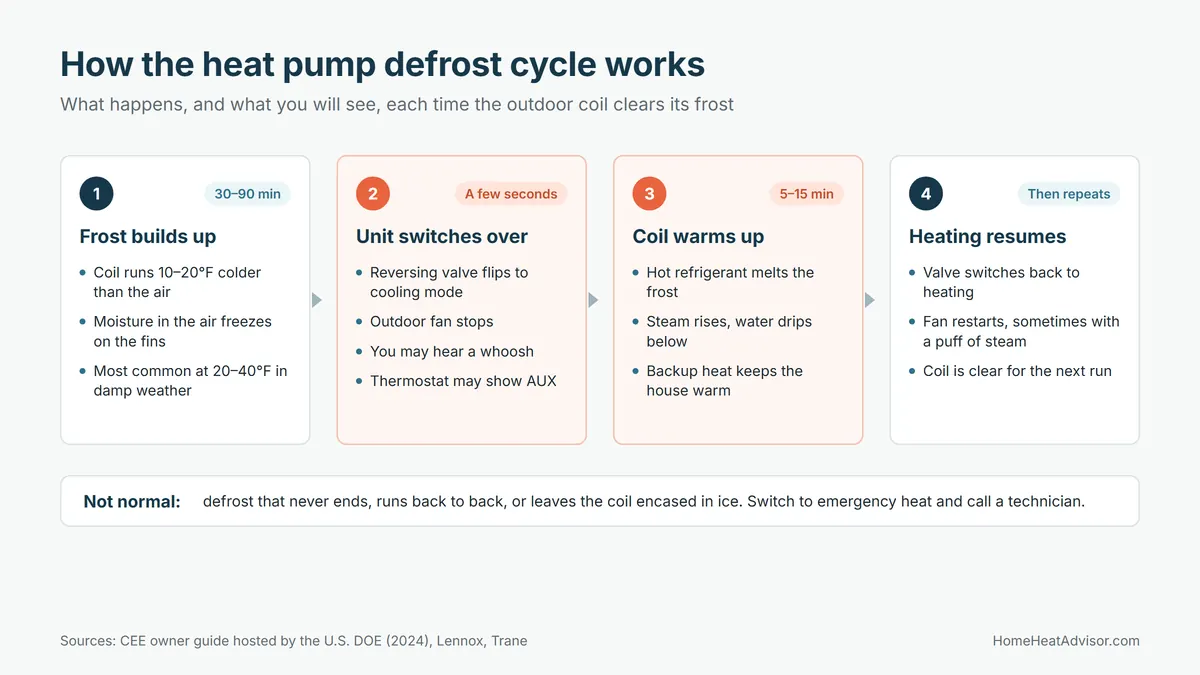
In heating mode, the outdoor coil absorbs heat from the outside air. To do that it has to be colder than the air: Trane puts it at 10–20°F below the outdoor temperature. Moisture in the air condenses on the cold fins, and once the coil is below 32°F that moisture freezes into frost.
Frost is an insulator, so a layer that keeps growing cuts the heat the unit can collect. The heat pump defrost cycle removes it before that happens. It is most common when the weather is between about 20°F and 40°F and humid, because that air carries the most moisture. In very cold, dry air there is less water to freeze.
What happens during heat pump defrost
When the controls decide the coil needs clearing, the reversing valve switches the system into cooling mode for a few minutes. Hot refrigerant now flows through the outdoor coil instead of the indoor one, and the outdoor fan stops so the heat stays on the coil. The DOE-hosted owner guide says defrost typically takes 5 to 15 minutes. Then the valve switches back and normal heating resumes.
Because the system is briefly cooling, ducted systems usually turn on their electric backup heat during defrost so you do not get a blast of cold air. Ductless indoor units may blow slightly cool air or pause their fan for a few minutes instead.
Timed and demand defrost
Older and basic systems use timed defrost. Below a set outdoor temperature they check the coil at a fixed interval, often every 30, 60 or 90 minutes of running time, and defrost whether it is needed or not. Lennox gives the same 30 to 90 minute range. Newer systems use demand defrost, which reads temperature sensors and only defrosts when frost is actually building, so it runs fewer and shorter cycles.
What you will see and hear
The first winter with a heat pump, the defrost cycle can look and sound like a breakdown. These are all normal:
- Steam rising from the outdoor unit. It is melting frost turning to vapor, not smoke.
- A whoosh or hiss when the reversing valve switches over, at the start and the end of the cycle.
- The outdoor fan stopping while the compressor keeps running, sometimes louder than usual.
- Water dripping or running from under the unit as the frost melts.
- “Aux” or “Aux heat” on the thermostat for a few minutes while the backup heat covers the gap.

Heat pump frozen, or just normal frost?
The question is not whether there is frost on the unit, but whether it clears. A normal heat pump frosts over and clears again many times a day in winter. A frozen heat pump keeps its ice through cycle after cycle, and the layer grows until air can no longer pass through the coil.
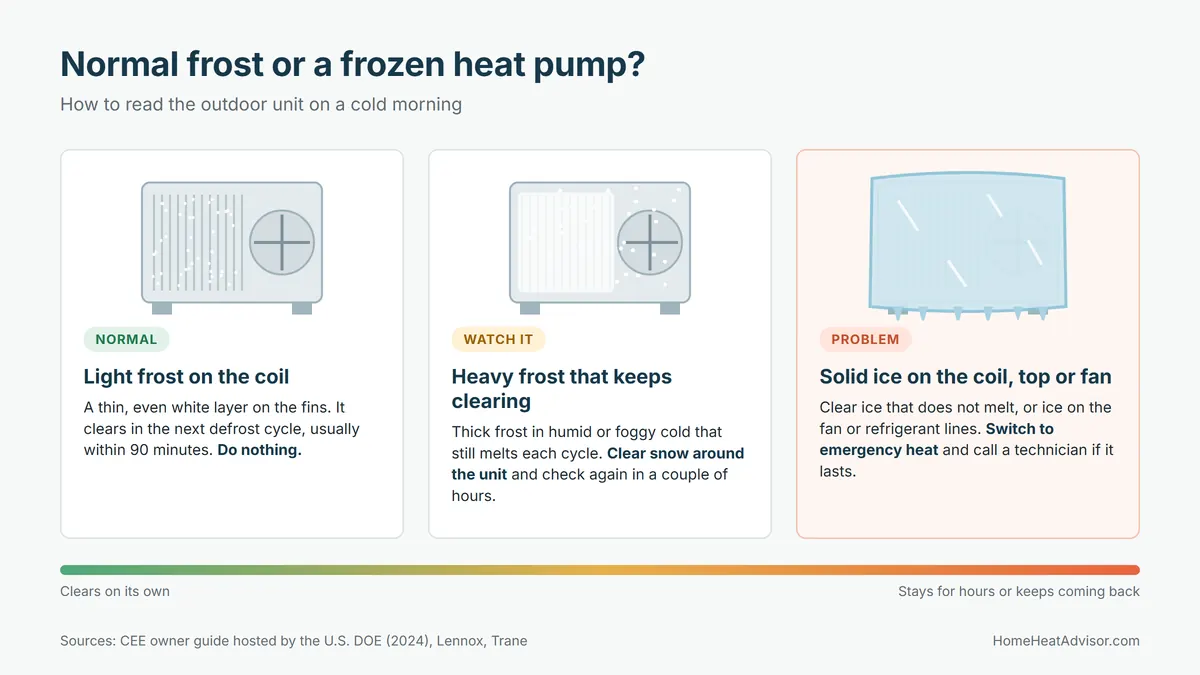
Use these signs to tell the difference:
- Normal: a thin, white, even layer of frost on the coil fins that disappears after the next defrost, with steam and dripping water.
- Keep an eye on it: heavy frost in fog, freezing drizzle or humid cold that still melts each cycle. Clear the snow around the unit and check again in a couple of hours.
- A problem: clear, solid ice on the coil, ice on the top or the fan blades, ice on the refrigerant lines, or a unit that has not steamed or gone quiet for defrost in hours.

The 2-hour check
Not sure? Look at the coil, wait two hours and look again. If the frost has come and gone, the heat pump defrost cycle is working. If the same ice is there or it has grown, treat it as a heat pump frozen up and follow the steps below.
What to do if your heat pump is frozen
With a heat pump frozen solid and not clearing, work through these steps. They are the same ones Lennox gives owners, and none of them involves opening the unit.
- Rule out a defrost in progress. If the fan has stopped and you see steam, wait 15–20 minutes before doing anything.
- Switch the thermostat to emergency heat. This turns off the outdoor unit and heats the house with the backup heat alone. It costs more to run, so treat it as temporary. Our guide to emergency heat vs auxiliary heat explains the difference between the two modes.
- Clear snow and debris. Brush snow off the top and sides with a soft broom and clear about 2 feet all around. Make sure the drain area under the unit is not blocked by ice or snow.
- Check the indoor air filter. Replace it if it looks gray. Poor airflow makes every part of the system work harder.
- Let the ice melt. Lennox says natural thawing typically takes 2 to 4 hours when it is above freezing outside, and longer in colder weather.
- Switch back to Heat and watch. Once the coil is clear, set the thermostat back to Heat and watch the unit for the next hour or two.

Never do this
Do not chip, scrape or hammer the ice: the aluminum fins and the copper tubing behind them damage easily, and a punctured line means a refrigerant leak. Do not pour hot water on the unit, because the sudden temperature change can crack parts. Do not run a hair dryer or heater near it, and never open the panels, as the electrical parts inside stay dangerous even with the power off.
Call a technician if the ice is still there after 6–8 hours of thawing, if it comes back soon after the unit restarts, or if the outdoor fan does not spin. The DOE-hosted guide is direct about it: if your heat pump is stuck in defrost or covered in ice, consult an HVAC professional. Our guide to a heat pump not heating covers the other checks to do while you wait.
Heat pump iced up? 7 reasons it won’t clear
When a heat pump is iced up for longer than a normal cycle, the cause is usually one of these seven. Fix the cause, or the heat pump iced up today will ice up again next week. The first four are about where the unit sits and the weather around it; the last three are equipment faults.
1. Snow piled against or over the unit
Drifting snow, snow sliding off the roof or snow thrown by a plow or blower can bury the coil. The unit cannot pull air through it, the coil gets colder still, and meltwater from each defrost refreezes in the snow around it.
Fix: Keep at least 2 feet clear around the unit and the top free of snow after every storm. In snowy areas, a stand that lifts the unit above the usual snow depth is the long-term answer.
2. Water dripping from the roof or gutter
A unit under a roof edge or a deck catches meltwater and icicle drips, which freeze straight onto the top and the coil. The DOE-hosted owner guide warns that units placed under a roof eave’s drip line or deck slats can have snow and water problems that affect airflow. It prefers the gable end of the house.
Fix: Clean and repair the gutters above the unit. If the unit sits under the drip line, ask a contractor about a snow shield or deflector, or moving it to a better spot.

3. Meltwater that cannot drain away
Every defrost cycle releases water. If the unit sits on the ground, in a hollow or on a pad that has sunk, that water pools under it and refreezes. Over a few days the ice climbs up from the base into the bottom of the coil, and it can trap the fan.
Fix: Clear ice and snow from under and around the base. A level pad or a stand that lifts the unit a few inches off the ground lets water drain away, and keeps the drip from freezing on a nearby walkway.
4. Freezing rain and ice storms
Freezing rain coats everything outside in clear ice, including the outdoor unit. The defrost cycle is designed for frost on the coil, not a shell of ice over the whole cabinet, so it may not keep up until the weather changes.
Fix: Switch to emergency heat until the storm passes, then let the ice melt as it warms up. If the fan blades are frozen in place, do not restart the unit until they are free.
5. An outdoor fan that is not running
If the outdoor fan stops outside a defrost cycle, air stops crossing the coil and you can have a heat pump frozen solid within hours. A failed fan motor or capacitor is the usual cause, and ice that has reached the fan blades can also stop it. Lennox lists a non-spinning outdoor fan as a reason to call a professional.
Fix: Turn the system off at the thermostat, switch to emergency heat and book a technician. Running the compressor with a stopped fan can damage it.
6. A faulty defrost control, sensor or reversing valve
If the heat pump never steams or goes quiet for a defrost, the system may not be starting the cycle at all. The defrost control board, its coil temperature sensor, the outdoor air sensor or the reversing valve can all fail. Trane also flags the opposite problem: a unit that switches into defrost constantly, with cycles that get longer while ice spreads over the coil.
Fix: This needs a technician, who can test the board, sensors and valve. It is a common heat pump defrost repair and usually far cheaper than the compressor damage it prevents.
7. Low refrigerant
A leak lowers the refrigerant pressure, which makes the outdoor coil colder than designed. It frosts faster than the defrost cycle can clear, often in patches on one part of the coil, and frost may appear on the refrigerant lines. Only a technician with EPA Section 608 certification can handle refrigerant.
Fix: A technician needs to find and fix the leak before recharging. Adding refrigerant without a repair only buys time.
Several of the reasons for a heat pump frozen over also explain a house that is not getting warm. Our guide to a heat pump with ice that won’t clear covers how they affect heating.
Heat pump frozen? Symptoms at a glance
Match what you see at the outdoor unit to the most likely cause, to tell a normal heat pump defrost from a heat pump iced up for good.
| What you see | Likely cause | Who fixes it |
|---|---|---|
| Thin white frost and steam every 30–90 minutes | Normal heat pump defrost | Nobody |
| Fan stops, a whoosh, “Aux” for a few minutes | Normal defrost cycle | Nobody |
| Ice on the top and sides after snow or freezing rain | Weather or roof drip (causes 1, 2, 4) | You, then fix the siting |
| Ice growing up from the base | Poor drainage (cause 3) | You clear it; a contractor raises the unit |
| Coil iced over and the fan not spinning | Fan motor or capacitor (cause 5) | Technician |
| Ice that never clears, no steam for hours | Defrost control or sensor (cause 6) | Technician |
| Defrost running back to back | Defrost control, sensor or low refrigerant (causes 6, 7) | Technician |
| Frost on part of the coil or on the refrigerant lines | Low refrigerant (cause 7) | Technician |
How to keep it from freezing again
Most cases of a heat pump frozen over come down to where the unit sits and how well it is kept. A few habits prevent most of it:
- Keep it clear. Remove snow from the top and sides after storms and keep plants and stored items about 2 feet away.
- Lift it above the snow. The DOE-hosted guide recommends a snow stand in cold climates, installed by a qualified contractor.
- Keep roof water off it. Clean the gutters before winter and use a snow shield if the unit sits under an eave.
- Do not cover it. Covers and tarps block the airflow the unit needs to heat. Only a shield over the top, open on all sides, is fine.
- Book a fall service. A technician can check the refrigerant charge, the defrost controls and the fan before the cold arrives.
- Watch the first freeze. Note how often your unit defrosts on a normal cold day, so you can spot a heat pump defrost problem later.

If you are still choosing a system, a cold-climate model and a good installation spot make a big difference. Our guide to cold-weather performance explains what to look for, and our heat pump pros and cons covers what owners say about winter defrost.
What frozen heat pump repairs cost in 2026
Clearing snow or fixing a gutter costs little. If a part has failed, these are typical U.S. prices including labor. Fixr’s 2026 data puts the average heat pump repair at about $400.
| Repair | Typical cost |
|---|---|
| Service call and diagnosis | $75–250 |
| Capacitor | $100–400 |
| Defrost control board | $200–500 |
| Reversing valve | $350–700 |
| Refrigerant recharge | $100–600 |
| Refrigerant leak repair | $200–1,500 |
Many companies credit the service call against the repair. Ask for a written quote that separates parts, labor and refrigerant. Our page on how we research costs explains where these figures come from, and our heat pump repair cost chart covers other common repairs.
Repair or replace?
A heat pump frozen because of snow, a gutter or a sensor is almost always worth repairing. The decision gets harder when ice reveals an expensive fault in an older system.
| Your situation | Usually |
|---|---|
| Ice from snow, roof water or poor drainage | Fix the siting. The heat pump itself is fine. |
| Failed sensor, capacitor or defrost board | Repair. These are moderate, one-off costs. |
| Refrigerant leak on a system over 12–15 years old | Get replacement quotes before paying for a leak repair. |
| Older system that uses R-22 refrigerant | Replace. R-22 has not been produced in the U.S. since 2020. |
| Ice problems every winter despite repairs | Replace, ideally with a correctly sized cold-climate model. |
To compare a repair quote with the price of a new system, see our heat pump installation cost breakdown.
Frequently asked questions
Is it normal for a heat pump to freeze up in winter?
Light frost is normal and clears itself during the heat pump defrost cycle, often several times an hour in damp weather. A heat pump frozen in solid ice that stays for hours is not normal and points to snow, roof water, drainage, a fan problem, a defrost fault or low refrigerant.
How long does a heat pump defrost cycle last?
Usually 5 to 15 minutes, according to the DOE-hosted owner guide. Some demand defrost systems finish in 3 to 5 minutes. A cycle that keeps going for much longer, or repeats back to back, needs a technician.
Should I turn off a frozen heat pump?
Yes, if your heat pump is iced up and the coil is encased. Switch the thermostat to emergency heat so the outdoor unit stops while the backup heat keeps the house warm, let the ice melt, then switch back to Heat and watch the next cycle.
Can I pour hot water on a frozen heat pump?
No. Lennox warns that the sudden temperature change can crack components, and the water can refreeze in the base. Let the ice melt naturally, and never chip it off with a tool.
Should I cover my heat pump in winter?
No. The DOE-hosted owner guide advises against covering it, because the unit needs airflow to heat. A shield over the top that keeps roof water and snow off, while leaving the sides open, is fine.
Why is my heat pump frozen in summer?
In cooling mode, ice usually forms on the indoor coil or the refrigerant lines rather than the outdoor coil. A dirty filter, blocked vents or low refrigerant are the common causes. Switch the system off, run the fan to melt the ice and call a technician if it comes back.
Sources
- Consortium for Energy Efficiency, hosted by the U.S. Department of Energy: You Installed an Air Source Heat Pump. Now What? (2024)
- Lennox: Heat pump frozen? Causes and fixes
- Trane: What is a heat pump defrost cycle?
- U.S. EPA: Section 608 of the Clean Air Act
- Fixr: Heat pump repair cost (2026)
- HVAC.com: Heat pump repair costs (2024)
About this guide
Published by HomeHeatAdvisor. The figures in this guide come from the sources listed above, checked in October 2026. This guide is general information: for anything beyond the owner checks, use a licensed HVAC technician. Our editorial policy explains how we research, fact-check and update our guides. Spotted an error? Let us know.