
A heat pump with oil furnace backup keeps your oil heat for the coldest hours and lets electricity do the rest. It is common in the Northeast, where many homes still burn heating oil and owners want lower fuel bills without giving up a safety net. The real questions are what it costs, where to set the backup and whether you need the oil at all.
This guide covers the heat pump oil furnace setups, the installed costs and rebate catches, and an original break-even calculation that shows when a heat pump beats oil. It builds on our heat pump vs furnace comparison. If you are new to the equipment, start with how a heat pump works.

A heat pump with oil furnace backup costs about $7,500 to $12,000 as a new hybrid system, or $2,500 to $8,000 to add a heat pump to an existing system (Fixr, January 2025). At September 2026 average prices, a cold-climate heat pump is cheaper to run than oil even in deep cold, so the oil furnace backup is there for capacity and peace of mind, not for savings. Set the switchover as low as your equipment allows, and never above 30°F if you want a Mass Save rebate.
Hybrid system
$7,500 to $12,000
Average $9,500 installed (Fixr, Jan 2025)
Switchover cap
30°F
Highest allowed for oil homes in Mass Save heat pump rebates (Cape Light Compact, 2026)
Break-even COP
1.27
Our calculation at 18.2¢/kWh and $4.93/gal oil (EIA, Sep 2026)
In this guide
- Heat pump with oil furnace backup: how it works
- Which oil furnace backup setup do you have?
- What a heat pump oil furnace setup costs
- The break-even rule: when a heat pump beats oil
- Where to set the oil furnace backup
- Is a heat pump with oil furnace backup worth it?
- Keeping the oil side safe and ready
- Frequently asked questions
Heat pump with oil furnace backup: how it works
In a heat pump with oil furnace backup, the heat pump is the main source of heat and the oil furnace steps in when it is cold enough, or when the heat pump cannot keep up. PickHVAC says the thermostat manages all the operations, and there is a setpoint at which it switches from one source to the other (PickHVAC, June 2025). It also notes that dual fuel can pair a heat pump with natural gas, propane or oil, mostly in the Northeast.
Fixr adds the installation detail that matters: converting an existing system needs a dual-fuel thermostat wired to both the heat pump and the furnace (Fixr, January 2025). That one control is what makes the two systems behave as a team instead of fighting each other.
This is different from the electric strips inside a heat pump air handler. If you are unsure what your thermostat is doing, read emergency heat vs auxiliary heat. An oil furnace backup is a second, separate heating system, and it burns fuel instead of using electric resistance.
Where this fits
This post covers the whole decision: setup, cost and whether the oil is worth keeping. A dedicated guide to the exact switchover temperature is coming in our dual fuel switchover temperature guide.
Which oil furnace backup setup do you have?
The right heat pump oil furnace pairing depends on how your house distributes heat. Most homes fall into one of two groups, and a third group is deciding what to do when the old oil furnace is nearly finished.
| What you have | How the pairing works | Watch for |
|---|---|---|
| Oil furnace with ducts | A ducted heat pump shares the ductwork. One dual-fuel thermostat picks the heat source. | The thermostat must be wired to both systems (Fixr, Jan 2025). |
| Oil boiler with radiators | A ductless or ducted heat pump runs alongside the boiler. The more it runs, the less the boiler does (Efficiency Maine). | Ask the installer how the boiler will be controlled, by the heat pump control or by hand. |
| Oil furnace near the end of its life | Replacing it like for like costs $6,700 to $10,000 (Fixr, Jan 2026). A heat pump may remove that bill. | Price a full switch against a hybrid before you decide. |

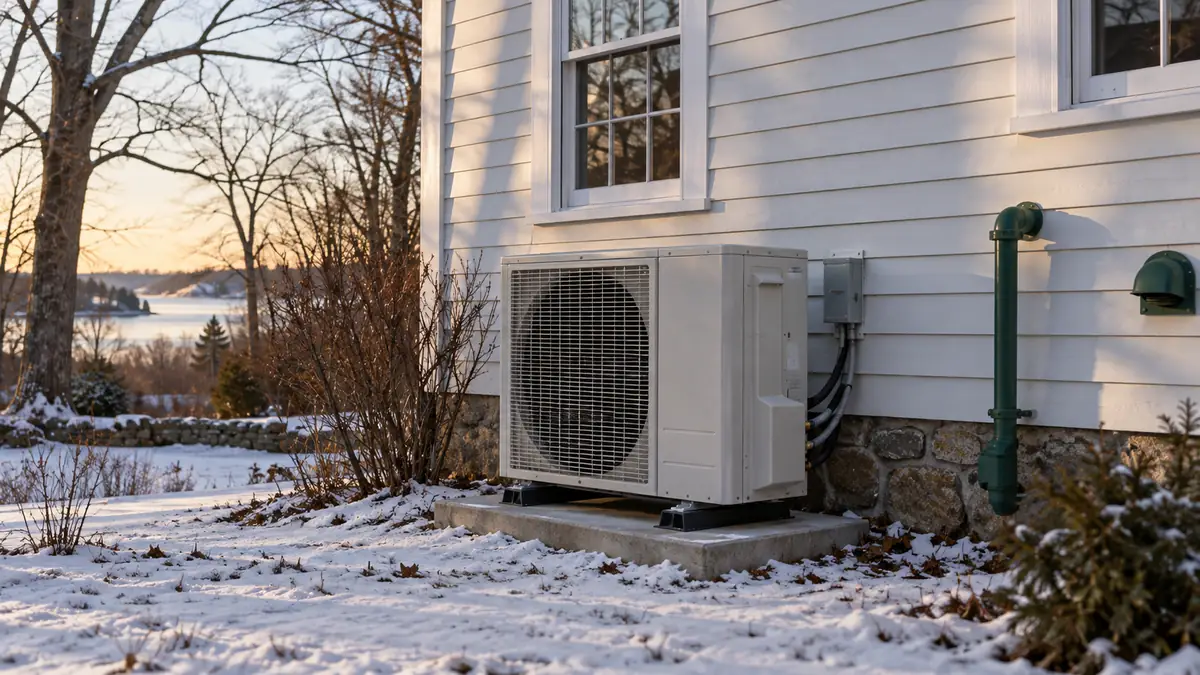
If your furnace is a ducted unit, the heat pump coil sits in the same air path as the oil furnace, as in the photo. If you heat with hot water, the outdoor unit usually feeds one or more indoor heads, and the boiler keeps serving the radiators. In both cases the oil furnace backup stays in place, which is the whole point of a heat pump with oil furnace backup.

Efficiency Maine puts the trade-off simply: users who limit the use of their heat pumps, treating them as a backup system, do not offset as much heating fuel and therefore limit their savings. It adds that the more you push your heat pump, the less your boiler or furnace will need to run (Efficiency Maine). In a good heat pump oil furnace setup, the oil system is the backup and the heat pump leads.
What a heat pump oil furnace setup costs
For a heat pump with oil furnace backup, Fixr puts a hybrid installation at $7,500 to $12,000, averaging $9,500. Converting an existing system costs $2,500 to $8,000, because the oil furnace stays and you add the heat pump and the dual-fuel thermostat (Fixr, January 2025). For the full furnace-replacement picture, see our guide to the cost to replace a furnace with a heat pump.
| Item | Typical amount | Source |
|---|---|---|
| New hybrid heat pump system | $7,500 to $12,000 (average $9,500) | Fixr, Jan 2025 |
| Add a heat pump to an existing system | $2,500 to $8,000 | Fixr, Jan 2025 |
| Replace an oil furnace like for like | $6,700 to $10,000 | Fixr, Jan 2026 |
| Mass Save integrated control add-on rebate | Up to $1,500 | Cape Light Compact, 2026 |
| NYS Clean Heat, Con Edison, furnace kept | $2,500 ($4,500 in disadvantaged communities) | NYS Clean Heat, Dec 2025 |
| Efficiency Maine whole-home ducted rebate | Not eligible with dual fuel | Efficiency Maine, Jun 2026 |
Rebates are where the oil furnace backup choice changes your price. Mass Save says an integrated control from its qualified product list must be installed in homes that already heat with oil, propane or natural gas, and it pays an add-on rebate of up to $1,500 for integrated controls added to an existing heat pump (Cape Light Compact, 2026). In Maine, the whole-home ducted rebate is not available with dual fuel (Efficiency Maine).
Federal help has shrunk. The 25C credit ended for equipment placed in service after December 31, 2025, and since May 29, 2026 the HEEHR rebate no longer pays to replace an oil system with a heat pump (Department of Energy Program Notice 26-2). See our heat pump tax credit guide for what is left, and heat pump installation cost for the base price.
The break-even rule: when a heat pump beats oil
Most advice about a switchover temperature starts from a guess. Focus on Energy defines the economic balance point as the outdoor air temperature at which running the heat pump backup system would cost the same (Focus on Energy, undated). It gives about 40 to 50°F for natural gas and closer to 15 to 20°F for propane, but no figure for oil. So for an oil furnace backup we use a cleaner test: compare the cost of one unit of heat from each source.
EIA says a gallon of heating oil holds 138,500 Btu and a kilowatt-hour is 3,412 Btu (EIA unit conversions). At 85% furnace efficiency, which is our assumption, a gallon of oil delivers about 34.5 kWh of heat. That gives one rule:
- Oil heat costs oil price per gallon divided by 34.5. At $4.93 a gallon that is about 14.3¢ per kWh of heat.
- Heat pump heat costs electricity price divided by COP, the heat delivered per unit of electricity.
- Break-even COP equals the electricity price times 34.5, divided by the oil price. Above that COP, the heat pump is cheaper.
EIA’s September 2026 outlook has residential electricity at 18.2¢ per kWh and heating oil at $4.93 a gallon (EIA Short-Term Energy Outlook, September 2026). That gives a break-even COP of 1.27. Here is the same math across a range of prices.
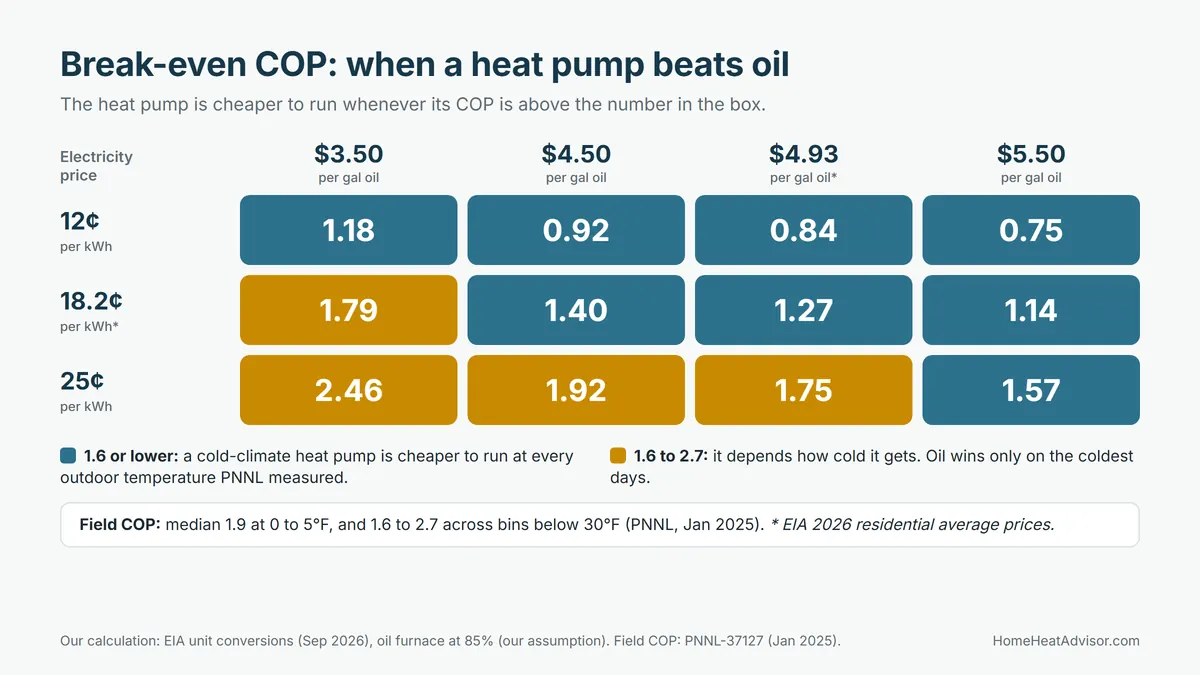
Now compare that with how a heat pump performs in real homes. In the DOE Cold Climate Heat Pump Challenge field tests, the median heating COP was 1.9 in the 0 to 5°F bin, and medians across the bins below 30°F ran from 1.6 to 2.7 (PNNL, January 2025). At 18.2¢ and $4.93, a break-even of 1.27 sits below every one of those numbers.
Read the result carefully
This is a calculation from published averages and field results for cold-climate models, not a promise for your house. Your own electricity rate, oil price and equipment decide the real break-even. Older or non-cold-climate heat pumps can perform worse in deep cold.
Where to set the oil furnace backup
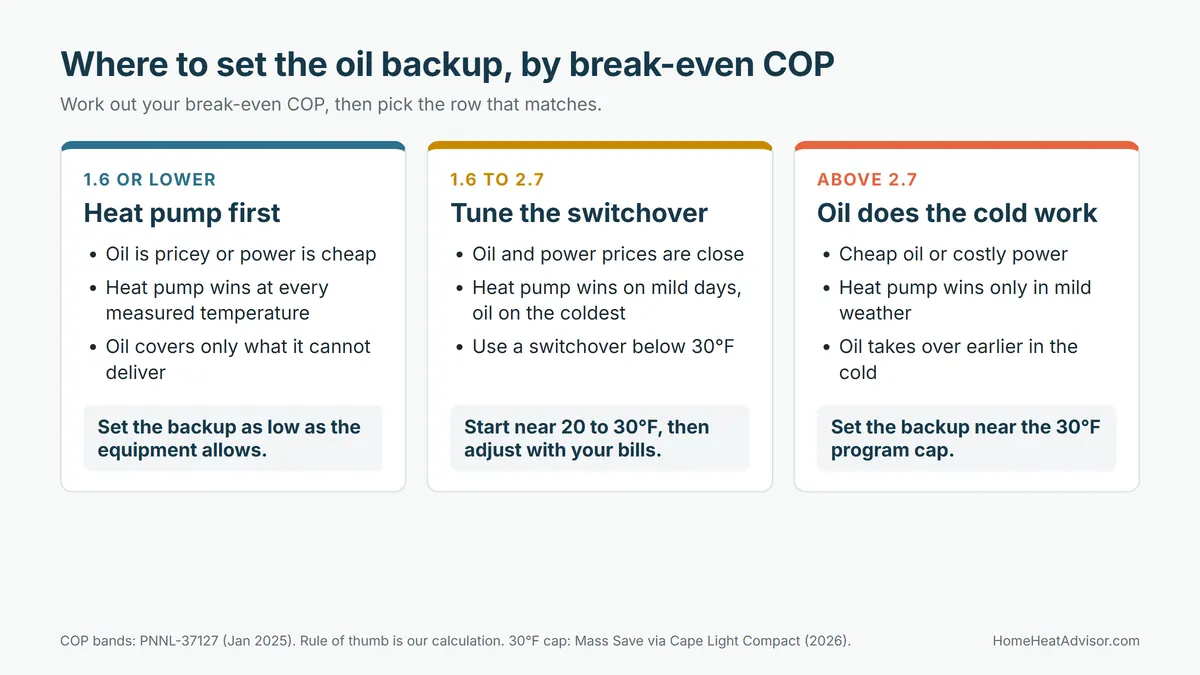
Work out your break-even COP with the rule above, then match your oil furnace backup to a row in the guide below. The bands come from the PNNL field range, so they describe how a cold-climate heat pump behaves, not any one brand.
There is one hard limit if you want a rebate. Mass Save says oil and natural gas backups must switch over no higher than 30°F, and propane no higher than 5°F, though customers may choose a lower setting (Cape Light Compact, 2026). Outside that program, the number is yours to choose.
- Break-even COP of 1.6 or lower: the heat pump wins at every temperature PNNL measured. Set the oil furnace backup as low as the equipment allows, and let it cover only what the heat pump cannot deliver.
- Between 1.6 and 2.7: it depends on how cold it gets. Start the backup near 20 to 30°F, which is our rule of thumb, then adjust by watching your bills over a few cold weeks.
- Above 2.7: oil is cheap or power is costly. The heat pump wins in mild weather, so let the oil furnace backup take over earlier, and keep the setting near the 30°F program cap.
Two more habits keep the setup honest. First, do not set the switchover high just because it feels safer, since every degree you raise it moves hours from cheap electricity to oil. Second, check that the heat pump actually carries its share by comparing winter electric and oil use, as in our guide to a high heat pump electric bill in winter. For the thermostat side, see the best heat pump temperature for winter.
Is a heat pump with oil furnace backup worth it?
A heat pump with oil furnace backup is worth it for most oil-heated homes, if you let the heat pump do the work. The calculation above says electricity is the cheaper fuel at current averages, so the oil furnace backup is mainly insurance: capacity on the coldest nights, a second system if one fails and a way to keep heat while you learn how the new equipment behaves.
Real homes back this up. A Maine case study of ten homes with backups that included oil, wood, electric, propane and kerosene found that seven did not need to use their backup heating from February to June 2021 (Maine Monitor, December 2022). That is a small sample from one state, so treat it as a sign, not a rule.
Capacity matters too. The NEEP cold-climate specification asks for a COP of at least 1.75 at 5°F and capacity at 5°F of at least 70% of capacity at 47°F (NEEP), so a unit that meets it keeps working in the cold. Read more on heat pumps in cold climates. A smaller or older unit may need the oil furnace sooner.
There is a bigger version of the choice. In our heat pump vs furnace model, switching from oil to a heat pump saved $9,100 in warm, $14,400 in mixed and $16,700 in cold climates over 15 years. Those are our figures at 2026 average prices (EIA, September 2026). Keeping an oil furnace backup for a few cold days costs far less than running it all winter.
Keep the oil furnace backup if
- it is less than ten years old and passes its yearly service
- your winters regularly go well below 0°F
- your heat pump is a smaller or older model, not a cold-climate unit
- a rebate you want requires a fossil-fuel backup, as in Mass Save integrated controls
Think about removing the oil furnace backup if
- it needs a costly repair or replacement soon, since a like-for-like swap runs $6,700 to $10,000 (Fixr, January 2026)
- you can size a cold-climate heat pump for your whole load
- your program pays more for a full switch, for example Efficiency Maine’s whole-home ducted rebate
Keeping the oil side safe and ready
The oil furnace backup does not stop needing care because it runs less. ENERGY STAR recommends a combustion and venting check for a fuel-burning furnace before the heating season (ENERGY STAR maintenance checklist). A backup that runs only on the coldest days still has to start the first time you need it.
- Book the yearly service with a licensed HVAC technician before the heating season, even if the furnace barely runs.
- Keep working carbon monoxide alarms near sleeping areas. That is standard advice for any fuel-burning equipment.
- Test the switchover once in the fall by setting the thermostat above the heat pump setpoint and confirming the oil furnace starts.
- Keep the outdoor unit clear of snow and debris, and read our guide to heat pump steam in winter so a normal defrost does not worry you.
For refrigerant, wiring or the oil burner, use a licensed HVAC technician. Do not rewire the dual-fuel thermostat yourself.
Frequently asked questions
Can I add a heat pump to my existing oil furnace?
Yes. For a heat pump oil furnace setup, Fixr puts the cost of converting an existing system at $2,500 to $8,000, and it needs a dual-fuel thermostat wired to both the heat pump and the furnace. The oil furnace stays as backup. Ask the installer how the two systems will be controlled before you sign.
At what temperature should an oil furnace backup turn on?
Mass Save rebates require an oil backup to switch over no higher than 30°F. Below that, use your break-even COP. If it is 1.6 or lower, set the backup as low as the equipment allows. Between 1.6 and 2.7, start near 20 to 30°F and adjust.
Is a heat pump with oil backup cheaper than oil alone?
At September 2026 EIA averages, 18.2¢ per kWh and $4.93 per gallon, the break-even COP is 1.27 in our calculation. PNNL field medians ran 1.6 to 2.7 below 30°F, so a cold-climate heat pump should cost less to run. Your prices and equipment change the result.
Do I need an oil furnace backup if I have a cold-climate heat pump?
Not always. In a Maine case study, seven of ten homes did not use their backup from February to June 2021. Keep the furnace if it is young, your winters are severe or a rebate requires it. Consider removing it if it needs a costly repair soon.
Can a heat pump work with an oil boiler and radiators?
Yes. A ductless or ducted heat pump can run alongside the boiler, and Efficiency Maine says the more you push the heat pump, the less your boiler needs to run. Ask your installer how the boiler will be controlled, because radiator systems do not share ducts with the heat pump.
Which rebates apply if I keep my oil furnace?
It depends on where you live. Mass Save pays up to $1,500 for an integrated control added to an existing heat pump. NYS Clean Heat Con Edison pays $2,500 if the furnace is kept. Efficiency Maine’s whole-home ducted rebate is not available with dual fuel. Amounts change, so confirm before you sign.
Sources
- Cape Light Compact: Heat pump program, Mass Save (2026)
- Focus on Energy: Electric Heat Pump Customer Buying and Operation Guide, page 18
- Efficiency Maine: Heat pumps
- Maine Monitor: In Maine, heat pumps are proving themselves even against extreme cold (December 2022)
- PNNL: Cold Climate Heat Pump Challenge field validation, PNNL-37127 (January 2025)
- NEEP: Cold-climate air-source heat pump specification and product list
- Fixr: Hybrid heat pump cost (January 2025)
- Fixr: Furnace cost (January 2026)
- PickHVAC: Dual fuel heat pump (June 2025)
- EIA: British thermal units and unit conversions
- EIA: Short-Term Energy Outlook (September 2026)
- NYS Clean Heat: Program Manual (December 2025)
- Efficiency Maine: Whole-home heat pump rebates (June 2026)
- U.S. Department of Energy: Program Notice 26-2 (2026)
- ENERGY STAR: Heating and cooling maintenance checklist
About this guide
Published by HomeHeatAdvisor. This guide is based on state energy office, utility program, national laboratory and cost-survey sources, checked in October 2026; each figure names its source and date, and calculations are labeled as ours. Rebate amounts and rules change often, so confirm them with your program before you sign. For refrigerant, wiring or the oil burner, use a licensed HVAC technician. Our editorial policy explains how we research, fact-check and update our guides. Spotted an error? Let us know. More heat pump guides.