

How to defrost a frozen heat pump comes down to three safe moves: stop the unit from running, clear the snow around it and wait. Lennox says a unit with the air above freezing should thaw naturally in 2 to 4 hours, and warns never to pour hot water on it or chip the ice (Lennox, undated page).
This guide is the action page. It shows how to tell a frozen heat pump from a normal defrost cycle, the steps to defrost a frozen heat pump safely, which thermostat setting to use and the methods to avoid. For the reasons a unit freezes in the first place, read why a heat pump freezes up. More fixes are in our heat pump troubleshooting section.

To defrost a frozen heat pump, set the thermostat to Emergency heat or Off, clear about 2 feet of snow and debris around the outdoor unit, check the indoor air filter and let the ice melt on its own. Lennox says a unit with the air above freezing should thaw in 2 to 4 hours. Never pour hot water on it or chip the ice. If ice remains after 6 to 8 hours, call a licensed HVAC technician.
Normal defrost cycle
5–15 min
Typical defrost time; Trane puts it at 3 to 5 minutes (CEE, January 2024; Trane, February 2026)
Natural thaw above freezing
2–4 hours
Longer in colder weather (Lennox, undated page, checked October 2026)
Call a technician after
6–8 hours
If the ice has not melted, or it refreezes quickly (Lennox, undated page, checked October 2026)
In this guide
- Is your heat pump frozen or just defrosting?
- How to defrost a frozen heat pump: 7 steps
- Emergency heat, Heat or Off: which setting to use
- What never to do to a frozen heat pump
- After the ice melts: restart and check
- Defrosting a frozen ductless heat pump
- When to call a technician
- How to keep a heat pump from freezing again
- What a service call costs
- Frequently asked questions
Is your heat pump frozen or just defrosting?
A heat pump that is defrosting stops its outdoor fan for a few minutes while steam rises, then restarts. Trane says a normal defrost cycle usually lasts 3 to 5 minutes (Trane, February 2026), and the Consortium for Energy Efficiency (CEE) says defrost typically takes 5 to 15 minutes (CEE, January 2024). In this guide, a frozen heat pump means solid ice on the coil, top grille, fan guard or base that is still there long after a defrost cycle should have cleared it.

Trane lists three warning signs that a frozen heat pump is developing: the unit constantly switching into defrost, cycles that last longer and longer, and frost and ice starting to cover the unit (Trane, February 2026).
Our rule of thumb, not a published figure: if the ice is the same or bigger when you look again two hours later, treat it as a frozen heat pump and follow the steps below. If it has cleared, it was defrosting. Our heat pump frozen guide covers the common causes and what each repair costs. This page covers what to do right now.
How to defrost a frozen heat pump: 7 steps
To defrost a frozen heat pump safely, stop the heat pump from running, clear the area around it and let the ice melt without adding heat or force. Lennox gives a short list of immediate steps (Lennox, undated page). The list below adds the drainage advice from the CEE owner guide and a safety precaution of ours, which is marked.
- Check that it is ice, not a defrost cycle. If the fan has stopped and steam is rising, wait 15 minutes first. Defrost typically takes 5 to 15 minutes (CEE, January 2024).
- Set the thermostat to Emergency heat, or to Off if you can heat the house another way. Lennox lists turning the heat pump off at the thermostat as its first immediate step. The next section explains the difference between the two settings.
- Switch off the outdoor disconnect before you go near the fan guard. This is our precaution, not a Lennox step. If you cannot find or identify the disconnect, leave the unit alone and call a licensed HVAC technician or electrician.
- Clear at least 2 feet on all sides. Lennox says to clear at least two feet around the unit. Brush snow off the top and sides with a soft broom and move leaves, branches and drifts away. Do not scrape or poke the coil.
- Check the indoor air filter. Lennox includes it in its immediate steps. Replace the filter if it is dirty.
- Let the frozen heat pump thaw on its own. Lennox says a unit should thaw naturally in 2 to 4 hours when temperatures are above freezing, and longer in colder weather. Do not chip, pour water or use tools in the meantime.
- Keep the meltwater draining. Defrost water drips at the outdoor unit, and the CEE guide says to make sure it does not pool and refreeze on a walkway (CEE, January 2024).
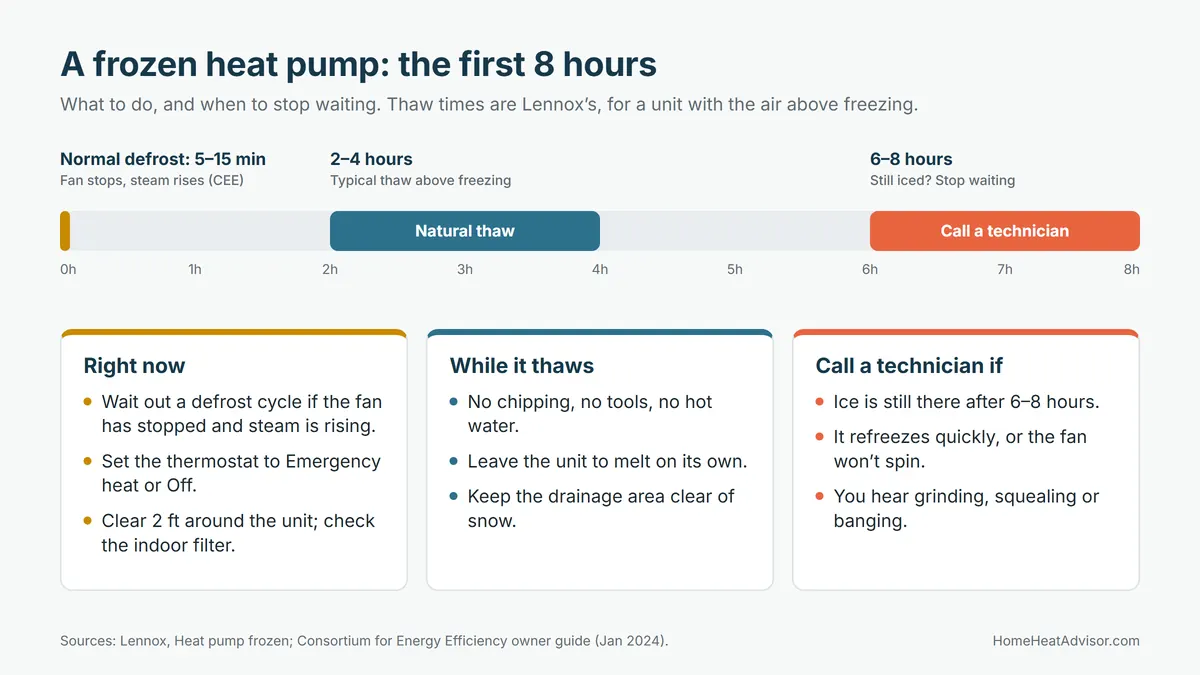

Short version
Stop the unit, clear two feet around it, check the filter and wait. A frozen heat pump above freezing temperatures should thaw in 2 to 4 hours (Lennox). Do not add heat or force.
Emergency heat, Heat or Off: which setting to use
Use Emergency heat if you need the house warm while the unit thaws, and Off if you do not. Lennox defines emergency heat as using your supplemental, second-stage heat by itself, without the use of your heat pump (Lennox FAQ, undated). Trane describes it as backup heat, usually electric, provided by the indoor unit (Trane Home support, undated). Either way, the outdoor unit stops running, and the house can still stay warm.
Lennox is not fully consistent on this. Its immediate steps say to turn the heat pump off at the thermostat, while another part of the same page says the emergency heat setting lets the outdoor unit thaw while keeping the home warm. Both stop the frozen heat pump from running, which is the point.
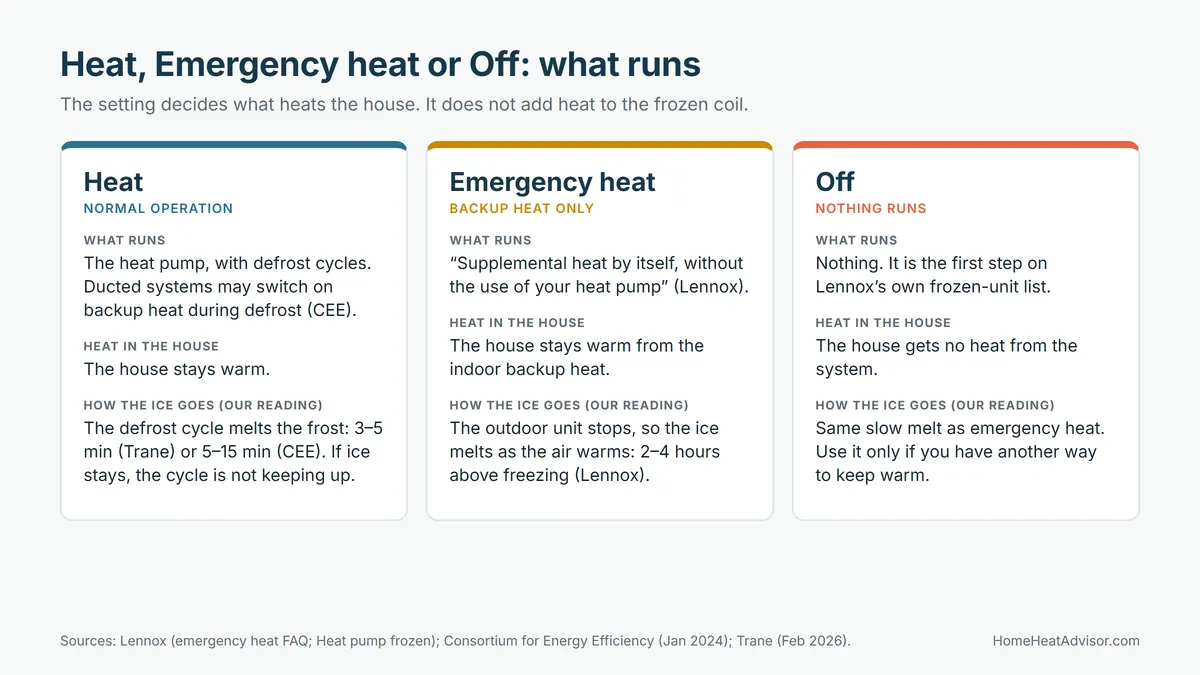
One honest limit: no source we found says emergency heat melts the ice on a frozen heat pump. It only runs the backup heat instead of the heat pump. Our reading is that the ice then melts as the air warms, which fits Lennox’s 2 to 4 hours above freezing and its warning that thawing takes longer in colder weather. In a hard freeze, expect a slow thaw.
If your thermostat has no Emergency heat setting, use Off. Our emergency heat vs auxiliary heat guide explains the difference between the two backup modes and when each applies.
What never to do to a frozen heat pump
Never pour hot water on a frozen heat pump, chip the ice or open the panels. Lennox says the sudden temperature change from hot water can crack components and cause serious damage, and that tools can damage the delicate coils, fins and fan blades. The table lists every method people try and what the sources say.

| Method | Verdict | What the sources say |
|---|---|---|
| Pouring hot water | Never | Lennox says the sudden temperature change can crack components and cause serious damage. |
| Pouring lukewarm or tap water | Skip it | Lennox warns about hot water. No manufacturer page we found recommends any water method, and runoff can refreeze on a walkway (CEE). |
| Chipping or breaking the ice | Never | Lennox says tools can damage the delicate coils, fins and fan blades. |
| Hair dryer, heat gun or torch | Skip it | No manufacturer page we found recommends it, though some contractor blogs do. Lennox’s advice is to let the unit thaw naturally. |
| Salt or de-icer | Skip it | No manufacturer page we found recommends it. Let the unit thaw naturally (Lennox). |
| Covering the unit with a tarp | Never | The CEE owner guide says to avoid covering the heat pump in winter, to keep the airflow. |
| Forcing or prying a fan that will not spin | Never | A fan that does not spin even after the ice melts needs a technician (Lennox). |
| Opening panels or touching refrigerant lines | Never | Only certified technicians may handle refrigerant (U.S. EPA, Section 608). Wiring is for a licensed electrician. |
| Cycling the breaker to “reset” it | Not a thaw step | No manufacturer thaw step we found includes it, though some contractor blogs suggest it. |
We write “no manufacturer page we found recommends it” rather than “it is dangerous” on purpose. Contractor blogs disagree with each other on lukewarm water, hair dryers and power cycling. The manufacturer pages we read do not endorse any of them for a frozen heat pump. That is an absence of support, not proof of harm, except for hot water and tools, where Lennox is explicit.
After the ice melts: restart and check
Once the frozen heat pump is clear of ice, switch the outdoor disconnect back on if you turned it off, set the thermostat back to Heat and watch the first run. Four checks tell you whether the unit is healthy:
- The outdoor fan spins. Lennox says to call a technician if the fan is not spinning even after the ice melts.
- The next defrost is short. The fan stops and steam rises for about 3 to 5 minutes (Trane) or up to 5 to 15 minutes (CEE, January 2024). Steam is normal: see why a heat pump steams in winter.
- The ice does not return quickly. Lennox says a unit that refreezes quickly after thawing, or whose defrost cycle never starts after several hours of running, needs a technician.
- No new noises. Lennox lists grinding, squealing or banging as reasons to call right away. Our heat pump noises guide explains what each sound can mean.
Defrosting a frozen ductless heat pump
A ductless (mini-split) frozen heat pump follows the same logic as a ducted frozen heat pump. For ductless systems, the CEE guide says the indoor head may put off some cooling while it defrosts the outdoor coils (CEE, January 2024), so a brief cool breeze indoors during defrost can be normal.
Lennox’s thaw steps are written for central systems, and we found no manufacturer page with ductless-specific thaw steps. Our advice is to use the same safe rules: no chipping, no hot water, clear around the outdoor unit, and call a licensed HVAC technician if ice stays. See our mini-split guides for more.
When to call a technician
Call a licensed HVAC technician if the ice has not melted after 6 to 8 hours of thawing, or if any of these Lennox triggers apply (Lennox, undated page):
- The ice is still there after 6 to 8 hours of thawing.
- The unit refreezes quickly after it thaws.
- The defrost cycle never starts after the unit has run for several hours.
- The outdoor fan is not spinning, even after the ice melts.
- You hear grinding, squealing or banging.
The CEE guide gives the same advice in one line: if your heat pump is stuck in defrost or covered in ice, consult an HVAC professional (CEE, January 2024). Anything involving refrigerant needs a technician with EPA Section 608 certification (U.S. EPA), and wiring problems need a licensed electrician. If you see smoke or smell burning near the unit, switch off the power and call 911.
How to keep a heat pump from freezing again
Keep air and meltwater moving. The CEE owner guide gives these habits (CEE, January 2024):
- Do not cover the heat pump in winter, so air can flow.
- Make sure defrost water drains and does not pool and refreeze on a walkway.
- Clear obstructions around the unit through the year.
- In cold climates, ask a qualified contractor about a snow stand. If the unit sits under an eave or drip line, ask about moving it or adding a deflector.
- Check the indoor air filter, which Lennox includes in its frozen-unit checks.
If a frozen heat pump keeps coming back even with clear airflow, a part may be failing. Our heat pump frozen guide lists the common causes, from a stuck sensor to low refrigerant, and what each repair costs.
What a service call costs
A service visit for a frozen heat pump usually starts with a flat call-out fee, and Fixr puts it at $75 to $250, which often covers diagnosis. Time past the first hour runs about $75 to $150 an hour, and the average heat pump repair is about $400 (Fixr, January 2026). The price depends on the fault; see the repair cost table in our heat pump frozen guide.
Frequently asked questions
Can I defrost a frozen heat pump myself?
Yes, in the safe way: set the thermostat to Emergency heat or Off, clear about 2 feet around the unit, check the indoor filter and let it thaw. Lennox says a unit above freezing should thaw in 2 to 4 hours. Do not chip the ice or pour water, and call a technician if the ice stays 6 to 8 hours.
How long does a frozen heat pump take to thaw?
Lennox says a frozen heat pump should thaw naturally in 2 to 4 hours when temperatures are above freezing, and longer in colder weather. If the ice has not melted in 6 to 8 hours, or it refreezes quickly, Lennox says to call a technician.
Is it OK to pour hot water on a frozen heat pump?
No. Lennox says to never pour hot water on a heat pump, because the sudden temperature change can crack components and cause serious damage. No manufacturer page we found recommends pouring any water on the unit, so let it thaw naturally.
Should I use emergency heat when my heat pump is frozen?
Emergency heat is a reasonable choice if you need the house warm, because it runs the backup heat without the heat pump (Lennox). If you can heat the house another way, Off also works. Neither setting adds heat to the coil, so the ice melts slowly as the air warms.
Is frost on a heat pump normal?
A thin layer of frost on the coil is normal in cold, damp weather, and the defrost cycle clears it in about 3 to 15 minutes (Trane, February 2026; CEE, January 2024). Solid ice that stays on the coil, grille or base for hours is not normal and means the unit is frozen.
Can I keep running a frozen heat pump?
Lennox’s first immediate step is to turn the heat pump off at the thermostat, so no. Running a frozen unit does not clear the ice, and Lennox says to call a technician if it refreezes quickly after thawing. Switch to Emergency heat or Off while it thaws.
Sources
- Lennox: Heat pump frozen (undated, checked October 2026)
- Lennox: What is the difference between emergency heat and auxiliary heat? (undated, checked October 2026)
- Trane: What is a heat pump defrost cycle? (February 2026)
- Trane Home support: Aux Heat and Emergency Heat (undated, checked October 2026)
- Consortium for Energy Efficiency: You Installed an Air Source Heat Pump. Now What? (January 2024)
- Fixr: Heat Pump Repair Cost (January 2026)
- U.S. EPA: Section 608 Technician Certification
About this guide
Published by HomeHeatAdvisor. This guide is based on manufacturer, efficiency-program and industry sources, checked in October 2026; each figure names its source and date, and our own readings are labeled as ours. Use a licensed HVAC technician for anything beyond the owner checks above. Our editorial policy explains how we research, fact-check and update our guides. Spotted an error? Let us know. More troubleshooting guides.