

A heat pump tripping breaker is the circuit doing its job: something is pulling more current than the wiring should carry, and the breaker cuts the power before the wire overheats. The cause can be as small as a clogged filter or as serious as a short to ground, so the first question is not “what is wrong?” but “is it safe to reset?”
This guide shows how to read the trip pattern when a heat pump keeps tripping breaker after every reset, walks through the seven usual causes, and explains why heat strips are the load most likely to push a tired breaker over the edge. It also covers the one rule worth remembering: never swap in a bigger breaker. New to the equipment? Start with how a heat pump works. For other faults, see our heat pump troubleshooting guides.

If your heat pump breaker keeps tripping, turn the system off at the thermostat, then reset the breaker once. If it trips again, stop resetting and call a licensed HVAC technician. A heat pump tripping breaker again and again means something is drawing too much current, and each reset adds stress. If you smell burning or see smoke or sparks, switch the system off, leave and call 911.
Blower alone
6.2 A
Current of the indoor blower in a Navien air handler (Navien, Oct 2025)
20 kW heat strip
83.4 A
Heater current at 240 V, over 13 times the blower (Navien, Oct 2025)
10 kW kit breaker
60 A max
Largest breaker the manual allows for a 10 kW kit (Navien, Oct 2025)
In this guide
- Is it safe to reset when your heat pump breaker keeps tripping?
- Read the trip pattern of a heat pump tripping breaker
- Seven causes of a heat pump tripping breaker
- Heat strips and a heat pump tripping breaker
- Never put in a bigger breaker
- What you can check yourself, safely
- What to tell the technician
- Frequently asked questions
Is it safe to reset when your heat pump breaker keeps tripping?
Once, yes, if you do it carefully. HVAC.com’s advice is to turn the system off first, then flip the breaker off and back on, and it says that a repeat trip points to a more complex problem such as a faulty capacitor or a wiring issue (HVAC.com, February 2025). Mitsubishi Electric adds a practical reason for switching the unit off first: its manual warns against using the breaker to switch the equipment on and off while it runs, because that can cause sparks (Mitsubishi Electric, June 2024).
The same Mitsubishi manual lists a breaker that trips frequently as a reason to stop using the unit and consult your dealer. HVAC School, which writes for technicians, starts a ground-fault diagnosis by resetting the breaker “and seeing how quickly it trips” (HVAC School, February 2020). That is the reason one careful reset is useful: how fast it trips tells you where to look.
Here is our guidance, based on those sources. Reset once, with the thermostat set to off. If the breaker holds, turn the system back on and watch it. If your heat pump keeps tripping breaker after that, leave it off and call for service. Repeated resets do not fix anything, and they push a circuit that is already in trouble.
Reset it properly
A tripped breaker usually sits in the middle. Push the handle firmly all the way to OFF first, then to ON. Touch only the handle. Never remove the panel cover, and never reset a breaker that feels hot, smells scorched or is discolored.
Read the trip pattern of a heat pump tripping breaker
With a heat pump tripping breaker, when it trips matters more than how often. A short or ground fault trips the instant power reaches it. A weak start-up part trips a few seconds in. Heat and airflow problems trip after the system has been running for a while. Heat strip trouble shows up only when auxiliary or emergency heat is on.
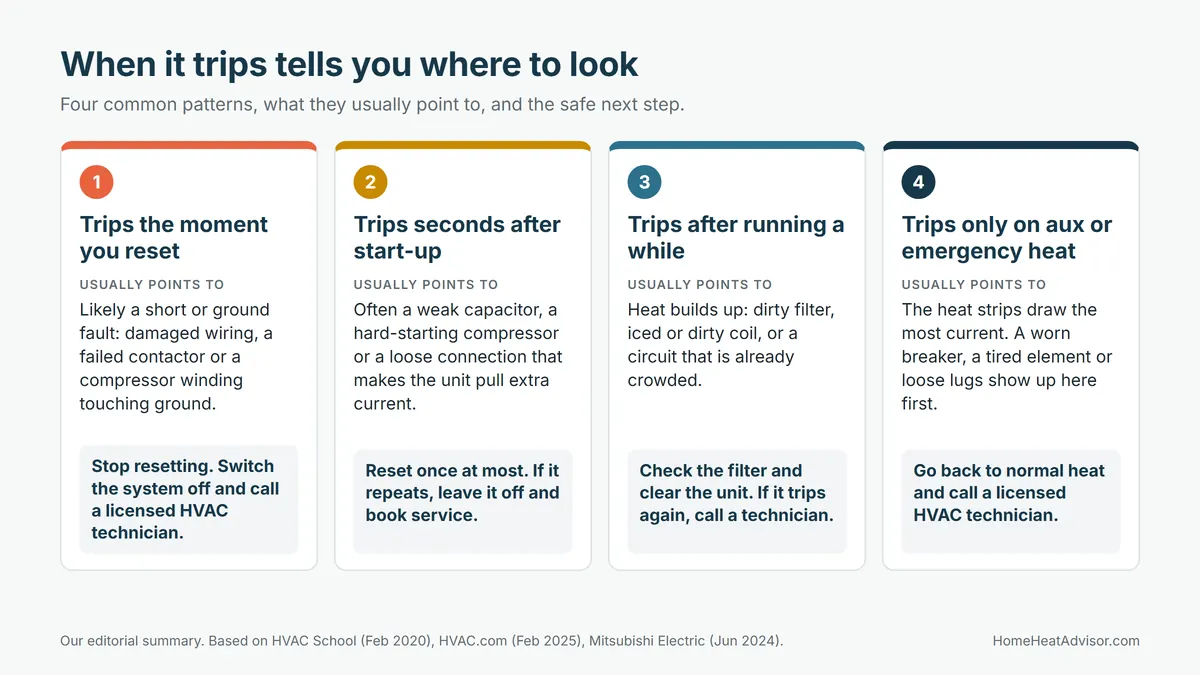
The pattern is a starting point, not a verdict. A heat pump breaker can keep tripping for different reasons. Two faults can trip it at the same moment, and an old breaker can trip early for no electrical reason. Use it to decide what to check and what to tell the technician.
Seven causes of a heat pump tripping breaker
HVAC.com lists overloaded circuits, dirty filters, wiring problems, faulty capacitors, frozen coils, worn breakers and refrigerant leaks as the usual reasons a heat pump trips the breaker (HVAC.com, February 2025). The list below follows that set, adds the ground fault that HVAC School describes, and puts the heat strips in their own entry. The first three are the ones a homeowner can often help with. The rest are for a licensed technician.
1. A dirty filter or blocked airflow
HVAC.com says a dirty or clogged filter blocks airflow and strains the system (HVAC.com, February 2025). In our plain-language explanation, a system that cannot move enough air runs hotter and works longer, so its motors pull more current and it can eventually trip. A heat pump tripping breaker from a dirty filter usually trips after the unit has been running for a while, not at start-up.
Fix: Switch the system off, replace the filter, and check that supply and return vents are open and not blocked by furniture or rugs. Then reset once.
2. An iced or dirty coil
HVAC.com says frozen evaporator coils force the heat pump to work harder than normal. Lennox says heavy ice covering the unit or blocking airflow is a problem, and it advises calling a dealer if the ice refreezes quickly after thawing (Lennox, February 2026). Light frost during a defrost cycle is normal. A coil that stays buried in ice is not, and if ice keeps returning, the heat pump breaker keeps tripping for the same reason: the unit is working too hard. Our guide to a heat pump frozen or iced up explains the difference.
HVAC.com also lists a refrigerant leak as a possible cause, though a less common one. A leak is not something to chase yourself: refrigerant work needs a licensed technician.
Fix: Clear snow and leaves from around the outdoor unit by hand. Do not chip at the ice. If it keeps coming back, call a licensed HVAC technician.
3. A weak or failed capacitor
HVAC.com says a faulty capacitor can stop the compressor or a fan motor from starting properly, so the motor draws extra power and the breaker trips. In our plain-language reading, the signs to watch for are a hum or click at start-up, or a unit that trips within seconds of starting. A heat pump tripping breaker seconds after start-up is the pattern that points to a capacitor. Our guide to heat pump noises covers the hum and buzz, and a failing capacitor can also show up as heat pump short cycling.
Fix: Do not open the unit. A capacitor can hold a charge after the power is off. This is a job for a licensed HVAC technician.
4. A short to ground in the compressor or contactor
This is the serious one. HVAC School says a breaker that trips immediately indicates a significant short, and describes how a technician checks resistance between the high-voltage contactor, each compressor terminal and ground (HVAC School, February 2020). Put simply, in this kind of heat pump tripping breaker fault, current is leaking to the metal frame instead of flowing through the motor, and the breaker cuts it off.
Fix: If your heat pump breaker keeps tripping the moment you reset it, stop. Leave the system off and call a licensed HVAC technician. Do not keep resetting.
5. Loose or damaged wiring
HVAC.com points to loose or damaged wiring in the heat pump (HVAC.com, February 2025). In our plain-language explanation, a loose connection heats up under load, and damaged insulation can touch metal. Smell and sight give it away: scorch marks, a burning smell or a warm outdoor disconnect mean you should stop at once.
Fix: Look at the outdoor disconnect and the visible conduit from a distance. If anything looks melted, burnt or chewed, switch the system off and call a licensed HVAC technician, or a licensed electrician for the house wiring.
6. An overloaded or worn breaker
HVAC.com says breakers wear out or malfunction and can trip easily, and describes an overloaded circuit as one where the unit draws more power than the circuit can handle. Mitsubishi Electric’s manual tells owners to observe the breaker capacity and to provide an exclusive circuit for the unit (Mitsubishi Electric, June 2024). If the heat pump breaker keeps tripping even with the unit off, that is a job for a licensed electrician, who can test it and the circuit.
Fix: If the same breaker trips with the heat pump off, or other loads share the circuit, ask a licensed electrician to check it.
7. Heat strips on aux or emergency heat
The electric heat strips are the biggest electrical load in the system. When they come on, current jumps, so a tired breaker, a failing element or loose lugs show up here first. If the breaker only trips on auxiliary or emergency heat, the compressor is probably not the culprit. The next section shows the numbers, and our guide to emergency heat vs auxiliary heat explains when those modes switch on.
Fix: Set the thermostat back to normal heat and call a licensed HVAC technician. Do not keep forcing emergency heat while the heat pump breaker keeps tripping.
Heat strips and a heat pump tripping breaker

A heat pump’s compressor and fans are modest loads. Heat strips are not. Navien’s installation manual for its electric heat kits lists the blower at 6.2 A, while a 5 kW strip draws 20.8 A at 240 V and a 20 kW strip draws 83.4 A (Navien, October 2025). Lennox’s heat kit manual shows the same range: a 10 kW kit draws roughly 36 to 40 A, with a maximum fuse or breaker of 50 or 60 A depending on the model (Lennox, November 2025).

Heat strips also run for long stretches in a cold snap, which is why a breaker that has coped for years can start to trip in January. That is our plain-language reading: a heat pump tripping breaker in January is often a heat strip story, and it is the reason a technician will test the breaker and the connections as well as the heater.
| Heat kit | Heater current at 240 V | Minimum circuit ampacity | Largest breaker |
|---|---|---|---|
| 5 kW | 20.8 A | 33.79 A | 35 A |
| 8 kW | 33.3 A | 49.42 A | 50 A |
| 10 kW | 41.7 A | 59.83 A | 60 A |
| 15 kW | 62.5 A | 85.67 A | 90 A |
| 20 kW | 83.4 A | 111.91 A | 120 A |
Your own numbers are on the nameplate of the air handler and the heat kit. They override any table, including this one.
Never put in a bigger breaker
When a heat pump breaker keeps tripping, someone usually suggests a bigger one. Do not. The breaker is there to protect the wire, and the wire is sized to the equipment. A larger breaker lets more current flow through wire that was never meant to carry it, and the failure moves from a trip to heat inside the wall.
Two limits apply. The first is on the equipment nameplate, which gives a minimum circuit ampacity and a maximum overcurrent protection rating. Navien’s table above shows how closely the two track each other. The second is the National Electrical Code. EC&M, citing Mike Holt, explains that NEC 440.22 sizes the branch-circuit protection for air-conditioning and heat pump equipment at 175% of the rated-load current, with up to 225% allowed if the unit will not start at the lower value, and that the nameplate maximum still applies (EC&M, January 2025). Confirm the details against the NEC edition your area has adopted, because local rules differ.
The one-line rule
If a heat pump breaker keeps tripping, find out why. The answer is never a larger breaker. A licensed electrician or HVAC technician can read the nameplate and check the circuit against the code that applies in your area.
What you can check yourself, safely

With a heat pump tripping breaker, most of the useful checks need no tools and no contact with wiring. Do these with the system off.
- Check the filter. Replace it if it is gray or clogged. Check that vents and returns are open.
- Look at the outdoor unit. Clear snow, leaves and debris by hand. Note heavy ice, which points to the defrost and ice problem.
- Look, do not touch, at the disconnect. The gray box on the wall near the outdoor unit should not look scorched, melted or wet. Do not open it or pull the handle while the unit runs.
- Note the pattern. When does the heat pump tripping breaker event happen: on reset, at start-up, after a while or only on aux or emergency heat? Write it down.
- Check for other symptoms. A unit that also struggles to heat may have a bigger issue. See our guide on a heat pump not heating and one on a heat pump running constantly.
Everything beyond that is for a licensed technician: capacitors, contactors, compressor tests, refrigerant, heat strips and any wiring. Mitsubishi Electric’s manual says the same in its own way, telling owners to stop using the unit and consult the dealer when the breaker trips frequently (Mitsubishi Electric, June 2024).
What to tell the technician
A clear description of a heat pump tripping breaker shortens the visit. Before you call, write these down.
- When it trips: instantly on reset, a few seconds after start-up, after minutes of running, or only on aux or emergency heat.
- How often: once, every day, or only in the coldest weather.
- Which breaker: the label on the handle, and whether it is a double-pole breaker with a single handle.
- What changed: new filter, recent storm, new equipment on the same circuit, or recent service.
- What you noticed: humming, clicking, ice on the unit, a burning smell, or a warm disconnect box.
- What you did: how many times you reset it, whether the heat pump keeps tripping breaker after each reset, and whether you changed any settings.
If the technician finds a problem with the breaker or the house wiring rather than the unit, they may ask a licensed electrician to take over. That is normal and worth the visit, because it fixes the cause instead of the symptom.
Frequently asked questions
Why does my heat pump keep tripping the breaker?
A heat pump tripping breaker usually comes down to one of these causes: a dirty filter, an iced coil, a weak capacitor, a short to ground, loose wiring, a worn breaker or heat strips pulling heavy current. HVAC.com lists these. The trip pattern helps: instant trips point to a short, start-up trips to a weak part, later trips to heat or airflow.
Is it safe to keep resetting the breaker?
No. If your heat pump keeps tripping breaker after reset, stop. Turn the thermostat off, reset once, and watch. If it trips again, call a licensed HVAC technician. Repeated trips mean something is drawing too much current. Mitsubishi Electric’s manual lists frequent tripping as a reason to stop using the unit and consult the dealer.
Why does my heat pump trip the breaker only in cold weather?
When a heat pump breaker keeps tripping in cold weather, our plain-language reading is that winter brings defrost, ice and long heat strip runs, and all of them add load. A tired breaker or loose connection can show up at that point. If it only trips on aux or emergency heat, the heat strips are the likeliest load. Call a licensed HVAC technician.
Why does my heat pump trip the breaker when it starts?
A heat pump tripping breaker seconds after start-up often points to a weak capacitor, a hard-starting compressor or a loose connection that makes the unit pull extra current. HVAC.com says a faulty capacitor can stop motors from starting properly. Reset once at most, then book service.
Can a dirty filter trip the breaker?
Yes, a dirty filter can leave you with a heat pump tripping breaker. HVAC.com says a dirty filter blocks airflow and strains the system, and a strained system can draw more current. This usually trips after the unit has run for a while. Replace the filter, check the vents, and reset once. If it trips again, call a technician.
Can I replace the breaker with a bigger one?
No. The breaker protects the wire, and both are sized to the unit’s nameplate. A bigger breaker removes that protection. NEC 440.22 sets sizing limits for this equipment, and the nameplate maximum still applies, per EC&M (January 2025). Ask a licensed electrician to test the breaker instead.
Sources
- Navien: NEHV/NEHS electric heat installation manual (October 2025)
- Lennox: Heat kit installation manual V1EHK (November 2025)
- Mitsubishi Electric: Wall-mounted air conditioner operating instructions (June 2024)
- HVAC.com: Why your heat pump keeps tripping the circuit breaker (February 2025)
- HVAC School: Troubleshoot a grounded or shorted-to-ground compressor (February 2020)
- EC&M: NEC requirements for AC and refrigeration equipment (January 2025)
- Lennox: Heat pump frozen (February 2026)
About this guide
Published by HomeHeatAdvisor. This guide is based on manufacturer manuals, trade publications and technician training sources, checked in October 2026; each figure names its source and date, and our own explanations are labeled as ours. The checks here are for homeowners only. For capacitors, wiring, breakers, heat strips or anything that keeps tripping a breaker, use a licensed HVAC technician or a licensed electrician, and call 911 for smoke, sparks or fire. Our editorial policy explains how we research, fact-check and update our guides. Spotted an error? Let us know. More troubleshooting guides.