
The heat pump pros and cons look different once you stop reading brochures and start listening to the people who live with one. Thousands of heat pump owners in the U.S., Canada and the UK have now been surveyed after full heating seasons. Utility programs in Massachusetts and Connecticut have metered real homes through New England winters, and the Department of Energy has monitored cold-climate units through two more. Their verdict is clear, but it comes with a few catches worth knowing before you buy.
This guide pulls that evidence together: what owners like, what bothers them when it gets cold, how reliable the equipment really is, and which complaints you can avoid with a better installation.

Most owners are happy. After a full New England winter, 95% of heat pump owners surveyed in Massachusetts and Connecticut said they would install one again, and 90% of U.S. heat pump owners in a national survey would recommend one. The big pros are lower bills for most homes, steadier comfort and built-in cooling. The cons show up in winter: air from the vents feels cooler than a furnace, defrost cycles and backup heat kick in on the coldest days, and repairs are more common than many buyers expect. Most complaints trace back to sizing, installation or thermostat setup.
Would install one again
95%
Massachusetts and Connecticut owners, surveyed after the 2023–24 winter
Break down by year 8
29%
Consumer Reports estimate, from 13,753 heat pumps owned by members
Winter heat from the heat pump
86–92%
Share of the heating load met in metered homes that replaced their old system
In this guide
Heat pump pros and cons at a glance
Here is the short version of the heat pump pros and cons, based on what heat pump owners report rather than what manufacturers promise.
What owners like
- Lower running costs in most homes, especially those leaving oil, propane or electric baseboards
- Even, steady warmth without the hot-then-cold swings of a furnace
- Heating and cooling from one system
- No combustion, so no flame or carbon monoxide risk from the heating system
- No fuel deliveries or tank to manage
What owners find hard
- Cooler air at the vents than a furnace, which some people notice
- Defrost cycles and backup heat on the coldest days
- Higher electricity bills, even when total energy costs fall
- More repairs than many buyers expect
- Controls take learning, and a poor install makes every con worse
If you are new to how the technology works, start with our guide to what a heat pump is and how it works, then come back here for the owner view.
What the owner surveys say
Five surveys asked heat pump owners about their experience after living with the system. Three are from the U.S., and together they cover different countries and methods, but they point in the same direction. Together they are the best test of the heat pump pros and cons against real life.
| Survey | Who was asked | Headline finding |
|---|---|---|
| Massachusetts and Connecticut utility study (Feb. 2024) | 134 owners in metered homes, after the 2023–24 winter | 95% would install a heat pump again; 93% of those who replaced their old system were satisfied with heating in normal winter weather |
| Mitsubishi Electric Trane (Nov. 2024) | 1,000+ U.S. homeowners, 300+ with heat pumps | 90% of heat pump owners would recommend one |
| Consumer Reports (2009–2025 data) | U.S. members who own 13,753 heat pumps | An estimated 29% break down by the end of year 8 |
| Clean Energy Canada (2025–26) | About 3,800 Canadian heat pump owners | 91% would recommend one; 64% reported only positive experiences, 22% mixed, 5% only negative |
| Nesta (Dec. 2022) | 2,395 UK heat pump owners and 1,025 gas boiler owners | 73% were as satisfied or more satisfied than with their previous heating |
What U.S. owners said after a full winter
The most detailed U.S. evidence comes from a study for the utility efficiency programs in Massachusetts and Connecticut, published in 2024. Researchers metered heat pumps in real homes through the winter, then surveyed the owners in February 2024. Asked to name the single biggest advantage and disadvantage, owners put lower energy costs first and higher electricity bills first. Their answers amount to a real-world list of heat pump pros and cons.

Each downside was named by a small minority of heat pump owners: higher electricity bills (15%), cold-weather performance (13%), hard-to-use controls (7%) and installation or repair costs (6%). Only 1% named defrost cycles. The telling detail is what owners would change: 95% would install a heat pump again, but 20% would pick a different model, mostly one that performs better in cold weather or has more capacity.
The same study caught a real stress test. During the February 2023 cold snap, when Massachusetts saw temperatures as low as −13°F, 10 of the 13 heat pump owners interviewed were satisfied and did not use any backup heat. Across the 2023–24 winter, 93% of owners who had replaced their old system were satisfied with their heating in normal weather, and 86% during cold periods.
How the U.S. results compare abroad
The Nesta survey is useful because it compared heat pump owners with gas boiler owners on the same questions. Heat pump owners were as happy or happier on safety, reliability, noise and running costs. The survey was run in Great Britain, but the pattern matches what U.S. owners report. The one clear gap was controls: fewer heat pump owners found their system easy to use.
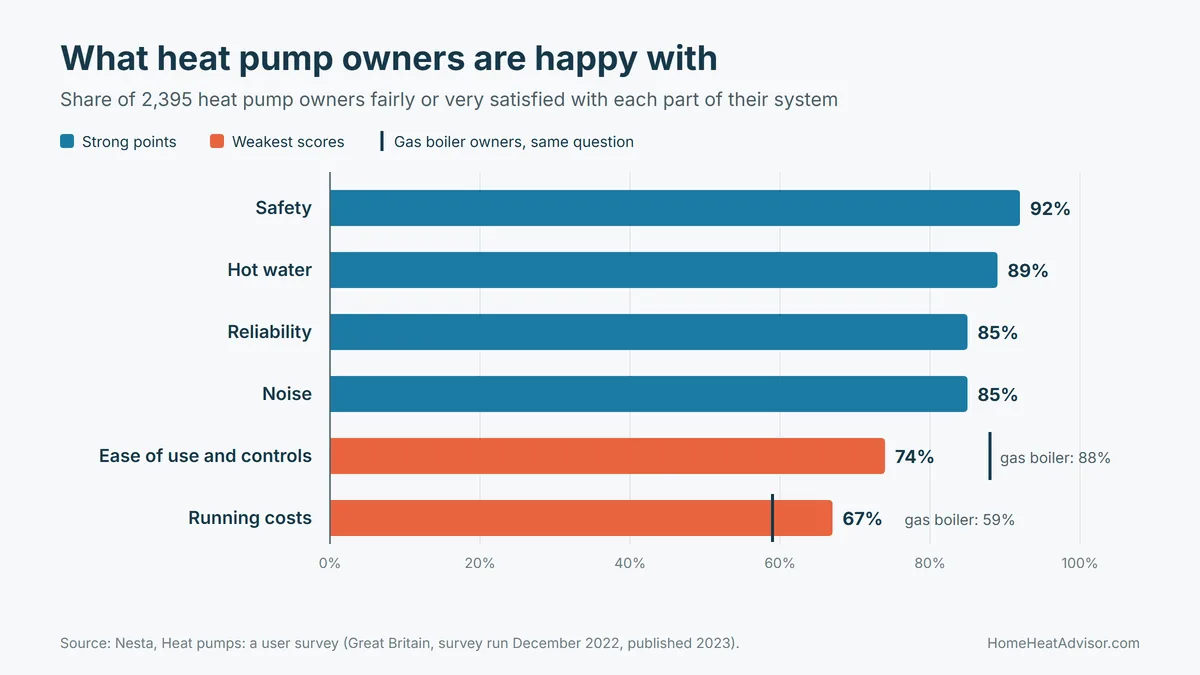
The same survey found a split between people who chose a heat pump and people who inherited one when they bought a house: 81% of those who installed their own were at least as satisfied as before, against 52% of those who moved into a home that already had one. Many in that second group had never been shown how to use it, which is a theme that comes up again below.
The pros owners mention most
Across the surveys, heat pump owners mention three benefits again and again: bill savings, comfort and cooling. Safety and freedom from fuel deliveries follow close behind.
1. Lower energy bills for most homes
In the Clean Energy Canada survey, bill savings topped the list of benefits. In the U.S., efficiency (55%) and cost savings (39%) were two of the top three reasons owners gave in the Mitsubishi Electric Trane survey. A Department of Energy study found that more than 90% of U.S. households would save money by replacing worn-out equipment with the right heat pump.
A national study by the National Renewable Energy Laboratory, published in the journal Joule in 2024, looked closer. Among the 49 million U.S. homes that heat with electricity, fuel oil or propane and also have air conditioning, 92% to 100% would see lower energy bills with a heat pump, with median savings of $300 to $650 a year depending on the efficiency of the unit. In the Massachusetts and Connecticut study, lower energy costs were the advantage owners named most often (32%).
The savings are largest for homes leaving expensive fuels. Consumer Reports interviewed Jerome Edgington in Leicester, Massachusetts, who estimated he saved about $150 a month in the coldest months compared with his oil boiler. Homes switching from cheap natural gas save less, and some save nothing. Our guide to heat pump running costs compares the cost per unit of heat by fuel. If you are replacing a gas furnace, the cost to replace a furnace with a heat pump shows what the switch costs up front.
2. Steadier comfort, even in deep cold
Variable-speed heat pumps run long, gentle cycles instead of blasting hot air and shutting off. Owners describe fewer temperature swings from room to room and hour to hour. The cold-weather worry also fades for most people once they have lived through a winter.
“The performance has been great.”
Derek Traxler, Minneapolis, whose heat pump kept his home warm for five winters in temperatures as low as −29°F, speaking to Consumer Reports
Consumer Reports also spoke to Dave Adams in Fort Wayne, Indiana, whose ducted heat pump kept the house warm at −9°F. In Canada, 92% of surveyed heat pump owners in Southern Ontario were happy with their heat pump during a freeze that reached −20°C (−4°F). And in the DOE field test, owner satisfaction with heating rose from 3.61 to 3.88 out of 5 after the new cold-climate units went in.
3. Air conditioning in the same box
A heat pump is also a high-efficiency air conditioner, and owners notice. Cooling was one of the top three benefits in the Canadian survey, and DOE field test participants rated cooling higher after the switch as well. For homes that never had central air, this is often the benefit that surprises people most.
4. Safer, cleaner indoor air
There is no flame, no flue and no carbon monoxide risk from the heating system. Safety was the highest-rated feature in the Nesta survey, with 92% of heat pump owners satisfied. For households that had gas or oil equipment in the basement, that removes one more thing to worry about.
5. No fuel deliveries
For homes on oil or propane, a heat pump ends tank refills, price spikes and delivery schedules. The DOE estimates a typical Michigan home heated with propane could save about $1,500 a year by switching to a heat pump.
Owner tip
Keep the outdoor unit clear of snow and leaves, and out from under roof drip lines. A stand or wall bracket above the typical snow line lets it defrost and drain properly.
The cons that show up in winter
None of the winter heat pump problems below mean the system is failing. But they are the things heat pump owners say they wish someone had explained on day one.
1. The air from the vents feels cooler
A gas furnace blows air at roughly 125°F. A heat pump usually delivers 85–110°F, which is still well above room temperature but cooler than furnace air, so it can feel cool near the vent. The house is warm; the airflow just does not feel hot.

Without a blast of hot air from the vents, people in drafty homes may “notice the chill everywhere else.”
Iain Walker, building scientist, speaking to Consumer Reports
The fix is usually the house, not the heat pump: air sealing, better insulation and sensible register placement make the gentler airflow feel comfortable.
2. Defrost cycles
In cold, humid weather, frost builds up on the outdoor coil. The heat pump clears it by running in reverse for a few minutes. You may see a cloud of steam rise from the unit, hear a whoosh, and feel cooler air indoors for a short time. It is normal, and Consumer Reports notes that heat pumps remain considerably more efficient than electric resistance or fuel-fired heat even when defrost is counted.

3. Backup heat on the coldest days
As the temperature drops, a heat pump produces less heat and works harder for it. In the DOE cold-climate field test, 22 homes across the U.S. and Canada saw a median efficiency (COP) of 1.9 between 0°F and 5°F, still almost twice as efficient as baseboard heat. But the auxiliary heat strips ran about 25% of the time between −10°F and 0°F.
The researchers also found that when backup heat switched on varied widely from home to home, largely because of thermostat programming and how occupants used the system. That is a setting you can control. Real U.S. homes show how small the backup share can be: in metered Massachusetts and Connecticut homes that replaced their old system, the heat pump met about 86% of the season’s heating load with a central unit and 92% with mini-splits. The old system covered 8–9%, and electric resistance heat about 4% at most. Read more in our section on heat pump performance in cold weather.
4. A bigger electricity bill
Even when total energy costs fall, the electricity bill goes up, because it now carries your heating. That shift can be a shock in the first cold month. Dave Adams told Consumer Reports his heating costs rose by about $270 year over year, with much of that from one unusually cold month. Whether you come out ahead depends on local electricity and fuel prices, which is why a heat pump cost estimate should start with your own bills.
U.S. surveys show how common the surprise is. In Massachusetts and Connecticut, about 30% of owners who fully replaced their old system, and 50% of those who kept it as backup, said heating costs were higher than they expected. Electricity prices played a part: average Massachusetts residential rates jumped from $0.27 per kWh in winter 2021–22 to $0.43 in winter 2022–23. Equipment efficiency matters too. NREL found that minimum-efficiency heat pumps could raise bills in 39% of U.S. households, but high-efficiency models would do so in only 5%.
5. Controls with a learning curve
Ease of use was the weakest score for heat pump owners in the Nesta survey: 74% were satisfied, against 88% of gas boiler owners. Of heat pump owners who inherited their system with a house, 44% said they received no advice on how to use it. Deep night setbacks, the wrong thermostat, or constantly changing the setpoint can trigger backup heat and push costs up. U.S. heat pump owners report the same gap: in Massachusetts and Connecticut, most homeowners who kept their old system as backup said they did not know the temperature at which their controls switch over to it.
6. Noise
Most heat pump owners are not bothered: 85% in the Nesta survey were satisfied with noise, the same level as gas boiler owners. Complaints tend to come from outdoor units placed under bedroom windows or close to a neighbor, and from the fan and defrost whoosh on cold nights.
Owner tip
Set a comfortable temperature and leave it. Heat pumps are most efficient holding a steady setpoint. Large setbacks at night can make the system call for backup heat in the morning to catch up.
Reliability and repairs
Reliability is the part of the heat pump pros and cons that surveys of happy owners tend to miss. Consumer Reports asked members about 13,753 heat pumps installed between 2009 and 2025 and estimates that 29% will have broken down by the end of the eighth year, making heat pumps one of the least reliable product categories it tracks.
Brand matters. Of the 22 brands Consumer Reports rated, 11 earned a favorable reliability rating. In its 2025 survey, though, no brand scored better than middling for owner satisfaction, which suggests the installer and service experience count for as much as the badge on the unit.
Early problems are less common. After two to three heating seasons, 9% of central heat pump owners and 19% of mini-split owners in the Massachusetts and Connecticut study reported a maintenance issue, most often condensate drainage, circuit boards or refrigerant leaks.
- Register the warranty as soon as the system is installed. Many manufacturers require it for the longer parts warranty.
- Ask for a labor warranty in writing, not just the manufacturer’s parts warranty.
- Book annual maintenance and change or clean filters every one to three months.
- Keep the paperwork, including the model and serial numbers and the commissioning report.
If you do run into heat pump problems, our troubleshooting guides cover the most common error codes and fixes.
Most complaints trace back to the install
A pattern runs through all of this owner feedback: many heat pump problems are really installation and setup problems. In the Nesta survey, 63% of owners had at least one issue during installation, including disruption (36%), delays (19%) and trouble setting up the controls (17%). In the U.S., 82% of heat pump owners said their contractor influenced their decision, so choosing the installer is choosing the outcome.
| What owners notice | Likely cause | What to ask your installer |
|---|---|---|
| Cool drafts, uneven rooms | Undersized unit, poor duct design or low airflow | A room-by-room Manual J load calculation and a duct check |
| High winter bills | Backup heat running too often | When the auxiliary heat switches on, and a lockout temperature that suits your climate |
| Short cycling, noise | Oversized unit | Sizing based on the load calculation, not the old furnace |
| Confusing controls | Incompatible thermostat or no handover | A thermostat designed for heat pumps and a walkthrough at handover |
| Ice buildup, poor defrost | Outdoor unit on the ground or under a drip line | A stand or wall bracket above the snow line, with drainage |
Before you sign
Ask whether the quote is for a cold-climate model rated to your local design temperature, and get at least three itemized quotes. Our rebate guides list the incentives that can offset the cost, and the heat pump tax credit guide explains what changed when the 25C credit ended.
Should you get a heat pump?
Weighing the heat pump pros and cons for your own home comes down to what you heat with now, your climate and the state of the house. More Americans are deciding in favor: according to industry group AHRI, 3.6 million air-source heat pumps shipped in the U.S. in 2025 against 3.2 million gas furnaces, the fourth year in a row heat pumps outsold furnaces. Our 15-year heat pump vs furnace comparison puts numbers on that choice.
| Your situation | Owner evidence suggests |
|---|---|
| Heating with oil, propane or electric baseboards | Strong yes. This is where bill savings are largest. |
| Replacing a central AC and furnace at the same time | Usually yes. One system covers both jobs. |
| Cold climate, well-insulated home | Yes, with a cold-climate model sized for your design temperature. |
| Cheap natural gas and a newer furnace | Maybe. Savings are small; consider a hybrid system or wait for replacement time. |
| Drafty older home, no plans to air seal | Fix the envelope first. Cooler supply air will feel worse in a leaky house. |
For homes that need heat in only a few rooms, a ductless mini-split is often the lowest-cost way to try a heat pump before committing to a whole-house system.
Frequently asked questions
Are heat pump owners happy with their systems?
Yes, most are. After the 2023–24 winter, 95% of heat pump owners surveyed in Massachusetts and Connecticut said they would install one again, and 90% of U.S. owners in a national survey would recommend one. Surveys in Canada and the UK show similar results. Satisfaction is lower among people who inherited a heat pump with a house and were never shown how to use it.
What are the main heat pump pros and cons?
The main pros are lower running costs for most homes, steadier comfort, cooling from the same system, no combustion and no fuel deliveries. The main cons are cooler air at the vents, defrost cycles and backup heat in very cold weather, a higher electricity bill and a higher repair rate than many buyers expect.
What is the biggest downside of a heat pump?
In winter, owners most often mention cooler air from the vents, backup heat on the coldest days and a higher electricity bill. Over the long term, reliability is the bigger issue: Consumer Reports estimates from member data that 29% of heat pumps break down by the end of year eight.
Do heat pumps work when it is below 0°F?
Cold-climate models do. During the February 2023 cold snap in Massachusetts, when temperatures fell to −13°F, 10 of 13 owners interviewed were satisfied and did not use any backup heat. In the DOE field test, units still had a median COP of 1.9 between 0°F and 5°F, but backup heat ran about a quarter of the time between −10°F and 0°F. Standard heat pumps rely more heavily on backup heat at those temperatures.
Will a heat pump lower my energy bills?
For most homes, yes. The DOE found that over 90% of U.S. households would save by replacing worn-out equipment with the right heat pump, and NREL puts the median saving at $300 to $650 a year for homes that heat with oil, propane or electricity and have air conditioning. Savings are largest when you switch from oil, propane or electric resistance heat, and smallest when you switch from low-cost natural gas.
How long does a heat pump last?
Most air-source heat pumps last about 10 to 20 years, with around 15 years typical. Annual maintenance, clean filters and a clear outdoor unit help, and a good installer matters as much as the brand.
Sources
- Guidehouse for the Massachusetts and Connecticut utility programs: Heat Pump Metering Study (October 2024)
- Wilson et al., NREL: Heat pumps for all? Distributions of the costs and benefits of residential air-source heat pumps in the United States, Joule (2024)
- Canary Media: Heat pump sales dipped in 2025. They still beat gas furnaces (February 2026, AHRI data)
- Clean Energy Canada: Heat pump owners have their say (March 2026)
- Nesta: Heat pumps, a user survey (2023)
- Consumer Reports: Most and least reliable heat pumps (January 2026)
- Consumer Reports: Can heat pumps actually work in cold climates?
- Pacific Northwest National Laboratory: DOE Cold Climate Heat Pump Challenge field validation (PNNL-37127, January 2025)
- Contracting Business: Mitsubishi Electric Trane homeowner heat pump survey (February 2025)
- U.S. Department of Energy: Most Americans with a heat pump can lower bills right now
- Energy Vanguard: Is heat pump supply air too cold for heating?
About this guide
Published by HomeHeatAdvisor. The figures in this guide come from the sources listed above, checked in October 2026. Our editorial policy explains how we research, fact-check and update our guides. Spotted an error? Let us know.