
Should you turn down a heat pump at night? With a gas furnace the answer was yes. With a heat pump the research says it is usually not worth it, and it can cost more than it saves. Deep overnight drops tend to trigger expensive backup heat when the thermostat tries to catch up in the morning.
This guide shows what the Department of Energy, national labs and efficiency programs actually say, how much a small setback can save compared with one hour of backup heat, and when turning the heat pump down does pay. If you are new to the equipment, start with how a heat pump works. For other winter problems, see our heat pump troubleshooting guides.

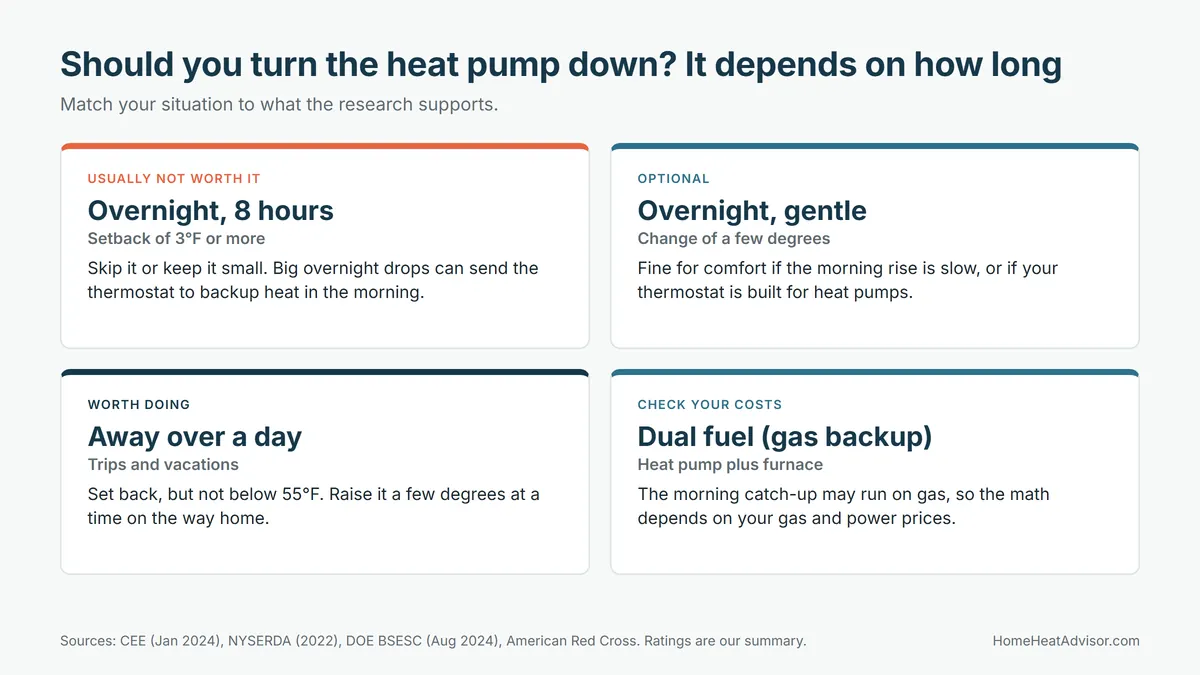
For most homes, the best answer is to leave the heat pump at one temperature overnight, or to use only a small, gradual change. Efficiency programs warn against abrupt changes of 3°F or more because the system can switch to costly backup heat to catch up. Setbacks do pay when you are away for more than a day, but keep the house at 55°F or higher. No agency has published a tested number of degrees for night setback.
Furnace-era setback saving
Up to 10%
For 7–10°F for 8 hours a day, heating and cooling together (DOE, 2022)
Change to avoid
3°F or more
Abrupt changes can trigger an inefficient catch-up mode (CEE, Jan 2024; NYSERDA, 2022)
Lowest setting when away
55°F
In cold weather, no lower than this (American Red Cross)
In this guide
- Should you turn down a heat pump at night? The short answer
- What DOE says about turning down a heat pump at night
- Why backup heat shows up when you turn down a heat pump at night
- How many degrees can you turn down a heat pump at night?
- The math: does it pay to turn down a heat pump at night?
- What smart thermostats can do for a heat pump setback
- When you should turn down a heat pump, at night or away
- A simple test for your own system
- Frequently asked questions
Should you turn down a heat pump at night? The short answer
Whether to turn down a heat pump at night depends on how long the drop lasts and how big it is. A furnace delivers heat fast, so letting the house cool for eight hours and warming it back up costs little. A heat pump setback runs against how the machine works: it is built to deliver slow, steady heat. When you ask it to recover a large gap quickly, it may not manage on its own, and the thermostat can call for backup electric heat to help.
Backup heat is the electric resistance heat that supports the heat pump on the coldest days and in recovery. Our guide to emergency heat vs auxiliary heat explains the difference between the two settings. A heat pump setback is not the only reason for long run times. A heat pump that runs for hours in winter is normal, so a long run after a setback is not a fault either. See why a heat pump runs constantly in cold weather.
What DOE says about turning down a heat pump at night
The advice most people remember about turning down a heat pump at night comes from the Department of Energy’s Energy Saver guide. It says you can save as much as 10% a year on heating and cooling by turning your thermostat down 7 to 10°F for 8 hours a day in the fall and winter (DOE, Energy Saver guide, 2022). That is the furnace-era rule for a thermostat setback, and it covers heating and cooling together, not heat pumps specifically.
The same sentence carries a warning about any heat pump setback. DOE says that if you have a heat pump, don’t do this without a smart or programmable thermostat designed for use with heat pumps. Its heat pump tips add that you should not set back the thermostat manually if it causes backup electric resistance heating to come on, because that heating is more expensive.
DOE’s Building Science Education Solution Center goes further. It says conventional programmable thermostats are generally not recommended for heat pumps because sudden setpoint changes or large setbacks create artificially high heating demand, and that the problem can be avoided with only small or gradual setbacks (DOE BSESC, August 2024). It gives no number of degrees.
Per-degree rule of thumb
DOE’s 10% for a 7 to 10°F drop works out to roughly 1.0 to 1.4% per degree. That is our calculation from DOE’s figures, not a DOE statement, and it applies to furnace-era heating and cooling combined.
Why backup heat shows up when you turn down a heat pump at night
The clearest field evidence comes from Pacific Northwest National Laboratory (PNNL), which monitored 22 homes with cold-climate heat pumps. Its report notes that some auxiliary heat use was triggered by night setbacks or manual setpoint changes rather than by the heat pump’s inability to meet demand. At most sites with high switchover temperatures, auxiliary heat tended to come on at a consistent time in the morning, which suggests occupants had set early-morning setbacks (PNNL-37127, January 2025).
The researchers are careful about it. Without continuous setpoint data from every site, they say, it is difficult to confirm the cause. They also say the habit was presumably driven by homeowners’ familiarity with furnaces.

Put the pieces together and the chain behind a heat pump setback is easy to follow. A big step up in the setpoint opens a large gap between the room and the target. Heat pumps put out slow, steady heat (NYSERDA, 2022), so the thermostat adds resistance stages. And the morning is also the coldest hour outside, when the heat pump is least efficient. Efficiency Vermont’s conference slides make the same point: deep setback means long recovery, and early-morning recovery happens at the lowest outdoor temperatures (Efficiency Vermont, 2018 slides).
Google’s Nest help page says backup heat can cost about 2 to 5 times as much as running the heat pump (Google Nest Help), and also that running the heat pump longer can be cheaper than using it. PNNL adds a fairness note: a setback may still save energy over the day, but the effect on the grid and on demand charges could mean higher utility bills.
How many degrees can you turn down a heat pump at night?
Here is the honest answer: nobody has published a tested number for how far to turn down a heat pump at night. We found no controlled U.S. study that measured the dollar result of a 2°F versus a 5°F night setback on a heat pump. What exists is guidance, and the guidance agrees on one line.
| Source | What it advises | Kind of evidence |
|---|---|---|
| CEE (Jan 2024) | Avoid abrupt changes of 3°F or more during unoccupied hours; adjust a few degrees gradually for nighttime comfort | Guidance |
| NYSERDA (2022) | A sudden change of 3°F or more could trigger an inefficient catch-up mode; raise the setting a few degrees at a time in the morning | Guidance |
| DOE BSESC (Aug 2024) | Use only small or gradual setbacks; no number given | Guidance |
| PNNL (Jan 2025) | Constant temperature, or a gradual setback if one is needed | Field study, 22 homes |
| CARB (Aug 2015) | Recovery ran at high speed and lower efficiency, yet electricity use likely still fell | One home, inverter ductless |
CEE and NYSERDA both draw the line at 3°F. CEE also says setbacks typically save energy if the absence lasts more than a day. NYSERDA’s advice for people who like a cooler bedroom is to raise the setting slowly, only a few degrees at a time, in the morning. Treat 3°F as shared guidance for any heat pump setback, not a measured threshold.
What about a heat pump setback on inverter units, the variable-speed systems common in ductless heat pumps? The one field case is thin. In a Building America study of seven inverter-driven units in the Northeast, only one home used an aggressive setback. After the setback, the compressor often ran at high speed to recover, for example 13,000 Btu/h at a COP of 2.15, falling to 6,500 Btu/h at 3.0 as the room warmed. The authors say recovery can lower seasonal efficiency, yet believe the setback still reduced electricity use (CARB, August 2015). It is one home, so it shows what can happen, not what usually does.
The math: does it pay to turn down a heat pump at night?
Numbers help here, so here is a heat pump setback worked through in dollars. To see whether you should turn down a heat pump at night, start with the saving. Take a 3°F, eight-hour setback, use the 1.0 to 1.4% per degree range from DOE’s figures, and apply it to the 518 kWh a typical U.S. electrically heated home uses for space heating in January (EIA RECS 2020). At 18.21 cents per kWh (EIA Short-Term Energy Outlook, October 2026), that is 15.5 to 22.3 kWh, or about $2.83 to $4.06 for the month.
Now the cost side. Trane’s electric heat kits for its air handlers come in sizes from 5 to 20 kW, and the 5 kW kit draws 4.8 kW at 240 volts (Trane heat kit sheet). One hour of that kit costs about 87 cents. Run it for an hour every morning for 30 days and it costs $26.22.
| Backup heat kit | Draw at 240 V | Cost per hour | 1 hour a day for 30 days |
|---|---|---|---|
| 5 kW kit | 4.8 kW | $0.87 | $26.22 |
| 10 kW kit | 9.6 kW | $1.75 | $52.44 |
| 15 kW kit | 14.4 kW | $2.62 | $78.67 |
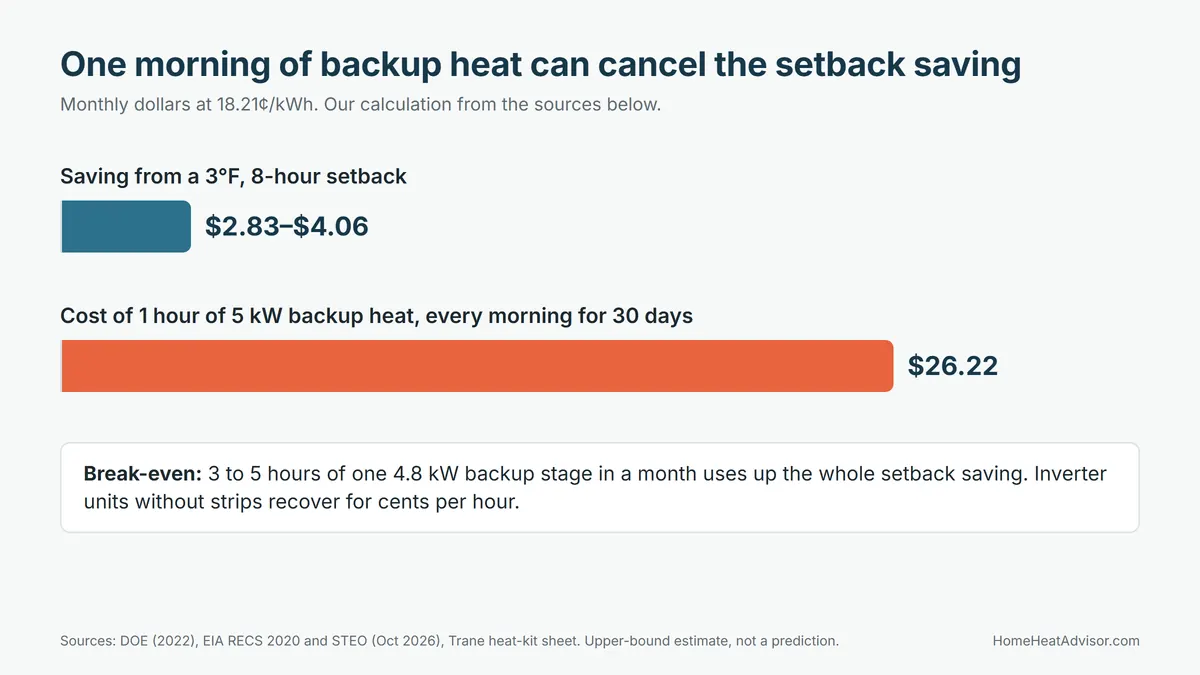
Put another way, only about 3 to 5 hours of one 4.8 kW stage in a whole month uses up the entire saving (15.5 to 22.3 kWh divided by 4.8 kW). If a deep setback brings the strips on for even a fraction of an hour most mornings, the saving disappears.
An inverter unit without strips changes the heat pump setback picture. Using the CARB recovery figures above, one hour at 13,000 Btu/h and a COP of 2.15 uses about 1.77 kWh, roughly 32 cents. One hour at 6,500 Btu/h and a COP of 3.0 uses about 0.64 kWh, roughly 12 cents (our calculation, kWh = Btu/h ÷ (3,412 × COP)). Recovery costs cents, not dollars, which is why the strips are the issue.
These are scale estimates, not predictions. DOE’s 10% is a furnace-era figure for heating and cooling, 518 kWh is a national average across mixed equipment, and real homes vary widely. We found no source for how many hours backup heat runs after a given setback.
For the other half of the bill, see why a heat pump electric bill is high in winter.
What smart thermostats can do for a heat pump setback
DOE’s advice leaves the door open: a smart or programmable thermostat designed for heat pumps may make a heat pump setback cost-effective. The manufacturers’ own pages describe what two popular models do, and where they stop.
Google’s Nest thermostat has a Heat Pump Balance setting. Max Comfort, the default, will try to reach your temperature even if it means using expensive backup heat. Max Savings tries to use backup heat as little as possible. Google adds that how much backup heat you use ultimately depends on your system (Google Nest Help). Its Early-On feature starts heating early so the home reaches the scheduled temperature on time, after a few days of learning (Google Nest Help, Early-On). Neither page says it fixes setbacks, so do not assume it does.
ecobee’s Smart Recovery works the same way. The manual says the thermostat learns how your system performs, taking weather into account, so your home reaches the scheduled set point at the scheduled time. For heat pumps it also lets you raise the Comp to Aux Delta, how many degrees the room can drop before backup heat is used, and set an Aux Heat Max Outdoor Temperature, above which backup heat will not run (ecobee Smart Thermostat Enhanced manual, March 2023). Those settings limit backup heat. They do not remove the catch-up.
Dual fuel
If your heat pump is paired with a gas furnace, the morning backup is usually gas rather than electric resistance, so the math changes. Compare your own gas and electricity prices. Our heat pump vs furnace guide covers the cost comparison.
When you should turn down a heat pump, at night or away
You can turn down a heat pump when the house is empty for a while, because setbacks do pay then. CEE says they typically save energy if the absence lasts more than a day. Efficiency Vermont says that if you are away for more than 24 hours, you can set back the temperature (Efficiency Vermont, mini-split guide, 2025). Its conference slides suggest saving setbacks for several days away, and not expecting fast recovery.
There is also a floor. The American Red Cross says that if you go away during cold weather you should leave the heat on, set to no lower than 55°F (American Red Cross). In a hard freeze it recommends the same temperature day and night, and accepts a higher heating bill to avoid burst pipes.
When you come home, do not jump the setting. NYSERDA’s advice is to raise it a few degrees at a time. If backup heat runs once to warm a cold house, that is expected rather than a fault.
Comfort is a fair reason too. If you sleep better in a cooler room, you can turn down a heat pump at night of a couple of degrees is reasonable. CEE and NYSERDA both allow it, as long as you move gradually and keep the change under their 3°F line.

A simple test for your own system
Every heat pump setback is different, so before you turn down a heat pump at night for good, test yours rather than trusting any rule. This costs nothing and takes a few mornings.
- Pick a cold night and make a small change, such as 2°F, at bedtime.
- Watch the thermostat in the morning. Many show AUX or a similar label when backup heat is running. Your manual or app will say what yours shows.
- If AUX comes on, shrink the change or drop it. DOE says not to set back manually if it triggers backup heat.
- If it does not, a small change is fine. Raise the setting a few degrees at a time, as NYSERDA advises.
- Compare your bill for a few weeks. A heat pump setback that saves a few dollars a month is easy to lose to one bad morning.
If backup heat runs often or the system struggles in cold weather, ask a licensed HVAC technician to check your thermostat settings and the lockout temperature. For a bigger picture, see our troubleshooting guides.
Frequently asked questions
Should you turn down a heat pump at night?
Usually not by much. If you turn down a heat pump at night, do it gently. DOE, CEE, NYSERDA and PNNL all point to a steady temperature or a small, gradual change, because a big drop can trigger expensive backup heat in the morning. If you want a cooler bedroom, change the setting by a degree or two and watch for backup heat.
How many degrees should I lower my heat pump at night?
No agency has published a tested number. CEE and NYSERDA advise avoiding abrupt changes of 3°F or more, and DOE says to use only small or gradual setbacks. Try a small change and check the thermostat in the morning for backup heat.
Does turning down a heat pump save money?
Rarely, if you turn down a heat pump at night. Our calculation puts a 3°F, eight-hour setback at roughly $3 to $4 a month in January, and one hour of 5 kW backup heat every morning costs about $26 a month. Setbacks save more when you are away for over a day.
Why does my heat pump use backup heat in the morning after a setback?
When you turn down a heat pump at night, the gap to the new setting can be too much for the heat pump alone, so the thermostat adds electric resistance heat. PNNL found backup heat at consistent morning times in homes with night setbacks. A smaller change or a heat pump thermostat helps.
Is it better to leave a heat pump at one temperature all day?
For most homes, yes. NYSERDA says heat pumps are most efficient when the thermostat holds a steady temperature, and PNNL recommends a constant temperature or a gradual setback. Exceptions are dual-fuel systems, where backup is gas, and trips lasting more than a day.
What temperature should a heat pump be set to when on vacation?
In cold weather, no lower than 55°F, according to the American Red Cross, to protect pipes. Efficiency Vermont says setbacks make sense for more than 24 hours away. Raise the setting a few degrees at a time when you return.
Sources
- U.S. DOE: Energy Saver, Tips on Saving Money and Energy in Your Home (2022)
- U.S. DOE BSESC: Smart Thermostats and Dual Fuel Control, Level 2 (August 2024)
- CEE: You Installed an Air Source Heat Pump. Now What? (January 2024)
- NYSERDA: Air Source Heat Pump Operating Tips (2022)
- PNNL: Performance Results from DOE Cold Climate Heat Pump Challenge Field Validation, PNNL-37127 (January 2025)
- CARB / Building America: Field Performance of Inverter-Driven Heat Pumps in Cold Climates (August 2015)
- Google Nest Help: Heat Pump Balance
- ecobee: Smart Thermostat Enhanced setup and user manual (March 2023)
- American Red Cross: Preventing and thawing frozen pipes
- Efficiency Vermont: How to use a mini-split heat pump (2025)
- U.S. EIA: Short-Term Energy Outlook, Table 2 (October 2026)
- U.S. EIA: Residential Energy Consumption Survey 2020, Table CE8.6.M
- Trane: Electric heat kits for J4AH4 air handlers
About this guide
Published by HomeHeatAdvisor. This guide is based on DOE, national laboratory, efficiency-program and manufacturer sources and EIA price data, checked in October 2026; each figure names its source and date, and calculations are labeled as ours. The checks here are for homeowners only. For thermostat wiring, lockout settings or anything that keeps tripping backup heat, use a licensed HVAC technician. Our editorial policy explains how we research, fact-check and update our guides. Spotted an error? Let us know. More troubleshooting guides.