
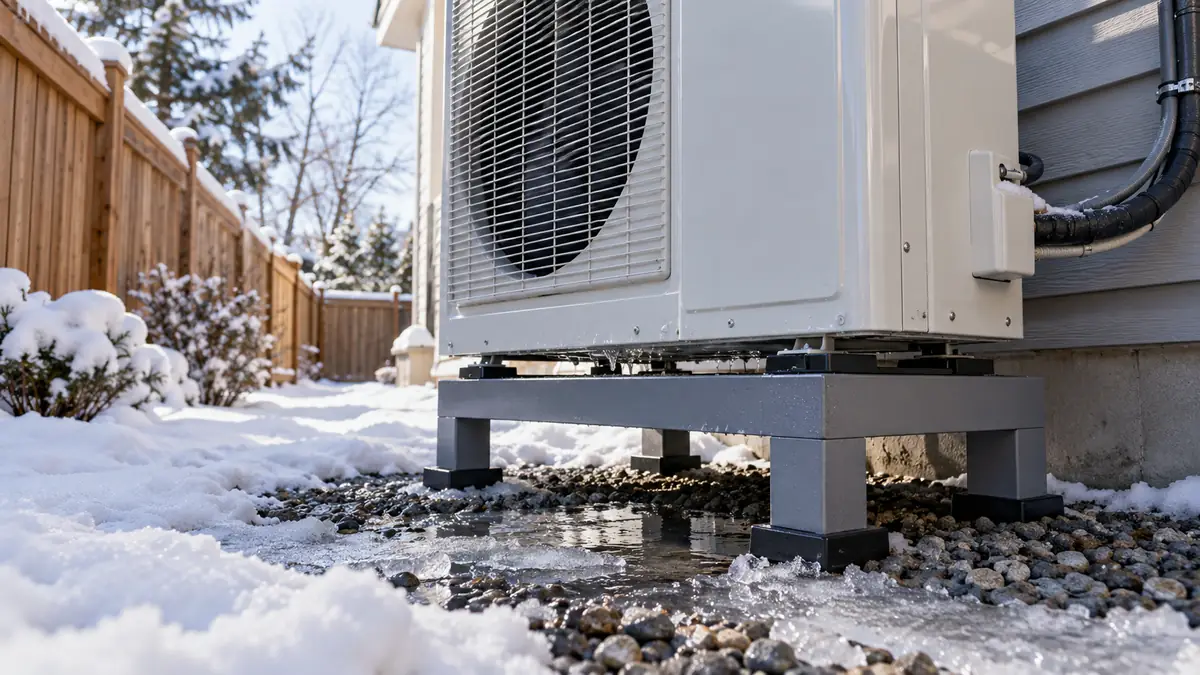
Heat pump leaking water outside in winter is usually defrost meltwater, and it is normal. The outdoor coil frosts over in cold, damp air, the unit melts the frost, and the water drips off the bottom. The real questions are whether the water is clear, where it goes and whether it is turning into ice where you walk.
This guide shows how to tell normal meltwater from a drainage problem or a refrigerant leak, using Trane, NEEP, CEE, Lennox and Robur. If you are new to the equipment, start with how a heat pump works. For other problems, see our heat pump troubleshooting guides.

A heat pump leaking water outside in winter is normal when the water is clear, has no smell or oily sheen, and drips from the unit during or after defrost. Trane says condensation forms outside in heating mode and may ice over, and defrost clears it. Call a licensed HVAC technician if the liquid is oily or smells chemical, the water pools or refreezes where people walk, or ice keeps covering the unit.
Typical defrost
A few minutes
How long clearing the ice normally takes (Trane, 2026)
Daily meltwater
Few L to 10–15 L
In very cold, humid air; a manufacturer estimate (Robur, Jan 2026)
Stand height
3 in. minimum
Above finish grade, one model’s manual (Lennox, Mar 2017)
In this guide
- Heat pump leaking water outside: the short answer
- How much water is normal?
- Five signs a heat pump leaking water is normal
- Water, oil or refrigerant: how to tell
- When a heat pump leaking water in winter is a problem
- Water inside the house is a different problem
- Keeping meltwater off walkways
- What a technician visit usually costs
- Frequently asked questions
Heat pump leaking water outside: the short answer
Trane says condensation can form outside during heating mode, that it may ice over in colder temperatures, and that the heat pump then enters its defrost cycle to clear the icing away, which normally takes a few minutes (Trane, 2026). CEE says the same thing from the owner’s side: defrosted water drips at the outdoor unit when it is freezing out (CEE, January 2024).
Here is the plain-language version, and it is our explanation rather than a quote. In heating mode the outdoor coil is colder than the air around it, so moisture condenses on it and freezes as frost. When the unit melts that frost, the water has to go somewhere, and it drips from the bottom of the cabinet.
So a heat pump leaking water in winter is mostly a drainage question, not a repair question. If you are seeing a white cloud rather than liquid, that is covered in heat pump steam in winter, and how defrost works in depth is in heat pump frozen or iced up. This guide stays with the liquid on the ground.
Where this fits
A heat pump leaking water only in cold weather and only outside is the usual meltwater pattern. A heat pump leaking water on a floor inside the house, or oily liquid anywhere, is a different problem and is covered further down.
How much water is normal?
There is no national standard for gallons per defrost, so treat any number with care. Robur, a heat pump maker, says a heat pump can produce from a few liters to more than 10 to 15 liters of water per day in very cold, humid air, and more for large units (Robur, January 2026). That is a manufacturer’s estimate, not a field study.
For scale, 15 liters is about 4 US gallons, which is our conversion. That is enough to make a visible puddle or a wet patch of gravel on a damp winter day. A bigger unit or a longer cold, humid spell means more water, which is why a heat pump leaking water into a big puddle is not automatically a fault.

With a heat pump leaking water, what matters more than the volume is the path. Water that soaks into gravel or drains away from the unit is fine. Water that collects under it, runs toward the house or spreads across a walkway is the problem to fix, and the fix is almost always about how and where the unit was installed.
Five signs a heat pump leaking water is normal
If all five of these fit, your heat pump leaking water is almost certainly just routine defrost meltwater.
- It is cold and the unit is heating. Trane says condensation forms outside during heating mode and may ice over in colder temperatures (Trane, 2026).
- The water is clear, with no smell and no oily sheen. One contractor-type guide says pure water usually means normal drainage, while oily or chemical-smelling liquid needs attention (PickComfort, April 2026; a secondary source).
- It drips from the base or lower coil area. CEE says defrosted water drips at the outdoor unit (CEE, January 2024).
- The amount is modest and tracks the weather. More on cold, damp days and less on dry ones, within the range Robur gives (Robur, January 2026).
- It drains away and does not refreeze where people walk. NEEP’s installation guide says to avoid placing the unit near walkways where refreezing meltwater might cause a slip-and-fall hazard (NEEP, October 2024).
If one of the five is off, do not panic. The next sections show what each exception usually means.
Water, oil or refrigerant: how to tell
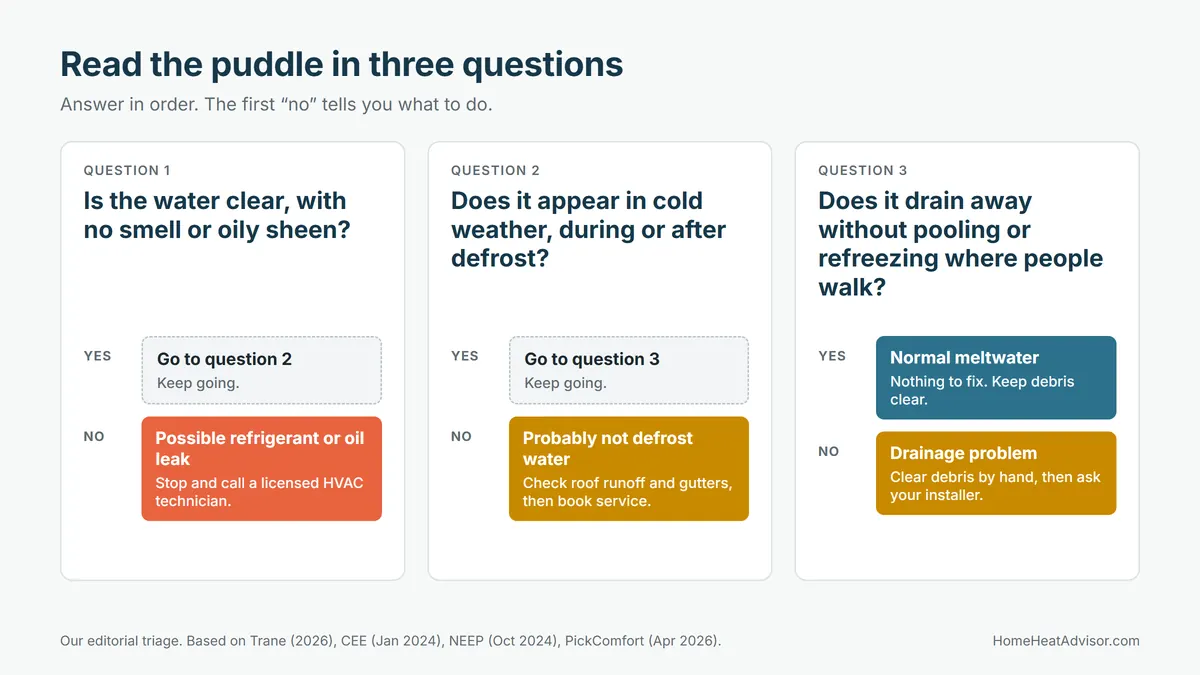
Most people searching for heat pump leaking water outside want one answer: is this water or is this a refrigerant leak? In our explanation, refrigerant is a gas in normal use, so a refrigerant leak does not normally look like a heat pump leaking water. What can show up is oil that circulates with it, and that is the liquid to watch for.
| What you see | Most likely cause | What to do |
|---|---|---|
| Clear water, no smell, cold weather, near the base | Defrost meltwater | Normal. Keep the water path clear of ice, leaves and mud. |
| Clear water that pools or turns to ice on a walkway | Drainage problem at the installation | Clear debris by hand, then ask your installer about level, stand height and grading. |
| Oily, slimy or chemical-smelling liquid, or an oily sheen | Possible refrigerant or oil leak | Stop using the system and call a licensed HVAC technician. |
| Water on the floor or around the indoor unit | Indoor drain line or drain pan | Switch the system off and call for service. |
| Water falling onto the unit from the roof edge | Roof runoff or snowmelt, not the heat pump | Check gutters and ask about drip caps (NEEP, October 2024). |
Refrigerant work is not a do-it-yourself job. The EPA says technicians who maintain, service or repair equipment that could release refrigerant must be certified under Section 608 (EPA, updated July 2026). Mitsubishi Electric’s manual adds that the user should not install, alter or repair the unit, and that some units use a flammable refrigerant such as R32 (Mitsubishi Electric, June 2024).
Do not touch it
If the liquid looks oily or smells chemical, keep children and pets away, do not wipe it up with bare hands, and call a licensed HVAC technician. Do not try to find or seal the source of a heat pump leaking water yourself.
When a heat pump leaking water in winter is a problem
A heat pump leaking water is not a fault by itself. These are the patterns that mean the water is a symptom of something else.
Water pools under the unit
Robur says to check that the water path is not blocked by ice, leaves, mud or other debris (Robur, January 2026). A heat pump leaking water under a unit in a low spot, or on a pad that is not level, can end up holding that water instead of letting it run off. NEEP says the outdoor unit should be level side to side and front to back, on well-drained soil that will not heave with frost (NEEP, October 2024).
Fix: Clear leaves, mud and loose debris by hand. If water still sits under the unit, ask your installer to check that it is level and on a stand or well-drained base.
Ice builds up on a walkway
A heat pump leaking water onto a walkway is a safety issue. CEE warns that defrosted water drips at the unit when it is freezing out and can refreeze on a walkway (CEE, January 2024). NEEP lists the same slip-and-fall hazard as a reason not to place a unit next to walkways.
Fix: Treat the ice for safety, and then talk to your installer about redirecting the water. Do not pour hot water on a unit to melt ice.
The liquid is oily or smells chemical
This is not defrost water. PickComfort says oily or chemical-smelling water may point to a refrigerant or lubricant leak (PickComfort, April 2026; a secondary source), and a refrigerant repair needs a certified technician. Our guide to heat pump smells covers other odors around the unit.
Fix: Turn the system off at the thermostat and call a licensed HVAC technician. This is our editorial advice, not a quoted rule.
Ice keeps covering the unit, and the house is cool
CEE says that if a heat pump is stuck in defrost or covered in ice, you should consult an HVAC professional (CEE, January 2024). If a heat pump leaking water also shows ice and weak heat, read heat pump frozen or iced up and heat pump not heating.
Fix: Switch to your backup heat if the house is cooling off, and book a technician visit.
Water falls onto the unit from the roof
This one is not a heat pump leaking water at all. NEEP says to avoid installing an outdoor unit directly under a roof drip line that would subject it to falling snowmelt, ice or concentrated rain runoff, and to use drip caps or shields approved by the manufacturer if that is not possible (NEEP, October 2024). NYSERDA also says to protect the unit from snow sliding off the roof (NYSERDA, August 2022).
Fix: Clean and check the gutters above the unit, and ask a roofer or your installer about a drip cap or shield.
Water inside the house is a different problem
Everything above is about the outdoor unit. A heat pump leaking water inside is different: if water appears on a floor, under a wall unit or near an indoor air handler, the cause is usually the condensate drain, not defrost. Trane says a clogged drain line causes the water to back up and onto the floor, and that the indoor drain pan needs a working float switch (Trane, 2026).
That is a drain and safety-switch issue, and it can damage ceilings and floors if it runs. Switch the system off at the thermostat and call a licensed HVAC technician. Typical repair prices are further down.
Keeping meltwater off walkways
The good news is that most cases of a heat pump leaking water outside are installation problems, which means you can ask for specific fixes. NEEP’s installation guide gives a clear set of rules, and they read like a checklist to hand your installer.
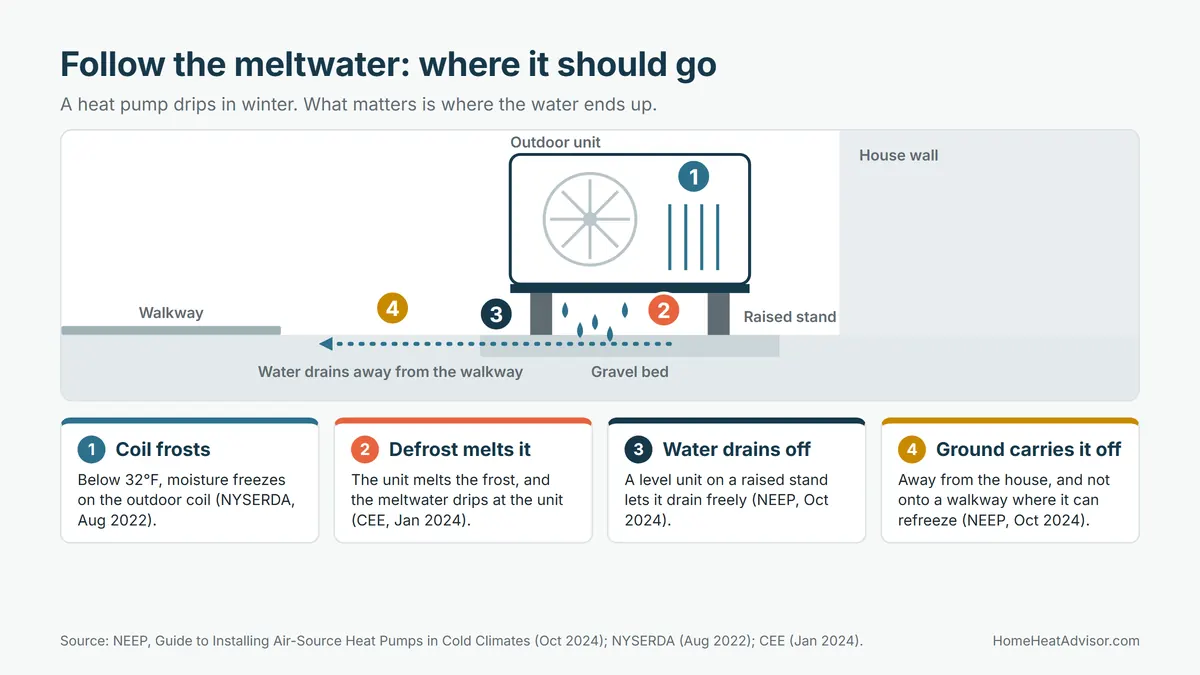
- Level unit. NEEP says the unit should be level side to side and front to back (NEEP, October 2024).
- Tall enough stand. NEEP says risers should be tall enough to avoid anticipated snow and sit on well-drained soil that will not heave with frost.
- Raised above grade. One model’s manual says to raise the unit at least 3 inches above finish grade and above the average snow line, so defrost condensate can drain freely and ice does not build up (Lennox LRP16HP manual, March 2017). That is one manufacturer’s example, not a rule for every unit.
- Away from walkways. NEEP says to avoid placing the unit where refreezing meltwater might cause a slip-and-fall hazard.
- Not under a roof drip line. If that cannot be avoided, NEEP says to use drip caps or shields approved by the manufacturer.

One more detail from the same guide: drain pan heaters are not generally needed when meltwater clearance and protection from precipitation are adequate (NEEP, October 2024). So the better first question to ask your installer is about level, stand height and where the water goes, not about adding a heater.
Do not cover the unit, and keep snow cleared by hand. NYSERDA says not to cover the unit (NYSERDA, August 2022). NEEP also says heat pumps should always be installed by licensed, trained professionals, so any change to stand height or position is a job for your installer, not a weekend project.
What a technician visit usually costs
If your heat pump leaking water is more than meltwater, these are typical US price ranges from Fixr for the visits and repairs behind it. A service call runs $75 to $250, drain line cleaning $75 to $300, a refrigerant recharge $100 to $600, and a refrigerant leak repair $200 to $1,500 (Fixr, January 2026).
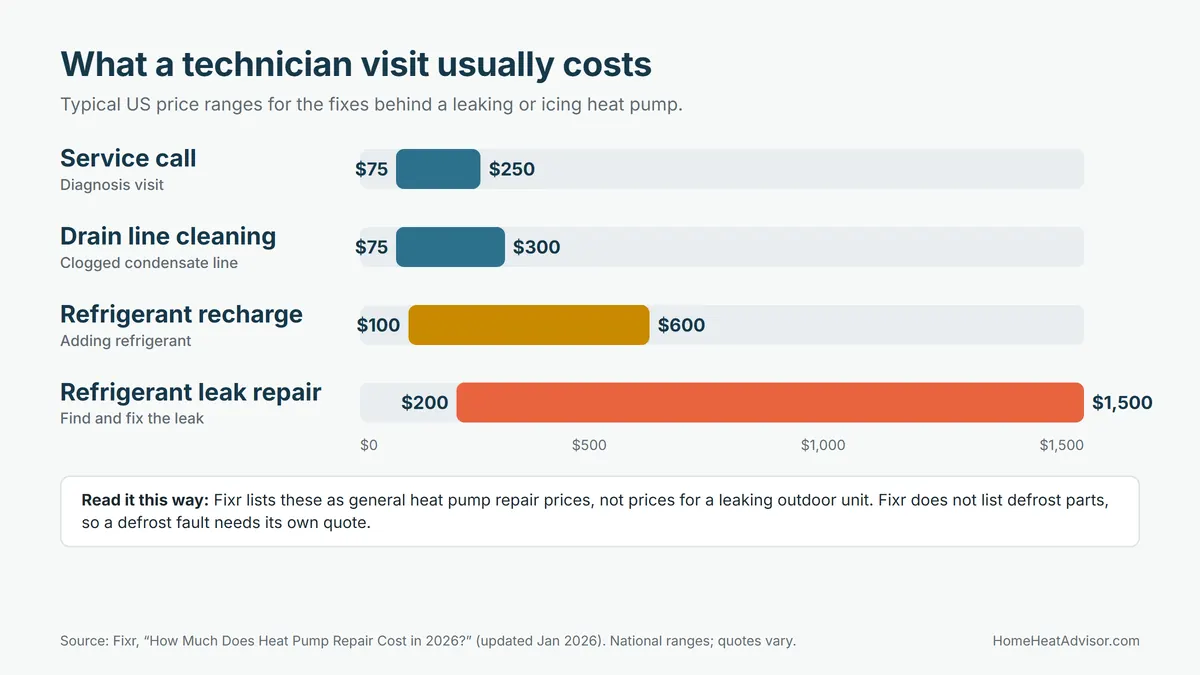
These are general heat pump repair prices, not prices for a heat pump leaking water outside. Fixr does not list defrost parts, so a defrost fault needs its own quote. Local labor rates and the type of unit change the total, so get more than one quote for anything beyond a service call.
A leak repair at the high end can start to look expensive next to a newer unit, particularly on an older system. Compare it with our heat pump installation cost guide before you decide, and see heat pumps in cold climates for how winter performance should look.
Frequently asked questions
Is a heat pump leaking water outside normal?
Yes, a heat pump leaking water outside in cold weather is normal. Trane says condensation can form outside during heating mode, may ice over, and is cleared by the defrost cycle. CEE says defrosted water drips at the unit. Call a technician if the liquid is oily, smells chemical, or keeps pooling or refreezing where people walk.
How much water does a heat pump drip in winter?
Robur, a heat pump maker, says from a few liters to more than 10 to 15 liters per day in very cold, humid air, more for large units (Robur, January 2026). That is about 4 US gallons at the top of the range, our conversion. It is a manufacturer estimate, not a study.
Why is my heat pump leaking water when it isn’t freezing?
Trane says condensation forms outside in heating mode and may ice over in colder temperatures, so the water itself does not require freezing air. If the water appears in warm weather, or on a floor inside, check the roof runoff, the drain line and the indoor drain pan, and call a technician if you cannot find the cause.
How can I tell a heat pump leaking water from a refrigerant leak?
Water is clear, has no smell, and appears in cold weather near the base. Oily, slimy or chemical-smelling liquid can point to a refrigerant or oil leak. Do not touch it. Refrigerant work requires an EPA Section 608 certified technician (EPA, July 2026).
Should I turn off a heat pump leaking water?
Not for a heat pump leaking water that is normal, clear meltwater. Turn it off at the thermostat and call a licensed HVAC technician if the liquid is oily or smells chemical, if water is on the floor inside, or if the unit is stuck in defrost and covered in ice. That is our editorial advice.
Does my heat pump need a drain pan heater?
NEEP says drain pan heaters are not generally needed when meltwater clearance and protection from precipitation are adequate (NEEP, October 2024). Ask your installer first about level, stand height, grading and where the water goes before paying for a heater.
Sources
- Trane: Heat pump leaking water (undated, © 2026)
- NEEP: Guide to Installing Air-Source Heat Pumps in Cold Climates (October 2024)
- CEE: You Installed an Air Source Heat Pump. Now What? (January 2024)
- Lennox: LRP16HP installation instructions (March 2017)
- Robur: Heat pumps and winter condensation (January 2026)
- PickComfort: Heat pump leaking water outside unit (April 2026)
- NYSERDA: Air Source Heat Pump FAQ (August 2022)
- Mitsubishi Electric: Wall-mounted air conditioner operating instructions (June 2024)
- EPA: Section 608 technician certification (updated July 2026)
- Fixr: How much does heat pump repair cost? (January 2026)
About this guide
Published by HomeHeatAdvisor. This guide is based on manufacturer, efficiency-program, state energy office and federal sources, checked in October 2026; each figure names its source and date, and calculations are labeled as ours. The checks here are for homeowners only. For refrigerant, wiring or anything that keeps tripping a breaker, use a licensed HVAC technician. Our editorial policy explains how we research, fact-check and update our guides. Spotted an error? Let us know. More troubleshooting guides.