

A high heat pump electric bill in winter has three usual causes: electricity costs more than it did last year, the weather was colder, or backup electric heat is doing work the heat pump should be doing. Only the third is a fault you can fix, so the first job is to find out which one you have.
This guide shows you how to read your heat pump electric bill, how to prove whether auxiliary heat is the problem, and what the seven most common causes cost you. New to the technology? Start with how a heat pump works, or browse our other energy bill guides.

A heat pump electric bill is higher in winter because you heat more and the heat pump makes less heat per kWh in the cold. A big jump usually comes from higher rates, a colder month, or backup electric heat running too often. Compare this month’s kWh with the same month last year. If kWh per degree day also rose, check the backup heat lockout, setbacks and emergency heat first.
U.S. residential electricity, 2026
18.21¢
Average projected price per kWh (EIA, Oct 2026)
Price rise, Q1 2026 vs Q1 2025
+8.6%
Our calculation from EIA, Oct 2026
Installs with backup lockout set to spec
43%
Pacific Northwest field study (BPA, Dec 2019)
In this guide
- Is a higher winter heat pump electric bill normal?
- Step 1: read your heat pump electric bill
- Heat pump electric bill high in winter? 7 causes and fixes
- What winter heat costs by fuel
- How much electricity should heating use?
- How to confirm it is backup heat
- Ways to lower your heat pump electric bill
- When to call a pro
- Frequently asked questions
Is a higher winter heat pump electric bill normal?
Some increase is normal. You heat for more hours in winter, and a heat pump moves less heat per unit of electricity as the air gets colder. In DOE field tests of cold-climate heat pumps, the median coefficient of performance (COP) was 1.9 in the 0 to 5°F range (PNNL, January 2025). At a COP of 1.9 you still get 1.9 kWh of heat for every kWh you pay for, but that is well below what the same unit delivers in milder weather.
There is no published rule for how much a normal winter bill rises, so we will not invent one. What the DOE-hosted CEE owner’s guide does list is the warning sign that matters: “a sudden increase in electricity consumption (kWh) on your utility bills” (CEE, January 2024). The table below sets that against what is expected.
| What you see | Expected or a problem? | What to do |
|---|---|---|
| Heat pump electric bill higher than summer, kWh up in the coldest months | Expected (EIA, RECS) | Compare with the same month last year |
| Dollars up, kWh about the same as last year | Rate change, not the system (EIA) | Check your cents per kWh and any tier change |
| kWh up in a colder-than-average month | Weather (EIA degree days) | Compare kWh per degree day |
| First winter after replacing gas, oil or propane | Expected: spend moves from fuel to electricity (Efficiency Vermont) | Compare total energy spend, not the heat pump electric bill alone |
| kWh jumped with the same weather and habits | Problem (CEE) | Check backup heat, lockout and settings |
| Auxiliary heat shown on the thermostat all the time | Problem (CEE) | See the causes below, then call a pro |
Step 1: read your heat pump electric bill before you change anything
Dollars hide the cause. Three numbers on your heat pump electric bill tell you what moved.
- kWh used and billing days. Divide kWh by days to get kWh per day. A 28-day bill and a 34-day bill are not comparable until you do.
- Cents per kWh. Divide the total by kWh. If this number rose and kWh did not, the price caused the jump.
- The same month last year. Compare January with January, not with December.
To separate weather from the system, use heating degree days. EIA explains that if the day’s mean temperature is below 65°F, the difference is counted as heating degree days (EIA, degree days). Utilities and weather services publish them by ZIP code. Take your bill kWh, subtract a baseline from a mild month such as May, and divide by the degree days in the billing period.

Weather can move a bill on its own. EIA’s October 2026 outlook puts first-quarter 2026 heating degree days in New England at 3,291 against a 10-year average of 2,957, and in the Middle Atlantic at 3,018 against 2,727. Our calculation from those figures: roughly 11% colder than average in both regions (EIA, October 2026). Your own region matters, so look up local degree days.
Good to know
Compare kWh per degree day for last winter and this winter. If the number is about the same, the weather and the price explain your heat pump electric bill, not a fault.
Heat pump electric bill high in winter? 7 causes and what to do
Work through these causes of a high heat pump electric bill in order. The first two are outside your control. Causes 3 to 6 are the ones you can usually fix. The last needs a professional.
1. Electricity costs more than last winter
EIA’s October 2026 outlook puts the U.S. average residential price at 18.21¢/kWh for 2026. For the first quarter, the price was 17.83¢ against 16.42¢ a year earlier, which is 8.6% higher by our calculation (EIA, October 2026). The same kWh costs more this winter, so your heat pump electric bill rises before the system does anything different.
Tiers can add to it. Some utilities charge a higher price once you pass a seasonal baseline allowance; PG&E, for example, bills energy above the baseline at a higher Tier 2 price, and the baseline depends on your location, heating source and season (PG&E, tiered rate plan). Heating with electricity can push you into the higher tier.
Fix: Look at cents per kWh on this bill and last winter’s. Ask your utility whether it offers a heat pump or seasonal rate (see the savings section below).
2. The winter was colder than the last one
A colder month means more heating hours and a lower COP, so the heat pump electric bill rises. If kWh rose but kWh per degree day stayed flat, this is the whole story, and no repair will bring it down.
Fix: Nothing to fix. Compare the same month and weather-adjust as above.
3. Backup electric heat is covering the gaps
Auxiliary heat is the electric strip inside the air handler. It delivers one kWh of heat per kWh of electricity. Google’s Nest guidance says it can cost 2 to 5 times as much as running the heat pump (Google Nest Help). Strip kits are sold at roughly 5 to 20 kW (Trane heat kit sheet), so at 18.21¢ a full hour of every element costs between about $0.91 and $3.64 by our calculation. Our guide to emergency heat vs auxiliary heat has the cost per hour in full.
Some aux use is normal. In DOE cold-climate field data, the coldest bins, −10 to 0°F, used auxiliary heat 25% of the time, while the median share of heating energy from aux was about 11% at 5°F (PNNL, January 2025). A heat pump electric bill that is high at moderate temperatures points to aux running when it should not.
Fix: Check how often the thermostat shows AUX or EMERGENCY and compare it with the outdoor temperature. Details are in the section on proving it.
4. The backup heat lockout is set too high
The lockout, or outdoor temperature limit for aux heat, tells the system when strips may run. If it is set too warm, strips come on when the heat pump could manage alone. In a Bonneville Power Administration field study, only 43% of installs met spec for aux heat lockout (BPA, December 2019).
Fix: Ask a technician to review the lockout against your balance point. Guides differ: NEEP suggests a cutout between 20 and 35°F (NEEP), and BPA’s ecobee sheet gives 35°F as a maximum outdoor temperature for aux (BPA). The right number depends on your system.
5. A big setback or setpoint change
A large thermostat setback forces the unit to recover quickly and can call in backup heat. The DOE’s Building Science Education Solution Center warns that large setbacks put artificially high heating demands on the unit (DOE BSESC, August 2024). The CEE guide advises avoiding abrupt thermostat changes during unoccupied hours (CEE, January 2024). PNNL found minor aux use triggered by night setbacks and manual setpoint changes, often at the same time each morning. Our guide to the best heat pump temperature for winter covers the settings that avoid it.
Fix: Hold one steady temperature, or limit changes to a degree or two. A setback is a bigger deal for some homes than others, and we cover it in a dedicated guide on turning a heat pump down at night.
6. Emergency heat is on, the fan is ON, or the filter is clogged
Emergency heat mode switches off the compressor and runs the strips on every call for heat, which is the 2-to-5-times cost case above. It should be a temporary setting, not a default. A fan set to ON keeps the blower running between cycles; CEE advises against running the indoor fan continuously and suggests starting with Auto (CEE, January 2024). A clogged filter also hurts performance, so check it too.

Fix: Make sure the thermostat is on HEAT, not EMERGENCY or AUX. Set the fan to AUTO and replace the filter.
7. Duct leaks, refrigerant or sizing problems
ENERGY STAR says leaky ducts can reduce heating and cooling system efficiency by as much as 20% (ENERGY STAR). In the BPA study, only 72% of installs had the refrigerant charge to spec and 42% met sizing spec. An undersized or low-charge system leans on backup heat more.
Fix: Call a licensed HVAC technician. Only an EPA Section 608 certified technician can work on refrigerant (EPA). Ask for a Manual J load calculation if sizing is in doubt; our heat pump installation cost guide explains it.
What winter heat costs by fuel
The chart turns EIA’s October 2026 prices into the cost of a million Btu of delivered heat. One kWh equals 3,412 Btu (EIA, Btu), so electricity at 18.21¢ costs $53.37 per million Btu before efficiency. A heat pump divides that by its COP. A strip, at COP 1, does not.

Two things stand out for a heat pump electric bill. At average prices a heat pump needs a COP of about 3.3 to match a 95% gas furnace on running cost, by our calculation, so a gas customer who switches can see a higher heat pump electric bill in deep cold. Against propane and oil, a heat pump at the field-test COP of 1.9 is cheaper. Prices vary a lot by state; our heat pump vs furnace guide covers the 15-year view and heat pump pros and cons weighs the rest. If you are switching from gas, our guide to the cost to replace a furnace with a heat pump covers the up-front side.
How much electricity should heating use?
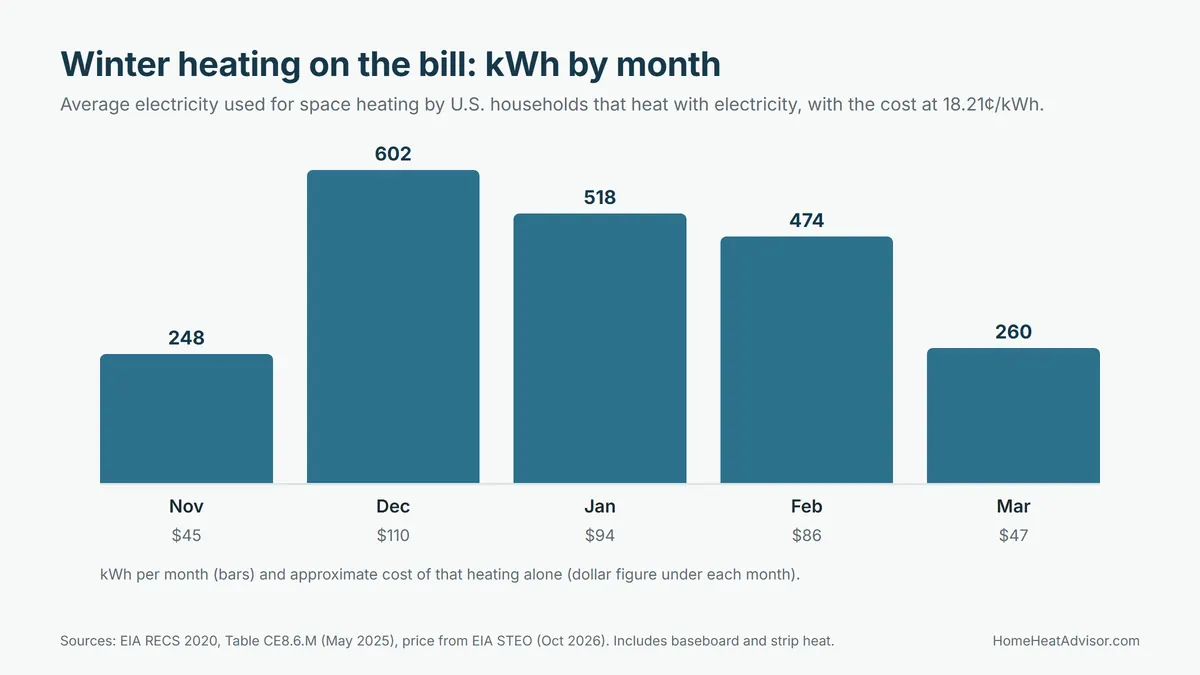
The best national data we found is EIA’s 2020 Residential Energy Consumption Survey. Among households that heat with electricity, average space heating used 602 kWh in December, 518 in January and 474 in February (EIA, RECS 2020). That group includes baseboard and strip heat as well as heat pumps, and it reflects 2020 weather, so treat it as a rough yardstick.
For a single hour, the math is short. Heat delivered, in Btu, divided by 3,412 and by the COP gives kWh. A Mitsubishi cold-climate unit delivers up to 14,690 Btu/h at 5°F with a COP of 2.24 (Mitsubishi Electric submittal). Our calculation: 14,690 ÷ (3,412 × 2.24) = 1.92 kWh, or about $0.35 an hour at 18.21¢. The same heat from a strip at COP 1 is 4.31 kWh, about $0.78. Real use depends on your home’s load, so a Manual J calculation is the right input for a precise answer.
How to confirm it is backup heat
Guessing is expensive, and a high heat pump electric bill is easy to misread. These checks cost nothing.
- Thermostat history. Many smart thermostats log runtime by stage, with separate heat pump and aux columns. Check your thermostat’s app or menu for the report; the wording varies by brand.
- Hourly utility data. Many utilities let you download interval data from your account. A strip stage draws roughly 5 kW or more, so a repeated morning spike to double your usual hourly kWh points to aux recovery.
- A steady-setpoint test. On a cold morning, leave the setpoint alone and watch for AUX. If it only appears right after a big temperature increase, that is the setback pattern. If it appears with a steady setpoint when it is above about 35°F outside, the lockout may be set too high.
- An electrician’s clamp meter. A licensed electrician or HVAC technician can read amps on the heat kit circuit. Amps × 240 V ÷ 1,000 gives kW; 20 A at 240 V is 4.8 kW.

Do not use a smart plug on the air handler to investigate your heat pump electric bill. It runs at 240 V and a plug-in monitor is not rated for it. Never open the electrical panel yourself.
Ways to lower your heat pump electric bill
| Action | What the source says | Source |
|---|---|---|
| Set the backup heat lockout properly | Only 43% of installs met spec; aux can cost 2 to 5 times as much | BPA (Dec 2019), Google Nest |
| Keep a steady setpoint | Avoid abrupt thermostat changes while away | CEE (Jan 2024) |
| Limit large setbacks | Large setbacks put high heating demands on the unit | DOE BSESC (Aug 2024) |
| Fan on AUTO, filters clean | Start with the fan on Auto rather than continuous | CEE (Jan 2024) |
| Seal and insulate | Up to 10% savings on annual energy bills | ENERGY STAR |
| Seal leaky ducts | Leaks can cut efficiency by as much as 20% | ENERGY STAR |
| Ask about a heat pump rate | Eversource MA heat pump rate customers paid about $72 less per month on average | Eversource |
Utility rates are worth a phone call if you want a lower heat pump electric bill. Eversource says customers on its Massachusetts heat pump rate paid about $72 less per month on average (Eversource). Rates like this exist only in some service areas, so ask your utility rather than assuming one is available.
A good envelope also lowers load, and with it your heat pump electric bill. ENERGY STAR says air sealing and insulation can save up to 10% on annual energy bills (ENERGY STAR). An energy audit can show where the heat leaks; Fixr puts a typical audit at $145 to $420, with a national average of $250 (Fixr, January 2025).
When to call a pro, and what repairs cost
A repair is only worth paying for when it addresses the cause of a high heat pump electric bill. Call a licensed HVAC technician if aux shows most of the day, the lockout needs changing, the house cannot hold temperature, or kWh per degree day rose without a settings change. These are national typical ranges:
| Service | Typical cost |
|---|---|
| Standard service call | $75–$250 |
| Thermostat replacement | $85–$300 |
| Refrigerant recharge | $100–$600 |
| Refrigerant leak repair | $200–$1,500 |
| Blower motor replacement | $300–$1,000 |
| Duct leak repair | $350–$650 |
| Full duct sealing | $1,000–$3,000 |
Frequently asked questions
Why is my heat pump electric bill so high?
Usually one of three things: higher electricity rates, a colder month than last year, or backup electric heat running too often. Compare kWh and kWh per degree day with the same month last year to find out which. If kWh per degree day rose, check the aux lockout, setbacks and emergency heat.
Does a heat pump increase your electric bill?
Yes, your heat pump electric bill goes up if it replaces gas, oil or propane, because your spend moves from fuel to electricity. Efficiency Vermont says the electric bill goes up while the fuel bill goes down, and the total can still fall depending on your backup fuel and rate.
How much will my heat pump electric bill go up?
Your heat pump electric bill depends on your home, climate, rate and the fuel you replace. EIA’s RECS 2020 data shows homes that heat with electricity used about 518 kWh for space heating in a typical January, roughly $94 at 18.21¢/kWh. Your own number could be well above or below that.
Do heat pumps use a lot of electricity in winter?
A heat pump electric bill is higher than in summer because heating demand is higher, and efficiency falls in the cold. PNNL’s field data found a median COP of 1.9 at 0 to 5°F. Heavy aux use is what makes consumption jump.
Is emergency heat expensive?
Yes. It disables the compressor and runs electric strips, which Google Nest says can cost about 2 to 5 times as much as the heat pump. Use it only when a technician tells you to or the heat pump has failed.
Is a heat pump cheaper than gas?
Not always. A heat pump electric bill can exceed a gas bill: at EIA’s average 2026 prices, a heat pump needs a COP of about 3.3 to match a 95% gas furnace on running cost, by our calculation. It beats propane and oil at a COP of 1.9. Prices vary by state, so check your local rates.
Sources
- U.S. EIA: Short-Term Energy Outlook, Table 2, energy prices (October 2026)
- U.S. EIA: Short-Term Energy Outlook, Table 9c, heating degree days (October 2026)
- U.S. EIA: Residential Energy Consumption Survey 2020, Table CE8.6.M (May 2025)
- PNNL: DOE Cold Climate Heat Pump Challenge field validation, PNNL-37127 (January 2025)
- Bonneville Power Administration: 2019 heat pump field study (December 2019)
- Center for Energy and Environment, hosted by U.S. DOE: You installed an air source heat pump. Now what? (January 2024)
- U.S. DOE BSESC: Smart thermostats and dual fuel (August 2024)
- Google Nest Help: Heat pump balance
- Mitsubishi Electric: MSZ-FS12NA / MUZ-FS12NA submittal
- Efficiency Vermont: How to use a heat pump (2025)
- Eversource: Massachusetts heat pump rate
- ENERGY STAR: Duct sealing benefits
- Fixr: Heat pump repair cost (January 2026)
About this guide
Published by HomeHeatAdvisor. This guide is based on EIA price and consumption data, national laboratory and utility field studies, energy program guidance and 2026 price data, checked in October 2026; each figure names its source and date, and calculations of our own are labeled as such. The checks here are for homeowners only. Anything beyond them needs a licensed HVAC technician, refrigerant work needs an EPA 608 certified technician, and electrical work needs a licensed electrician. Our editorial policy explains how we research, fact-check and update our guides. Spotted an error? Let us know. More energy bill guides.