

What size heat pump for 1500 sq ft is one of the most common questions before a quote, and the published answers range from 1.5 to 3.5 tons. The U.S. Department of Energy and NREL warn against casual sizing estimates based on floor area, because the house, not the square footage, sets the size.
This guide puts the published rules side by side, shows a DOE worked example of one house sized two ways, and lists what to ask your contractor for. If you are new to the equipment, start with how a heat pump works. For prices, see our heat pump installation cost guide.

What size heat pump for 1500 sq ft? Published rules of thumb put a 1,500 sq ft house anywhere from 1.5 to 3.5 tons (18,000 to 42,000 Btu/h), and 2.5 to 3 tons is the most repeated range for an average home in a moderate climate. But the U.S. Department of Energy says floor-area estimates are unreliable and that a Manual J load calculation should set the size. Ask your contractor for the calculation in writing before you accept a quote.
Published range
1.5 to 3.5 tons
Rules of thumb for 1,500 sq ft from four sources (ACHR News, Jun 2004, to PickComfort, Mar 2026)
Selection target
100–115%
Of the design heating load at the design temperature (NEEP sizing guide, Apr 2020)
Oversizing is common
Nearly 40%
Of contractors in one large survey said they purposely oversized (DOE and NREL, Jan 2002)
In this guide
- What size heat pump for 1500 sq ft: the short answer
- What a ton means in Btu
- Heat pump size for 1500 sq ft: the published rules
- Why heat pump size for 1500 sq ft depends on more than square footage
- How to find the right heat pump size for 1500 sq ft
- What size heat pump for 1500 sq ft in a cold climate
- Replacing an existing system
- What happens when it is too big or too small
- What to ask for in the quote
- What a 1,500 sq ft install costs
- Frequently asked questions
What size heat pump for 1500 sq ft: the short answer
The published rules for heat pump size for 1500 sq ft do not agree. PickComfort says a 1,500 sq ft house in a moderate climate often needs about 2.0 to 2.5 tons, a warm and well-insulated one 1.5 to 2.0 tons, and a cold or poorly insulated one 2.5 to 3.5 tons or more (PickComfort, March 2026). PickHVAC lists 2.5 to 3 tons for a moderate climate zone with average insulation (PickHVAC, June 2025), and Fixr gives the same 2.5 to 3 tons in its installation guide (Fixr, January 2026).
None of those is a design method. The DOE and NREL fact sheet warns against sizing based on home floor area or contractor experience, and recommends the ACCA Manual J and Manual S procedures instead (DOE and NREL, January 2002). That is the source to trust for finding the right heat pump size for 1500 sq ft, and the rest of this guide follows it.
In plain terms, and this is our summary rather than a quote: a quote between 2 and 3 tons is inside what the published rules cover, but that does not make it right for your house. The load calculation decides. If a contractor cannot show one, you are being sold a guess.
Short version
For what size heat pump for 1500 sq ft, expect quotes between about 2 and 3 tons. Then ask what load calculation backs the number, because a leaky house and a tight house of the same size can differ by a full size or more.
What a ton means in Btu
A ton is a size label. One ton equals 12,000 Btu per hour (PickComfort, March 2026; Fixr, January 2026), so a 3-ton unit is a 36,000 Btu/h model. A sizing guide from the Bonneville Power Administration lists seven common sizes: 1.5, 2, 2.5, 3, 3.5, 4 and 5 tons (BPA, 2021). You cannot buy 2.7 tons, so the final choice always rounds to one of these steps. So when someone asks how many tons heat pump for 1500 sq ft, they are really asking for a Btu number that fits the house.
| Nominal size | Btu per hour | Where it appears in the published rules |
|---|---|---|
| 1.5 tons | 18,000 | Warm climates with efficient insulation (PickComfort, March 2026) |
| 2 tons | 24,000 | Moderate climates, and the efficient house in the DOE example below |
| 2.5 tons | 30,000 | Moderate climate, average insulation (PickHVAC, June 2025; Fixr, January 2026) |
| 3 tons | 36,000 | Top of the PickHVAC and Fixr range for 1,500 sq ft |
| 3.5 tons | 42,000 | Cold or poorly insulated homes (PickComfort, March 2026) |
| 4 tons | 48,000 | Not a published default at this size; the leaky house in the DOE example needed 4 to 4.5 tons at 2,000 sq ft |
One more caution. The ton on the box is a nameplate size, not the heat the unit puts out on a cold day. Heating capacity changes with the outdoor temperature, which is why NEEP says to read the manufacturer’s extended performance tables for the capacity at your actual design conditions (NEEP, April 2020). The cold-climate section below covers this.
Heat pump size for 1500 sq ft: the published rules
Here is every rule we could find that names a heat pump size for 1500 sq ft, with the conditions each source attaches. We list them because the gap between them is the point: the same floor area gives answers from 1.5 to 3.5 tons.
| Source | Tons for 1,500 sq ft | Conditions stated |
|---|---|---|
| PickComfort (March 2026) | 2.0 to 2.5 | Moderate climates |
| PickComfort (March 2026) | 1.5 to 2.0 | Warmer climates with efficient insulation |
| PickComfort (March 2026) | 2.5 to 3.5 or more | Colder or poorly insulated homes |
| PickHVAC (June 2025) | 2.5 to 3.0 | Moderate climate zone, average insulation and sun exposure |
| Fixr (January 2026) | 2.5 to 3.0 | Rule of thumb in its installation cost guide |
| ACHR News (June 2004) | About 3.3 | 450 sq ft per ton, basic home, moderate climate. Our arithmetic: 1,500 ÷ 450 |

The oldest rule is worth a note. The 450 sq ft per ton figure comes from an ACHR News Q&A by a licensed engineer, who offered it as a way to reach a satisfactory selection for basic homes in moderate climates, and who also recommended an ACCA Manual J program for an authoritative load (ACHR News, June 2004). Even the people who published the shortcut pointed to the real method.
The modern sources add conditions: climate, insulation, sun exposure. That is already an admission that floor area is not enough. The next section shows how much the house matters.
Why heat pump size for 1500 sq ft depends on more than square footage
DOE and NREL give a worked example for a hypothetical 2,000 sq ft home in Raleigh, North Carolina. With conventional construction, the design heating load was 46,100 Btu/h, the cooling load 52,100 Btu/h, and the heat pump size 4.0 to 4.5 tons. After efficiency upgrades the same house needed 21,300 Btu/h of heating and 23,300 Btu/h of cooling, and a 2-ton unit (DOE and NREL, January 2002).
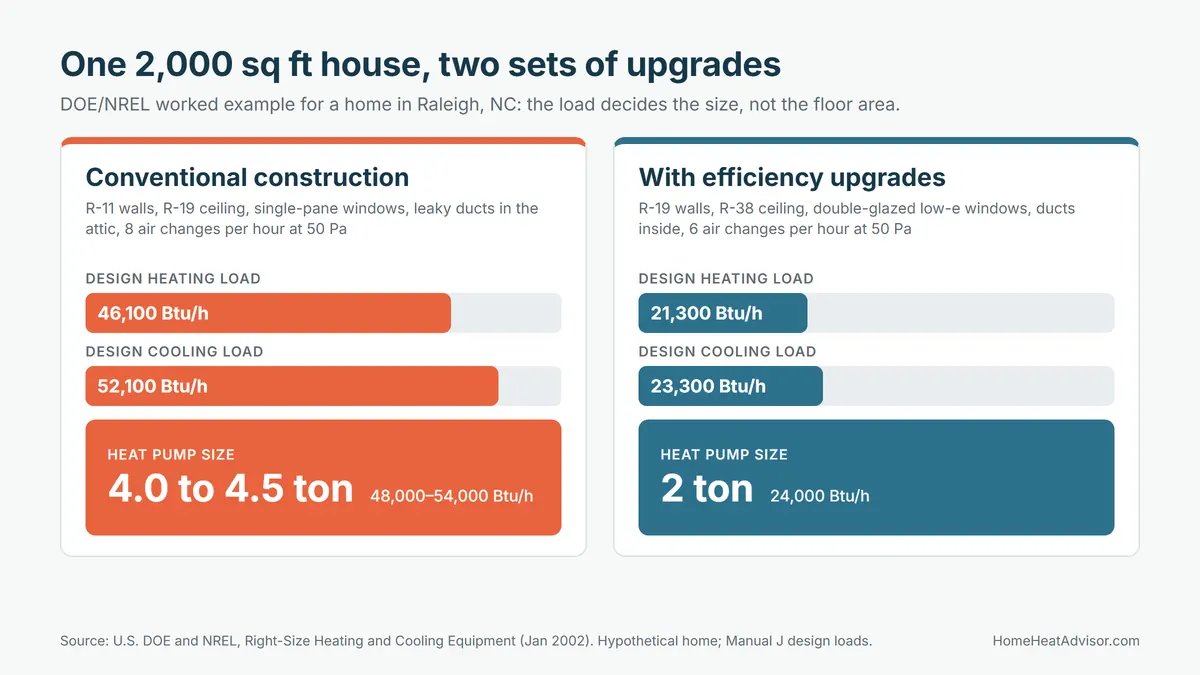
The floor area never changed. What changed was insulation, windows, overhangs, air leakage and duct leakage. This is a 2002 hypothetical in one climate, so do not read the tonnages as a prediction for your home. Read it as proof that the same floor area can need a size that differs by more than half, so the right heat pump size for 1500 sq ft in one house can be wrong in the next.
DOE puts the rule plainly: as a home becomes more efficient, the recommended system size should drop (DOE and NREL, January 2002). The DOE Building Science Education Solution Center adds that the loads in efficient homes can be small enough to fall below the range of capacities manufacturers offer (DOE Building Science Education Solution Center, undated).

These are the inputs that move the answer, taken from the DOE example and from the BPA sizing guide:
- Insulation levels in the walls and ceiling (the DOE example went from R-11 walls and R-19 ceiling to R-19 and R-38).
- Windows: single-pane versus double-glazed low-e, and how much roof overhang shades them.
- Air tightness. The DOE example went from 8 to 6 ACH50, and the BPA guide lists house tightness inputs from 0.35 to 0.8 air changes per hour (BPA, 2021).
- Ducts: leakage and location. The DOE example moved the ducts from an unconditioned attic into the conditioned space, and BPA uses a duct multiplier of 0 to 20 percent.
- Climate: the outdoor design temperatures for your location, which the contractor takes from standard weather data.
One more point from DOE: in much of the US the cooling load is larger than the heating load, so a unit sized for summer can be bigger than winter needs (DOE Building Science Education Solution Center, undated). In cold regions the opposite check matters, as covered below.
How to find the right heat pump size for 1500 sq ft
The method has three named parts. BPA describes them this way: Manual J calculates the heat loss and heat gain, Manual S selects the equipment, and Manual D designs the ducts (BPA, 2021). DOE and NREL recommend Manual J and Manual S for sizing (DOE and NREL, January 2002).
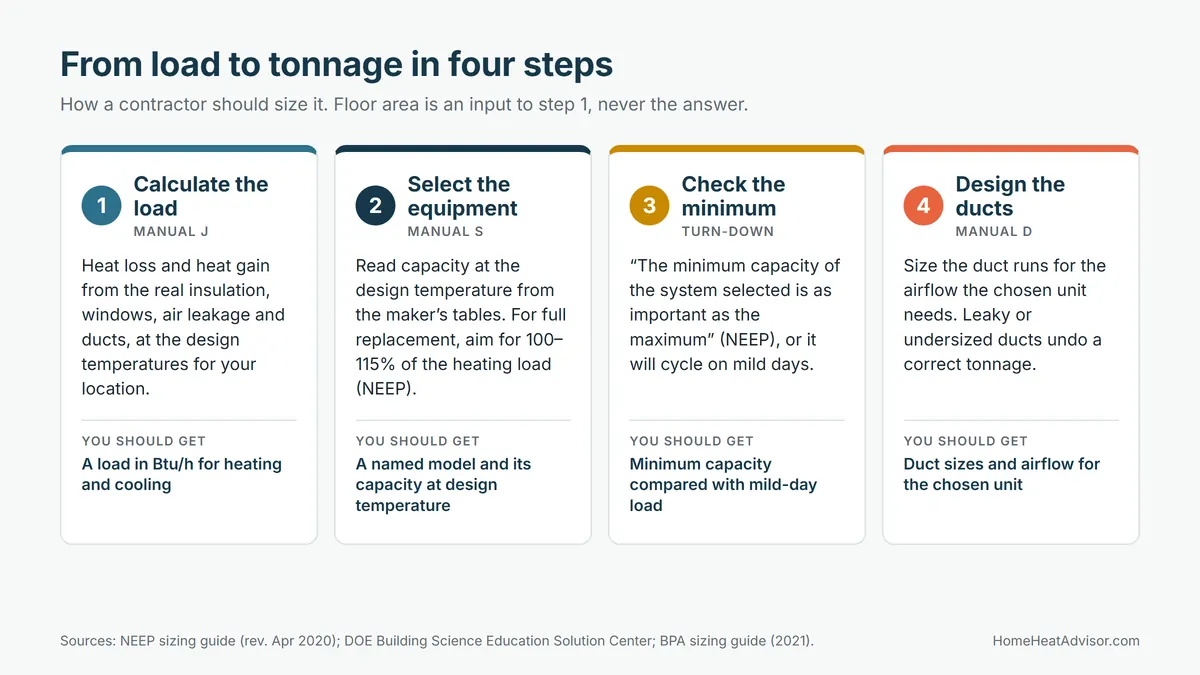
NEEP adds the rules that matter at the selection step. Do not pad the estimate with extra safety factors, use approved outdoor design temperatures for the location, and for a full replacement or new construction match the system capacity at the design temperature to 100 to 115 percent of the estimated heating load (NEEP, April 2020). The same guide says the minimum capacity of the system is as important as the maximum, which is why a unit that is too big for your home cannot always turn down enough.

Plain English: the contractor measures the house, calculates how much heat it loses on the coldest design day, and then picks the unit whose output at that temperature lands just above that loss. Floor area is one input in step 1. It is never the answer to what size heat pump for 1500 sq ft you need.
What size heat pump for 1500 sq ft in a cold climate
In a cold climate the question changes, and you read the table at the design temperature. NEEP defines cold climate as IECC zone 4 and higher, and says capacity must come from the manufacturer’s extended performance tables at your design conditions, not from the nameplate (NEEP, April 2020). The NEEP cold-climate specification reports maximum heating capacity at 5°F, which is a useful comparison point between models.
For heat pump size for 1500 sq ft in the cold, NEEP gives two designs for a full replacement. Match 100 to 115 percent of the heating load at the design temperature without backup heat, or design for 75 to 85 percent of the load and add just enough supplemental heat. Both are deliberate. A heat pump that falls short on the coldest day and leans on strip heat by accident is not the same thing.
We do not quote a percentage for how much a heat pump loses in the cold, because it depends on the model. Ask the contractor for the capacity of the exact model at your design temperature. For performance expectations see heat pumps in cold climates, and for how backup heat behaves see emergency heat vs auxiliary heat.
Replacing an existing system
Replacing a furnace or air conditioner invites the shortcut of copying the old size. NEEP says total heat pump capacity at design conditions should not exceed the existing heating equipment capacity, and in many cases will be smaller (NEEP, April 2020). It also says to weatherize first, because that reduces the size of the equipment required.
There is another reason not to copy. DOE and NREL say ACCA-approved sizing methods are often not used and oversizing is very common (DOE and NREL, January 2002). So the system you have now may itself be larger than your house needs, and a new one sized to match would repeat the mistake. Do not copy the old size when choosing a heat pump size for 1500 sq ft.
If you are moving from a furnace, see the cost to replace a furnace with a heat pump and heat pump vs furnace for the money side of the decision.
What happens when it is too big or too small
NEEP says grossly oversizing equipment can lead to excessive cycling, low efficiency and ineffective summer dehumidification (NEEP, April 2020). The DOE Building Science Education Solution Center lists higher cost, wasted energy and too-frequent on-and-off cycling (DOE Building Science Education Solution Center, undated).
DOE and NREL cite a Florida study where cooling units oversized by 50 percent or more used 9 percent more annual cooling electricity and drew 13 percent higher summer peak demand (DOE and NREL, January 2002). That is cooling in one state, not a heating number, but it shows the direction. Our short cycling guide covers how oversizing shows up at home.
Undersizing is the other risk, and it is our explanation rather than a quote: a unit that is too small cannot hold the temperature on the coldest days and leans on backup heat. The fix for both is the same when settling what size heat pump for 1500 sq ft you need: a real load calculation and a selection checked at the design temperature.
What to ask for in the quote
Ask for these before you sign, whatever the quote says about what size heat pump for 1500 sq ft you need. They turn a quote from a tonnage into something you can check, and a good contractor will have them ready. It is also worth collecting at least three estimates, which PickComfort recommends (PickComfort, March 2026).
- The load calculation in writing. A Manual J report or equivalent, showing the design temperatures used, not just a tonnage.
- The capacity at your design temperature from the manufacturer’s extended performance table (NEEP, April 2020).
- Minimum and maximum capacity, not just the nameplate tons, so you know how low the unit can turn down.
- A duct check. Whether the existing ducts were assessed (Manual D) or assumed to be fine. Leaky ducts raise the load.
- The weatherization assumption. Whether the size assumes insulation or air-sealing work that has not been done yet.
- The backup heat plan and its size, if any, and when it is meant to switch on.
- A licensed contractor. NEEP says heat pumps should always be installed by licensed, trained professionals.
A useful question
If you hear “we always put in a 3-ton for that size,” ask what the load calculation says for your house. That is our advice, not a quoted rule, and it is a fair question to ask any contractor.
We found no reliable national price for a load calculation, so we give none. Ask whether it is included in the installation quote or billed separately.
What a 1,500 sq ft install costs
For 1,500 sq ft and 2.5 to 3 tons, Fixr lists a typical installed price of $6,700 to $14,000 (Fixr, January 2026). That depends on the ducts, the electrical work, the brand and your region. Our heat pump installation cost guide has the full breakdown by home size, so we do not repeat it here.
Your heat pump size for 1500 sq ft affects price, but the larger effect is on the bill you pay afterward. A unit that is too big costs more to buy and, per the sources above, can cost more to run.
Frequently asked questions
What size heat pump for 1500 sq ft do I need?
The right heat pump size for 1500 sq ft depends on the house. Published rules of thumb range from 1.5 to 3.5 tons, and 2.5 to 3 tons is the most repeated range for an average home in a moderate climate (PickHVAC, June 2025; Fixr, January 2026). DOE and NREL say a Manual J load calculation should set the size, because floor area alone is unreliable.
How many tons heat pump for 1500 sq ft in a cold climate?
For how many tons heat pump for 1500 sq ft needs in the cold, the answer often points to the higher end, and PickComfort gives 2.5 to 3.5 tons or more for colder or poorly insulated homes (PickComfort, March 2026). NEEP says to match 100 to 115 percent of the design heating load at the design temperature, using the maker’s capacity tables.
Is a 2-ton heat pump enough for 1,500 sq ft?
It can be, in a warm or efficient house. PickComfort lists 1.5 to 2.0 tons for warm, well-insulated homes and 2.0 to 2.5 for moderate climates (PickComfort, March 2026). In the DOE example, a hypothetical efficient 2,000 sq ft home needed 2 tons. Whether it is enough for yours depends on the load calculation.
Is a 3-ton heat pump too big for 1,500 sq ft?
Not automatically. PickHVAC and Fixr both list 2.5 to 3 tons for this size. But for a tight, well-insulated home it may be larger than the load, and oversizing causes cycling and poor dehumidification (NEEP, April 2020). The load calculation shows which case you are in.
Can an online calculator tell me what size heat pump for 1500 sq ft I need?
Use it only for a ballpark. Online size calculators are floor-area rules of thumb, and DOE and NREL warn against floor-area sizing. A contractor’s Manual J load calculation uses your insulation, windows, air tightness, ducts and local design temperatures.
Should I add extra tonnage to be safe?
No. NEEP says not to pad the estimate with additional safety factors, and that the minimum capacity matters as much as the maximum (NEEP, April 2020). Extra size can bring excessive cycling and weak summer dehumidification, which is the opposite of safe. The right heat pump size for 1500 sq ft is the one the load calculation supports.
Sources
- U.S. DOE and NREL: Right-Size Heating and Cooling Equipment (January 2002)
- NEEP: Guide to Sizing & Selecting Air-Source Heat Pumps in Cold Climates (revised April 2020)
- DOE Building Science Education Solution Center: Proper Sizing of HVAC Systems (undated)
- Bonneville Power Administration: Heat Pump Sizing Reference Guide (2021)
- PickComfort: How Many Ton Heat Pump for 1500 Square Feet (March 2026)
- PickHVAC: HVAC Size Calculator (June 2025)
- Fixr: How Much Does Heat Pump Installation Cost? (January 2026)
- ACHR News: The Hotline (June 2004)
About this guide
Published by HomeHeatAdvisor. This guide is based on federal, efficiency-program and industry sources, checked in October 2026; each figure names its source and date, and calculations are labeled as ours. Sizing and installing a heat pump is work for a licensed HVAC contractor. Our editorial policy explains how we research, fact-check and update our guides. Spotted an error? Let us know. More cost guides.