

Most heat pump noises are normal. A heat pump hums, clicks, whooshes and sometimes hisses as part of its everyday work, and it gets louder in winter when it defrosts. A few sounds do mean something is wrong, and catching them early can keep a small repair from becoming a large one.
This guide sorts each sound into normal or problem, using what manufacturers write in their own manuals, and tells you who should fix it and what that usually costs. For other faults, see our heat pump troubleshooting guides or start with how a heat pump works.

Normal heat pump noises include a whoosh and steam during defrost, a hum while the outdoor fan is stopped, a short hiss or gurgle as the system starts or stops, clicks as parts switch on and off, and creaks from plastic panels. Problem noises are hissing that does not stop, ongoing gurgling, grinding, screeching, banging, loud buzzing and rattling with vibration. If a quiet unit suddenly gets loud, Trane says to shut it off and call for repair.
Typical defrost cycle
5–15 min
Normal whoosh and steam (Lennox, Nov 2025)
Full-speed heating, 3 ft to 15 ft
62 → 48 dBA
Trane XV20i product data (Feb 2022)
Average heat pump repair
$150–$650
Fixr (Jan 2026)
In this guide
- Heat pump noises at a glance
- Normal heat pump noises
- Heat pump making noise: 10 warning sounds
- How loud should a heat pump be?
- Heat pump noise rules and your neighbors
- How to make a heat pump quieter
- What it costs to fix a noisy heat pump
- Repair or replace?
- When to call a technician
- Frequently asked questions
Heat pump noises at a glance
Two questions narrow down almost any heat pump noise: does it come and go with the system’s normal cycles, and is it new? A sound that appears for a few minutes during cold, damp weather and then stops is usually defrost. A heat pump noise that is new, constant or getting worse needs a closer look.
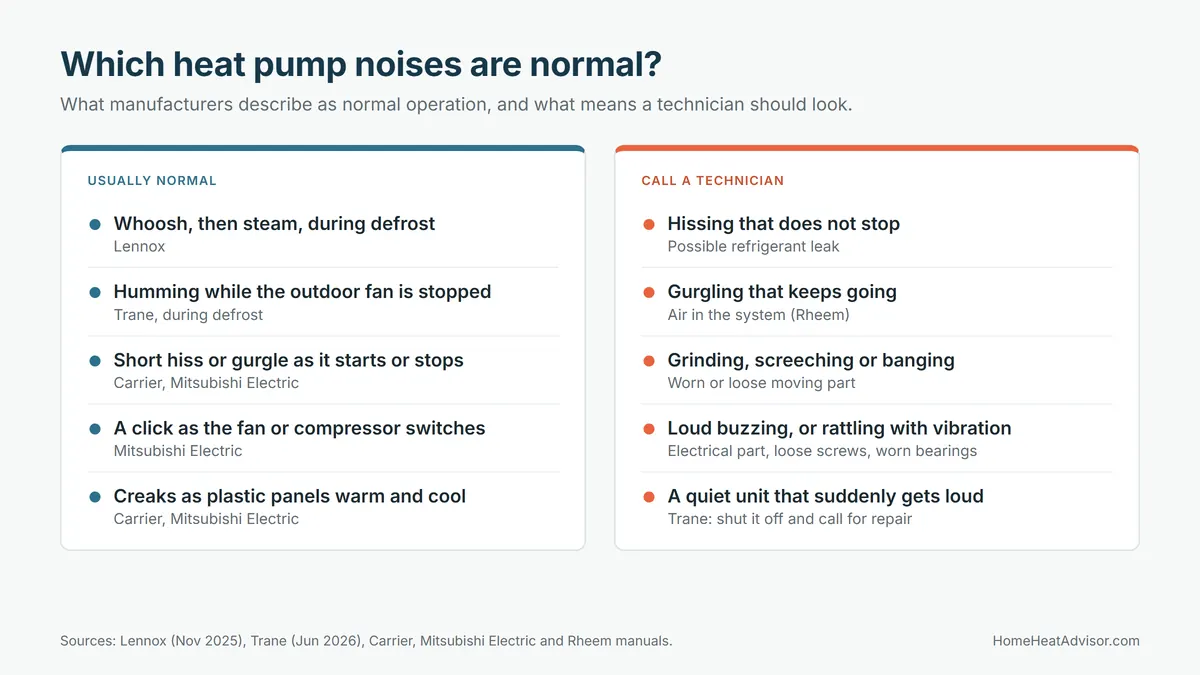
| Noise | Likely cause | Who fixes it |
|---|---|---|
| Whoosh, then steam from the outdoor unit | Defrost cycle (normal) | Nobody. Wait 5–15 minutes |
| Short hiss or gurgle at start or stop | Refrigerant flow settling (normal) | Nobody |
| Hissing that does not stop | Possible refrigerant leak | EPA 608 certified technician |
| Gurgling that keeps going | Air in the refrigerant lines, or water in the drain | HVAC technician |
| Loud humming or buzzing | Capacitor, contactor or motor | HVAC technician |
| Rattling | Loose panel or screws, debris, worn bearings | You (debris only), then a technician |
| Banging, grinding or screeching | Loose, broken or worn moving part | HVAC technician. Turn it off |
| Rapid clicking, no start | Control board, loose connection, capacitor or contactor | HVAC technician |
| Whistling indoors | Dirty filter or undersized grilles | You (filter), then a technician |
Normal heat pump noises
These heat pump noises are described as normal in manufacturers’ own manuals. They can be annoying, but none of them means the system is failing.
A whoosh, a hum and steam during defrost
In heating mode, frost builds up on the outdoor coil, sometimes even when the weather feels mild. Lennox says most systems check for frost every 30 to 90 minutes. To clear it, the heat pump briefly runs in reverse. Lennox notes you may hear a whooshing sound as the system shifts modes, and you may see steam rising outside (Lennox, November 2025).
Trane adds that heat pumps get louder in defrost, especially in colder weather, and that a hum while the outdoor fan is stopped is normal (Trane, June 2026). This defrost heat pump noise usually lasts 5 to 15 minutes on Lennox units, 4 to 10 minutes on a Carrier ductless model and about 2 to 10 minutes on a Mitsubishi Electric wall unit, according to their manuals.

Good to know
Some heat pumps are built to soften the defrost sound. Rheem’s installation instructions describe a 30-second compressor delay at defrost to cut the noise (installation instructions, August 2015). If yours slams loudly into and out of defrost, ask a technician whether that setting is on. Ice that does not clear after defrost is a different problem, covered in why a heat pump freezes up.
A short hiss or gurgle when it starts or stops
Carrier’s owner’s manual says you may hear a low hissing sound while the compressor runs or just after it stops, caused by refrigerant flowing or coming to a stop (Carrier). Mitsubishi Electric describes the same thing, plus the sound of condensed water flowing inside the indoor unit (Mitsubishi Electric, June 2024). The key word is short: a normal heat pump noise of this kind lasts a few seconds at start-up, shutdown or a change of mode.
Clicks as parts switch on and off
A single click when the system starts or stops is a relay or contactor closing, one of the most common heat pump noises. Mitsubishi Electric calls it the switching sound of the fan or compressor turning on and off. Clicking becomes a problem heat pump noise only when it repeats rapidly and the system will not start.
Creaks and squeaks from plastic panels
Plastic parts expand as they warm and shrink as they cool, which makes light creaking or squeaking heat pump noises. Both Carrier and Mitsubishi Electric list this as normal, most often when the system starts, stops or switches between heating and defrost.
A louder heat pump noise in winter
Most heat pumps run harder in heating than in cooling, and the spec sheets show the extra heat pump noise. A Carrier Infinity variable-speed heat pump, size 24, is rated at 71 dBA at nominal heating against 68 dBA in cooling (Carrier product data, October 2024). Trane’s XV20i, size 48, is rated at 76 against 74 at full speed. Trane also notes that some brands of heat pumps are naturally loud when starting and stopping.
Heat pump making noise: 10 warning sounds
Trane lists banging, screeching, rattling, buzzing, grinding and gurgling as sounds that are not normal, and its advice is plain: if you hear strange noises, contact an HVAC professional (Trane troubleshooting guide). Here is what each heat pump noise usually points to, and the limit of what you can safely check yourself.
1. Hissing that does not stop
Hissing is the heat pump noise where advice online seems to conflict. Trane says hissing is not a normal sound, while Carrier and Mitsubishi Electric describe a low hiss as normal. The difference is timing. A brief hiss at start-up or shutdown is refrigerant settling; a steady hiss while the system runs, or one that continues after it stops, can mean refrigerant is escaping.
Fix: Turn the system off and call a technician. Refrigerant work requires an EPA Section 608 certified technician, and federal rules only allow certified technicians to buy most refrigerants (EPA, March 2026).
2. Gurgling or bubbling that keeps going
Rheem’s troubleshooting table links a gurgle or pulsing noise at the expansion device or liquid line to air or other non-condensable gases in the system (Rheem). Air in the lines points to a leak or an installation problem. A gurgle from the indoor unit’s drain can be water flowing, so note where the sound comes from.
Fix: Check that the condensate drain line indoors is not blocked. If the gurgle comes from the refrigerant lines or the outdoor unit, a technician needs to find and fix the leak, then evacuate and recharge the system.
3. Loud buzzing
A heat pump making noise like a loud electrical buzz often has a worn contactor, the switch that sends power to the compressor and fan. The City of Bellevue, Washington, notes that worn bearings, other limited-life parts and loose screws are a common source of buzzing and rattling noises (Bellevue mechanical equipment guidance).
Fix: Turn the system off at the thermostat and at the outdoor disconnect. Electrical parts carry dangerous voltage even with the unit off at the thermostat, so testing and replacing them is a job for a technician or licensed electrician.
4. Humming that will not stop
A hum during defrost is normal. A heat pump making noise like a hum when the fan or compressor should be running usually has a part that cannot start. Trane links a loud hum from the outdoor unit to the capacitor, contactor or fan motor, and from the indoor unit to the blower motor (Trane, June 2026). A weak capacitor is one of the cheapest and most common fixes.
Fix: Switch the system off so the motor does not overheat, then book a service call. A capacitor typically costs $100 to $400 to replace, according to Fixr.

5. Rattling
When a heat pump is making noise like a rattle, the cause is often simple: a loose access panel, a loose screw, or twigs and leaves inside the outdoor unit’s cabinet. Trane notes that rattling with excessive vibration is not normal, which points to a loose or failing part such as a fan blade or motor mount.
Fix: Turn the power off at the outdoor disconnect and clear leaves and debris from around the unit. Lennox says to brush debris from the coil with a soft brush and light pressure, wear gloves because the fins have sharp edges, and never bend the fins (Lennox installation instructions, September 2026). If the rattle continues, call a technician.

6. Banging or clanking
A banging heat pump noise means something is hitting something else: a loose or broken fan blade, a part that has come free inside the cabinet, or a compressor moving on its mounts. In winter, ice built up around the fan can also strike the blades.
Fix: Turn the system off right away to prevent further damage, then call a technician. Do not chip ice off the unit; see what to do when a heat pump freezes.
7. Grinding or metal-on-metal
Grinding heat pump noises usually come from worn motor bearings in the outdoor fan motor or the indoor blower. It tends to get louder over a few days or weeks before the motor fails completely.
Fix: Turn the system off and book a repair. An outdoor fan motor typically costs $200 to $700 and an indoor blower motor $300 to $1,000, based on the cost sources below.
8. Screeching or squealing
Trane says a high-pitched heat pump noise from the outdoor unit can be something as simple as a loose screw, or the fan motor, capacitor or compressor (Trane, June 2026). Indoors, a dirty or too-restrictive filter can whistle or squeal.
Fix: Check the air filter first and replace it if it is dirty. If the screech continues, or comes from the outdoor unit, turn the system off and call a technician.
9. Rapid clicking without starting
One click is normal. A repeated clicking heat pump noise with no start-up suggests the system is trying and failing to run. Trane links clicking indoors to a faulty control board, a loose connection or a safety switch, and outdoors to the capacitor or contactor. If the unit also stops heating, see our guide to a heat pump not heating.
Fix: Check that the thermostat has fresh batteries and is set to Heat. If the clicking continues, a technician should check the controls and wiring.
10. Whistling or air noise indoors
A heat pump making noise like a whistle at the vents usually means air is being forced through too small an opening. Rheem notes that undersized supply and return grilles become noisy, and a clogged filter restricts airflow in the same way (Rheem).
Fix: Replace the filter and make sure supply and return vents are open and not blocked by furniture. If the whistle remains, ask a technician to check airflow and duct sizing.
How loud should a heat pump be?
Outdoor units are rated for noise under industry standard AHRI 270, which measures sound power: the total sound energy the unit gives off (AHRI). That rating is not the heat pump noise you hear. What reaches your ear, called sound pressure, depends on distance, nearby walls and what is between you and the unit. A companion standard, AHRI 275, estimates it.
Heat pump noise ratings vary by model, size and speed. Carrier advertises its 27VNA0 variable-speed heat pump at as low as 54 dBA at low speed, while the size 24 is rated at 71 dBA at nominal heating. The City of Bellevue says heat pump sound power is usually in the 70 to 80 dBA range. For comparison, normal conversation is 60 to 70 dBA (NIDCD, April 2025).
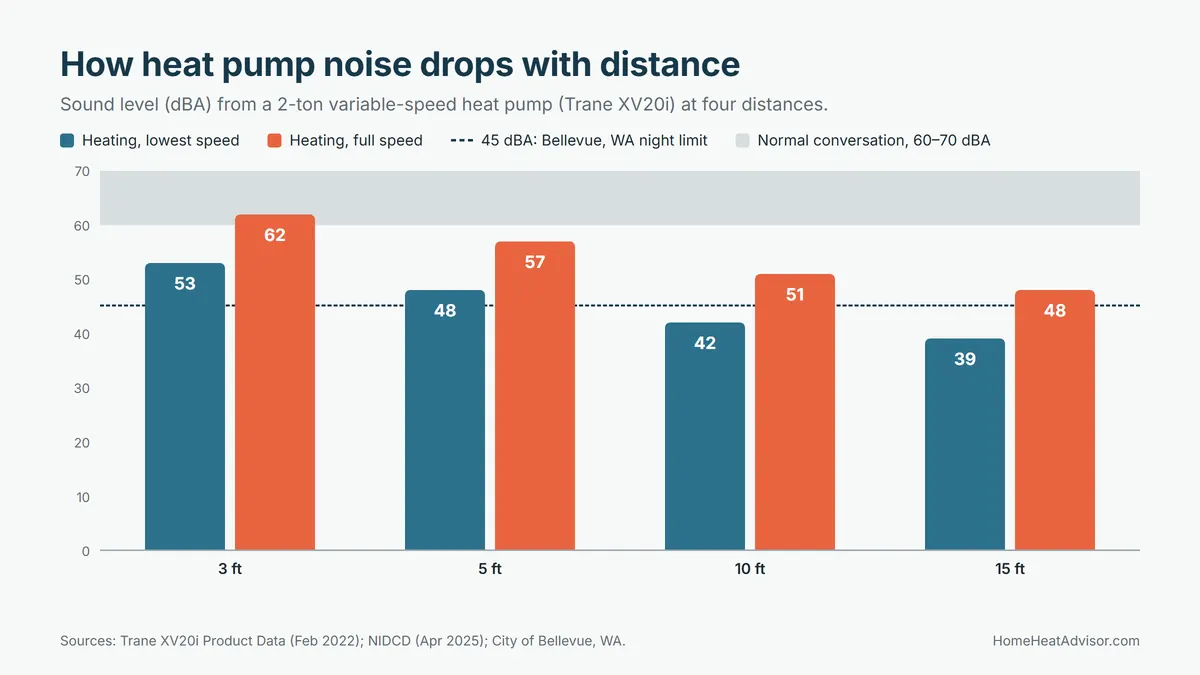
Trane publishes how loud its XV20i heat pump is at set distances, which shows how quickly heat pump noise fades:
| Distance from unit | Heating, lowest speed | Heating, full speed |
|---|---|---|
| 3 ft | 53 dBA | 62 dBA |
| 5 ft | 48 dBA | 57 dBA |
| 10 ft | 42 dBA | 51 dBA |
| 15 ft | 39 dBA | 48 dBA |
AHRI 275 puts numbers on what else changes the sound you hear (ANSI/AHRI Standard 275):
- Distance: each doubling of distance takes about 6 dB off.
- Walls and windows: an open window cuts about 10 dB, a closed single-glazed window 17 dB, and a closed double-glazed window or solid wall 23 dB.
- Placement: one nearby hard wall adds about 3 dB, and an inside corner adds about 6 dB.
That is why a unit tucked into a corner under a bedroom window can sound far louder indoors than the same unit on an open side of the house, and why placement is the cheapest way to cut heat pump noise.
Heat pump noise rules and your neighbors
Some cities set a limit on heat pump noise at the property line. Bellevue, Washington, allows 45 dBA at night (10 p.m. to 7 a.m.) and 55 dBA during the day, and warns that a unit may need to be 40 to 100 feet from the property line to meet those limits. It also notes that the mechanical inspector does not check noise at installation (City of Bellevue).
Tiburon, California, limits residential equipment to 55 dBA at any point on the property line and requires a zoning permit to install, replace or move an outdoor HVAC unit (Town of Tiburon, September 2017). Heat pump noise rules differ widely between cities, so check your own code before choosing where a new outdoor unit goes.
Before you install
Ask your installer for the unit’s AHRI sound rating at low and full speed, and where they plan to place it relative to bedrooms, windows and your neighbor’s house. Moving a unit later costs far more than placing it well the first time.
How to make a heat pump quieter
Some fixes for heat pump noise are safe for any homeowner. Others belong to the installer, because they involve moving the unit, its pad or its refrigerant lines.
What you can do:
- Keep the area around the outdoor unit clear of leaves, grass clippings and snow, with the power off at the disconnect before you clean near it.
- Replace the indoor filter on schedule so the blower does not strain.
- Leave the clearance your manual calls for. Rheem asks for at least 6 inches on all sides and recommends 12, and the Lennox EL16KP1 calls for 30 inches on the service side.
- Let defrost finish on its own. Lennox warns against using any means to speed up defrosting other than those it recommends (Lennox, 2025).
What an installer can do:
- Set the unit on sound-absorbing isolation pads. Lennox names a product called Isomode in its installation instructions, and Trane lists an isolator kit for the XV20i.
- Make sure the concrete pad does not touch the house foundation. Both Lennox and Rheem say it should not, to stop vibration traveling into the structure.
- Leave slack in the refrigerant lines between the house and the unit, and secure lines that vibrate. Rheem notes that a vibrating vapor line can carry noise inside.
- Move the unit away from sleeping areas and windows, which Lennox lists as places to avoid.

If heat pump noise shows up inside soon after a new install, call the installer back before you pay for a separate repair.
What it costs to fix a noisy heat pump
Most repairs behind heat pump noises are moderate in price. Fixr puts the average heat pump repair at $150 to $650, about $400 on average, with labor at $75 to $150 an hour and a service call fee of $75 to $250 (Fixr, January 2026).

| Repair | Typical cost |
|---|---|
| Service call and diagnosis | $75–$250 |
| Capacitor | $100–$400 |
| Contactor | $150–$400 |
| Outdoor fan motor | $200–$700 |
| Indoor blower motor | $300–$1,000 |
| Reversing valve | $350–$700 |
| Refrigerant leak repair | $200–$1,500 |
| Compressor | $800–$2,500 |
Repair or replace?
Heat pump noise alone is rarely a reason to replace the system. The repair behind it, the age of the system and whether it is still under warranty decide it.
| Your situation | Usually |
|---|---|
| Capacitor, contactor or fan motor on any age of system | Repair |
| Refrigerant leak on a newer system under warranty | Repair, and ask what the warranty covers |
| Compressor failure on an older system out of warranty | Get a replacement quote alongside the repair quote |
| Repeated repairs plus noise on an older system | Compare repair costs with a new system |
| Noise only from placement or vibration | Ask the installer to fix the pad, lines or location |
When to call a technician
Call a licensed HVAC technician for any problem heat pump noise beyond the owner checks above. Turn the power off at the thermostat and the outdoor disconnect before you clean near the unit; Lennox’s instructions say to disconnect power before servicing (Lennox). Fixr adds that DIY repair mistakes can raise the risk of fire and electrical shock.
- Anything involving refrigerant needs an EPA Section 608 certified technician.
- Wiring, breakers and electrical parts need a licensed technician or electrician. A hum that comes with a tripping breaker is covered in our guide to why a heat pump keeps tripping the breaker.
- If a normally quiet unit suddenly gets loud, Trane’s advice is to shut the system off and call for repair.
If the system shuts down while you wait for a repair, your thermostat’s backup heat can keep the house warm; our guide to emergency heat vs auxiliary heat explains when to use it.
Frequently asked questions
Why is my heat pump making a loud whooshing noise?
Most likely it is defrosting. The heat pump briefly reverses to melt frost off the outdoor coil, which makes a whoosh as it switches and often sends steam up from the unit. Lennox says defrost usually lasts 5 to 15 minutes and is normal.
Why does my heat pump hiss?
A short, low hiss as the system starts or stops is refrigerant flowing or settling, which Carrier and Mitsubishi Electric describe as normal. A hiss that continues while the system runs, or after it stops, can mean a refrigerant leak and needs an EPA 608 certified technician.
Why is my heat pump louder in winter?
It works harder in heating, and the Carrier and Trane spec sheets in this guide rate their units louder in heating than in cooling. Cold, damp weather also brings more defrost cycles, each with its own whoosh and hum. Trane notes heat pumps naturally get louder in defrost.
How loud should a heat pump be?
It depends on the model and distance. Trane’s 2-ton XV20i measures 62 dBA at 3 feet at full heating speed and 48 dBA at 15 feet. Normal conversation is 60 to 70 dBA. A new sound, or one that gets louder over time, matters more than the number.
Should I turn off a heat pump making a strange noise?
Yes, if the noise is grinding, banging, screeching, loud buzzing or a sudden change from a quiet unit. Trane advises shutting the system off and calling for repair. Running a failing motor or compressor can turn a small repair into a larger one.
Is it normal for a heat pump to make noise at night?
Yes. Heat pumps run more at night when it is colder, and defrost can happen at any hour. Normal heat pump noises are the same day or night. If a neighbor complains, some cities set night limits, such as 45 dBA at the property line in Bellevue, Washington.
Sources
- Lennox: Understanding the heat pump defrost cycle (November 2025)
- Lennox: Merit ML15KSPV installation instructions 508844-01 (September 2026)
- Lennox: EL16KP1 installation instructions 508406-01 (2025)
- Trane: Is this normal? HVAC smells and sounds, explained (June 2026)
- Trane: Heat pump troubleshooting
- Trane: XV20i heat pump product data 22-1953-1A-EN (February 2022)
- Carrier: 27VNA0 Infinity variable-speed heat pump product data (October 2024)
- Carrier: 38MG ductless heat pump owner’s manual (November 2014)
- Mitsubishi Electric: MSZ-AP operating instructions (June 2024)
- Rheem: Heat pump outdoor unit installation instructions 92-105074-04-03 (August 2015)
- AHRI: Standard 270, sound performance rating of outdoor unitary equipment
- AHRI: Standard 275, application of sound rating levels of outdoor unitary equipment (2010)
- NIDCD: Noise-induced hearing loss (April 2025)
- City of Bellevue, WA: Mechanical equipment noise requirements
- Town of Tiburon, CA: HVAC and similar mechanical equipment noise policy (September 2017)
- Fixr: Heat pump repair cost (January 2026)
- HomeGuide: Heat pump maintenance and repair cost (January 2025)
- U.S. EPA: Section 608 technician certification (March 2026)
- U.S. EPA: Refrigerant sales restriction (March 2026)
About this guide
Published by HomeHeatAdvisor. The heat pump noises in this guide are explained from manufacturers’ manuals and product data, industry sound standards, city noise rules and published repair-cost guides, checked in October 2026; each figure names its source and date. Use a licensed HVAC technician for anything beyond the owner checks described here. No installer, manufacturer or utility pays to be included. Our editorial policy explains how we research, fact-check and update our guides. Spotted an error? Let us know.