

Heat pump steam in winter looks alarming the first time you see it: a white cloud rolling off the outdoor unit on a cold morning. In almost every case it is the defrost cycle melting frost off the coil, and it is normal. What matters is telling that steam apart from smoke, and knowing the few signs that mean a technician should look at it.
This guide pulls together what Trane, Lennox, NYSERDA, CEE and Mitsubishi Electric say about a heat pump steaming, adds a side-by-side field guide for steam versus smoke, and lists the warning signs. If you are new to the equipment, start with how a heat pump works. For other problems, see our heat pump troubleshooting guides.

Steam from a heat pump outdoor unit in winter is normal when it is a white, odorless cloud that appears while the unit is defrosting, lasts about 5 to 15 minutes and then stops. The unit is melting frost off its coil. Call a licensed HVAC technician if defrost seems constant, runs longer each time or ice covers the unit. If you see gray or black smoke, smell burning or see flames, turn the system off, leave and call 911.
Typical defrost
5 to 15 min
Most sources agree (CEE, Jan 2024; NYSERDA, Aug 2022)
Frost checks
30 to 90 min
How often most systems look for frost in heating mode (Lennox, Nov 2025)
Frost forms below
32°F
When coil moisture freezes and a defrost is needed (NYSERDA, Aug 2022)
In this guide
- Heat pump steam: the short answer
- Why a heat pump steams in winter
- Five signs heat pump steam is normal
- Heat pump steam vs smoke: how to tell
- When heat pump steam is a warning sign
- Steam from a ductless heat pump
- What to do while your heat pump is steaming
- Does a heat pump steaming waste energy?
- Frequently asked questions
Heat pump steam: the short answer
Trane says a cloud of steam coming from the outdoor unit is the ice melting and evaporating, and is perfectly normal (Trane, February 2026). Lennox says the same: the steam you notice rising from the outdoor unit is water vapor, and it is normal during the process (Lennox, November 2025). Mitsubishi Electric’s operating instructions even list the symptom in their own words, describing vapor from defrosting that looks like white smoke (Mitsubishi Electric, June 2024).
Steam coming from heat pump units in cold weather is a routine sight, so the cloud itself is not the problem. The questions that matter are how long it lasts, how often it repeats and what else is happening to the unit. The rest of this guide answers those, starting with why a heat pump steams at all.
Where this fits
This post covers steam. For how defrost works in depth, including what heavy ice means, read heat pump frozen or iced up.
Why a heat pump steams in winter
In heating mode the outdoor coil is the cold part of the system. It pulls heat out of outdoor air, so it runs colder than the air around it. NYSERDA explains that when the coil drops below 32°F, moisture in the air freezes on it as frost, and the unit has to run a defrost cycle (NYSERDA, August 2022).
During defrost the heat pump briefly acts like an air conditioner. NYSERDA says the system switches to cooling mode, so warm refrigerant flows to the outdoor coil and melts the ice. The outdoor fan usually pauses while this happens, which lets the coil warm up quickly.
Here is the plain-language version of what you see, and it is our explanation rather than a quote. A coil that was well below freezing is suddenly warm and wet. As the frost melts, the water evaporates into the cold air above the unit, and the vapor shows up as a white cloud, much like your breath on a cold morning. When the ice is gone, the unit switches back to heating and the cloud thins out.
Lennox describes the same moment: you may hear a whooshing sound as the system shifts modes, and on cold, damp days frost builds faster, so cycles come more often (Lennox, November 2025). That is why heat pump steaming is most common on humid days just below freezing, and less common on very dry, very cold ones.
Five signs heat pump steam is normal
Use this checklist the next time your heat pump is steaming. If all five fit, it is almost certainly a routine defrost.
- It is cold and damp outside. Frost forms fastest in cold, humid air, so steam clusters on those days (Lennox, Nov 2025).
- The outdoor fan stops or slows. Fan pauses during defrost are expected. CEE says fans might stop or slow while the unit defrosts (CEE, Jan 2024).
- It lasts about 5 to 15 minutes, then stops. That is the range Lennox, NYSERDA and CEE give. Trane says defrost is usually 3 to 5 minutes, and Mitsubishi Electric says up to 10 minutes on its wall units.
- The cloud is white, odorless and thins fast. It looks like vapor, not smoke, and it does not smell like anything.
- Warm air comes back afterward. NYSERDA says a normal defrost should not impact the temperature of your home.
Different sources give slightly different durations because they describe different equipment and conditions. The chart shows each one next to the others. Our rough count of how often it happens comes from Lennox’s 30 to 90 minute frost checks (Lennox): over 8 cold hours that works out to about 5 to 16 clouds, assuming the interval counts running time. That is our calculation, not a manufacturer figure.
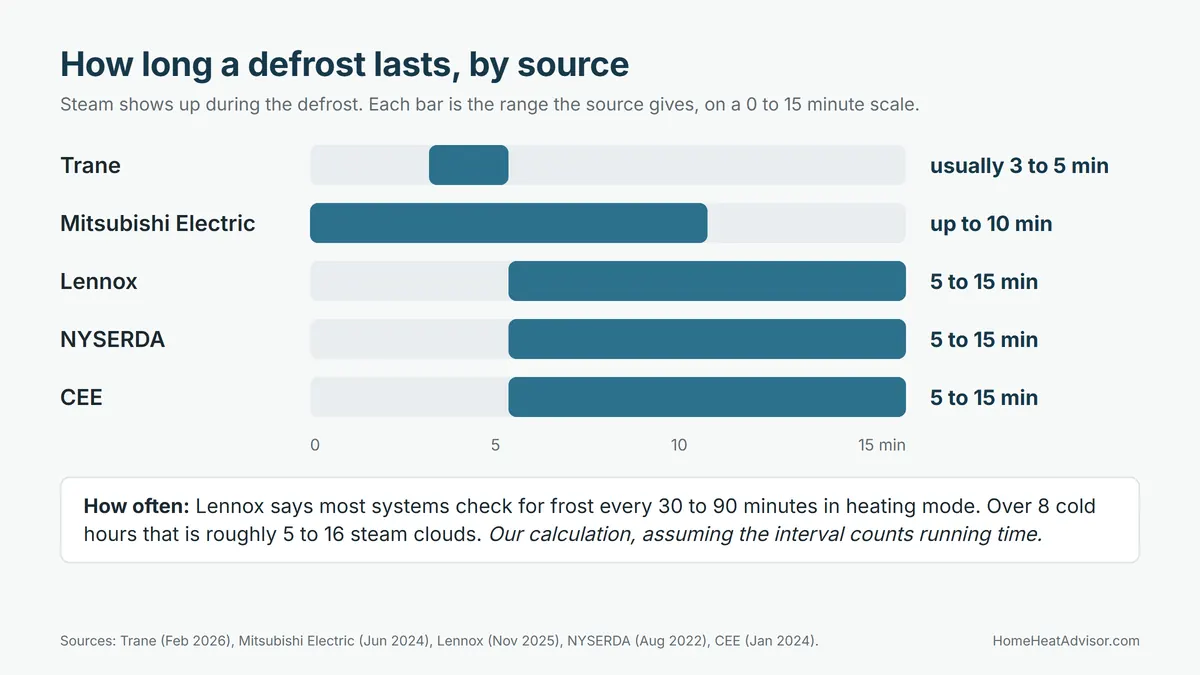
If your unit steams a few times an hour in cold, damp weather and each cloud clears within a quarter of an hour, that is the heat pump steam pattern the manufacturers describe.
Heat pump steam vs smoke: how to tell
This is the question that sends people to search at night. Heat pump steam and smoke can look similar from a window, but they behave differently once you look for color, smell, timing and source.
| What to check | Steam from defrost | Smoke from a fault |
|---|---|---|
| Color | White, and it thins quickly | Gray or black, and it lingers |
| Smell | No smell | Burning, acrid or hot electrical |
| Timing | Clears in about 5 to 15 minutes, then repeats later | Does not stop on its own |
| Where it comes from | The outdoor coil area, when it is cold and damp | Anywhere, including the indoor unit, a panel or wiring |
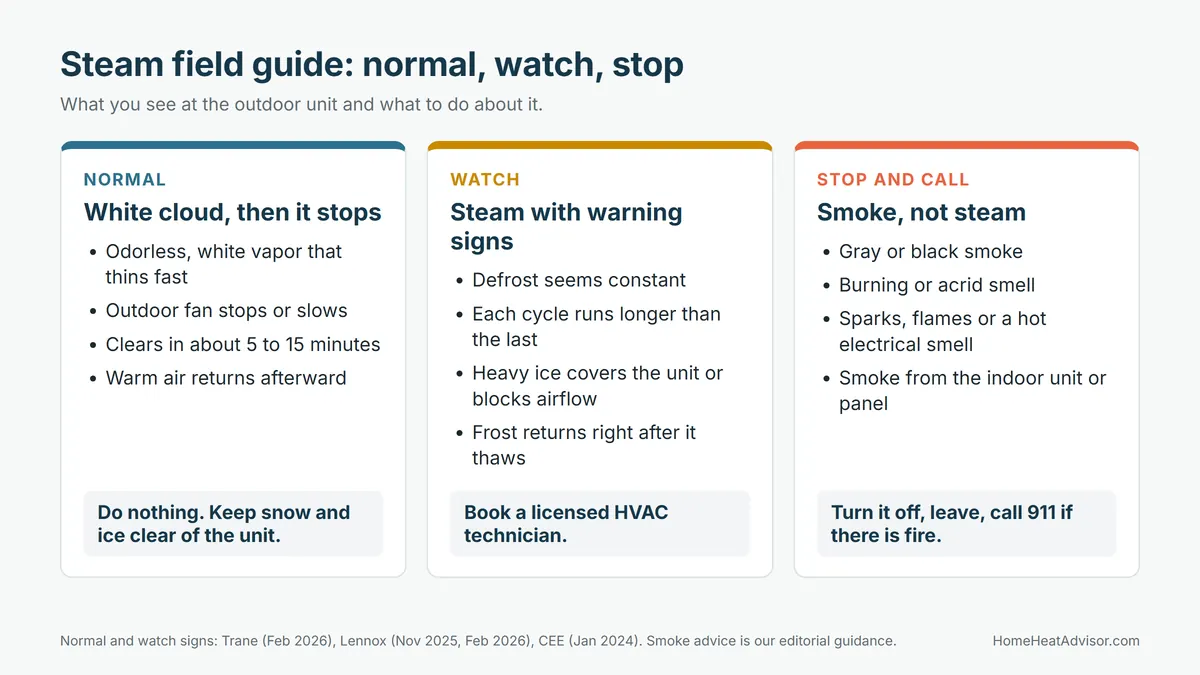
Smell is the strongest tell. Steam has no smell. A burning or electrical smell is a different problem, covered in our guide to heat pump smells. If you ever see actual smoke or flames, do not wait to see whether it clears. Leave the house and call 911.
When in doubt
A cloud that is white, odorless and gone in a quarter of an hour is heat pump steam. Anything gray, black or smelly is not. If you are unsure and cannot tell which it is, treat it as smoke, switch the system off if you can do so safely and call a licensed HVAC technician.
When heat pump steam is a warning sign
Heat pump steam on its own is not a fault. These patterns around the steam are what the manufacturers tell you to watch.
Defrost seems constant
Trane says that if your heat pump seems to be constantly switching into defrost, or the defrost cycles last longer and longer with frost and ice starting to cover the unit, you should call your local HVAC dealer (Trane, February 2026). Lennox adds that repeated long cycles should be checked by an HVAC professional.
Fix: Note how often and how long, for example ‘every 20 minutes, 25 minutes each time’, and give that to the technician.
One cycle that never ends
Lennox says a cycle that stays in defrost much longer than usual may be struggling to clear the ice or to switch back to heating (Lennox, November 2025). CEE puts it plainly: if your heat pump is stuck in defrost or covered in ice, consult an HVAC professional (CEE, January 2024).
Fix: If steam has run for much longer than 15 minutes and the house is cooling off, switch to your backup heat and book service.
Heavy ice, not light frost
A light layer of frost in cold, humid weather is normal. Lennox says heavy ice covering the unit or blocking airflow is a problem, and it advises calling a dealer if the ice refreezes quickly after thawing (Lennox, February 2026). Our guide to a heat pump frozen or iced up covers the causes.
Fix: Do not chip at the ice. Mitsubishi Electric’s manual warns against using any means to speed up defrosting other than those the manufacturer recommends.
Steam coming from heat pump with no heat
Heat pump steam during defrost is expected, and so is a short pause in heat. Steam combined with a house that is not warming up is not. If the system defrosts, then keeps blowing cool air, read our guides on a heat pump not heating and a heat pump running constantly. If it also starts and stops every few minutes, that is a different pattern: see heat pump short cycling.
For refrigerant, wiring or breaker problems, leave the work to a licensed HVAC technician.
Steam from a ductless heat pump

A ductless heat pump defrosts the same way as a ducted one, so the heat pump steam looks the same at the outdoor unit. The difference is inside the house. CEE says that on ductless systems the indoor head may put off some cooling to heat the outdoor coils, while ducted systems may switch on supplemental heat during defrost (CEE, January 2024).
Mitsubishi Electric’s operating instructions describe what owners can notice. During defrost the fan can slow or stop, the vane can move to a horizontal position, and warm air can pause for a short time. They say the defrost is completed in a maximum of 10 minutes, and that when heating resumes it can take a few minutes to blow out warm air (Mitsubishi Electric, June 2024).
The same manual says vapor from the condensation on the indoor heat exchanger can look like white smoke at the air inlet after defrost. That should be brief and odorless. If anything inside the room smells like burning, treat it as a fault, not steam.
What to do while your heat pump is steaming

For normal heat pump steam, you need to do nothing. Defrost is automatic, and the unit finishes it on its own. A few simple habits keep it that way.
- Let the cycle finish. Defrost is automatic and ends on its own, so there is nothing to switch or reset for normal steam.
- Do not cover it. NYSERDA says not to cover the unit, and that you should protect it from snow sliding off the roof (NYSERDA, August 2022).
- Clear snow and debris by hand. Sweep loose snow from around the unit with a soft broom. Do not chip or scrape the coil.
- Watch where the meltwater goes. CEE warns that defrosted water drips at the outdoor unit when it is freezing out, so make sure it does not pool and refreeze on a walkway (CEE, January 2024).
- Expect a brief change in heat. On ducted systems, supplemental heat may come on for a few minutes. If you see an AUX light, read about emergency heat vs auxiliary heat.
If heat pump steam shows up with strange sounds as well, check our guide to heat pump noises. Whooshing at the start of a cycle is normal, while grinding or banging is not.
Does a heat pump steaming waste energy?
Defrost does cost something, but it is a built-in part of heating in cold, damp weather rather than a sign of a fault. In the DOE Cold Climate Heat Pump Challenge field tests, defrost used a median 5 to 8% of heating energy between 5 and 35°F (PNNL, January 2025).
That figure covers modern cold-climate units in real homes. It tells you that a normal amount of heat pump steam has a modest energy cost, and that a unit stuck in defrost all day would cost much more. For ways to lower the rest of your winter bill, see our guide on the best heat pump temperature for winter.
Frequently asked questions
Is it normal for a heat pump to steam in winter?
Yes. Trane and Lennox both call steam from the outdoor unit normal during defrost. It is melting frost off the coil. A normal cycle lasts roughly 5 to 15 minutes, with the fan paused, and warm air returns afterward. Call a technician if defrost seems constant or ice covers the unit.
How can I tell heat pump steam from smoke?
Steam is white, has no smell, thins quickly and clears in about 5 to 15 minutes. Smoke is gray or black, smells of burning and does not stop on its own. If you see actual smoke or flames, leave the house and call 911. For smells without smoke, see our heat pump smells guide.
How long should heat pump steam last?
Lennox, NYSERDA and CEE give 5 to 15 minutes for a defrost cycle. Trane says usually 3 to 5 minutes, and Mitsubishi Electric says up to 10 minutes on its wall units. A cycle that runs much longer, or repeats constantly, is worth a technician visit.
Why is steam coming from my heat pump when it is not that cold?
NYSERDA ties frost to a coil below 32°F, and in our explanation the coil runs colder than the air around it, so frost can form when the air is a few degrees warmer. Lennox notes cold, damp days cause more frequent cycles. Light drizzle or fog is enough to trigger more steam.
Should I turn off my heat pump when it steams?
No, not for normal steam. Defrost is automatic and finishes on its own, so there is nothing to reset. Turn it off and call for help only for real smoke, a burning smell, or ice that keeps covering the unit.
Does ductless heat pump steam look different?
Outside, ductless heat pump steam looks the same. Inside, Mitsubishi Electric says the fan may slow or stop and warm air pauses for a few minutes during defrost. CEE says the indoor head may put off some cooling. A little vapor at the indoor air inlet after defrost can also look like white smoke.
Sources
- Trane: What is a heat pump defrost cycle? (February 2026)
- Lennox: Heat pump defrost cycle (November 2025)
- Lennox: Heat pump frozen (February 2026)
- NYSERDA: Air Source Heat Pump FAQ (August 2022)
- CEE: You Installed an Air Source Heat Pump. Now What? (January 2024)
- Mitsubishi Electric: Wall-mounted air conditioner operating instructions (June 2024)
- PNNL: Cold Climate Heat Pump Challenge field validation, PNNL-37127 (January 2025)
About this guide
Published by HomeHeatAdvisor. This guide is based on manufacturer, state energy office, efficiency-program and national laboratory sources, checked in October 2026; each figure names its source and date, and calculations are labeled as ours. The checks here are for homeowners only. For refrigerant, wiring or anything that keeps tripping a breaker, use a licensed HVAC technician, and call 911 for smoke or fire. Our editorial policy explains how we research, fact-check and update our guides. Spotted an error? Let us know. More troubleshooting guides.