
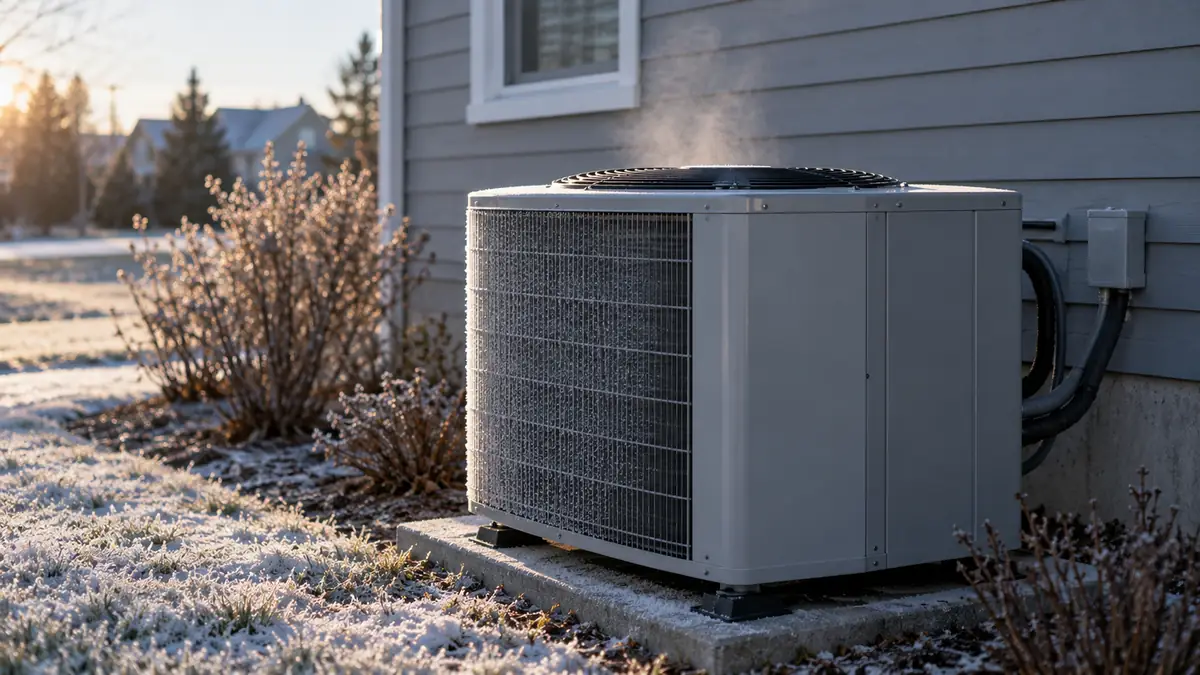
A heat pump running constantly in cold weather is usually doing exactly what it was designed to do. Heat pumps make steady, gentle heat instead of short blasts, so on a cold day the outdoor unit may hum along for hours without a break. Carrier’s owner’s manual warns new owners: “You may notice your system runs for longer periods of time” (Carrier, September 2019).
Long runs only become a problem when they come with other signs: the house never reaches the set temperature, the thermostat shows auxiliary heat all day, the coil stays iced, or the electric bill jumps. This guide shows you how to tell the difference, with seven checks you can do yourself. New to the technology? Start with how a heat pump works.

Yes, a heat pump running constantly in cold weather is normal, especially a variable-speed model, which is designed to run continuously at low speed. It is a problem if the house cannot reach the set temperature, auxiliary heat shows on the thermostat most of the time, the outdoor coil stays frozen, or your kWh use suddenly jumps. Those are the warning signs listed in a DOE-hosted owner’s guide. Whether the indoor fan runs between cycles is a separate thermostat setting; see our guide to heat pump fan auto or on.
Supply air from a heat pump
95–105°F
Steady, not a furnace blast (Carrier, Sept 2019)
Heat from backup at 5°F
About 11%
Median, DOE field test homes (PNNL, Jan 2025)
Installs with backup lockout set to spec
43%
Pacific Northwest field study (BPA, Dec 2019)
In this guide
Why heat pumps run longer than furnaces
A gas furnace burns fuel at full blast, overheats the air, then shuts off. A heat pump moves heat from the outdoor air into your home and delivers it in a steady stream. Carrier describes the result as a “constant flow of air at around 95°F” to about 105°F, compared with the sudden blasts of hot air from a typical furnace (Carrier, September 2019). Air at 95°F feels cooler on your hand than furnace air, so a heat pump has to run longer to deliver the same heat.
How long it runs also depends on the compressor. A guide hosted by the U.S. Department of Energy, written by the Center for Energy and Environment (CEE), explains that heat pumps “operating optimally when running continuously” deliver a consistent, gentle airflow (CEE, January 2024). It separates two kinds:
- Variable-speed (inverter) units slow down and speed up to match the heat your home is losing. On a cold day they may end up running constantly, and that is their most efficient way to work.
- Single-stage units are either on at full power or off, so they cycle more like a furnace. A single-stage unit running nonstop on a mild day deserves a closer look.
A heat pump running constantly does not mean high bills. Boulder County’s owner’s guide puts it plainly: “Don’t assume they are using more energy just because they are running a lot!” (Boulder County, March 2024). The same guide says heat pumps, especially cold-climate models, are designed to run continuously at a low level.
Good to know
Carrier also notes that a heat pump runs longer when doors open often, when you run laundry or take hot showers, and when more people are at home. All of these add heat demand.
The balance point: why it runs nonstop when it’s coldest
As it gets colder outside, two things happen at once. Your home loses heat faster, and the heat pump can make less heat. PNNL notes that a conventional heat pump’s heating capacity drops below its rated capacity once outdoor temperatures fall below 40°F (PNNL, January 2025). The temperature where the two lines cross is called the balance point.
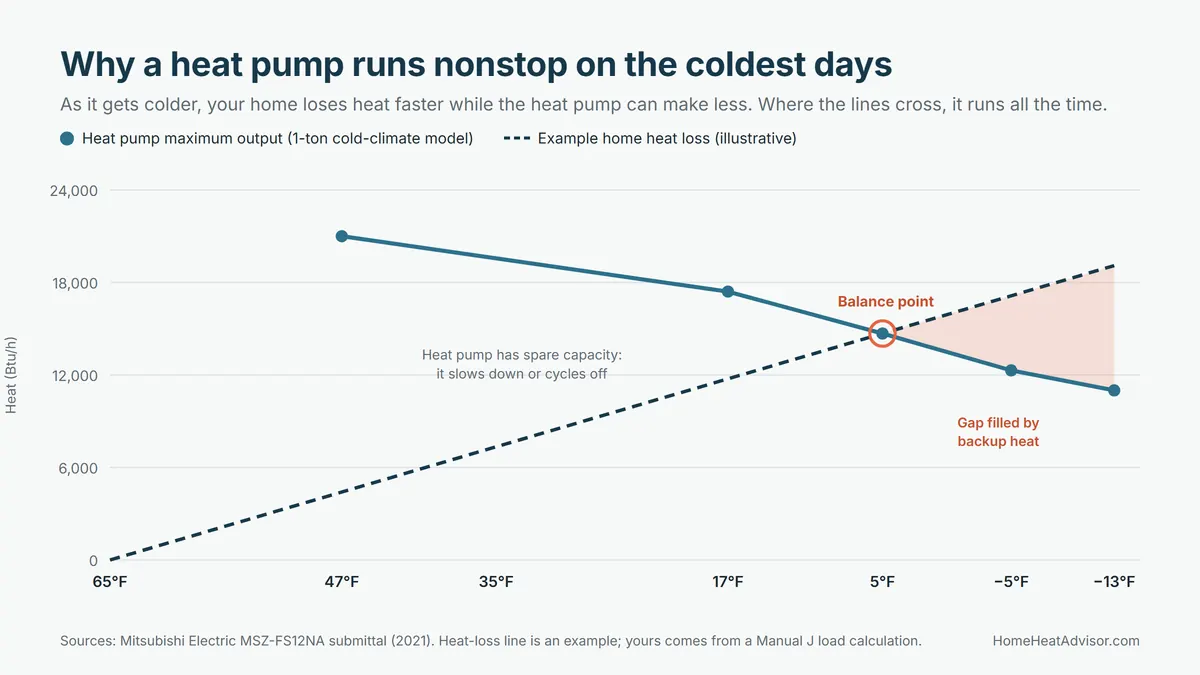
The solid line uses a real 1-ton cold-climate unit, which delivers 21,000 Btu/h at 47°F and 11,000 Btu/h at −13°F (Mitsubishi Electric submittal, 2021). The dashed line is an example house. Above the balance point the unit slows down or cycles. At the balance point it is running constantly, 100% of the time, which is normal. Below it, a heat pump can’t keep up alone, and backup heat fills the difference. Your own balance point depends on your home and your unit; our guide to how heat pump capacity drops in the cold covers the full picture.

Normal or a problem? A quick test
Runtime alone does not tell you much. There is no published rule for how many minutes per hour a heat pump should run. What matters is what else happens while it is running constantly. The left column below comes from manufacturer and energy program guidance; the warning signs come from the DOE-hosted CEE guide.
| What you notice | Normal or a problem? | What to do |
|---|---|---|
| Runs for hours on cold days, faster as it gets colder | Normal (Carrier) | Nothing, if the house stays warm |
| Steady air at 95–105°F that feels cooler than a furnace | Normal (Carrier) | Nothing |
| Runs nonstop at low speed | Normal for variable-speed units (Boulder County) | Nothing |
| Stops for 5 to 15 minutes, with steam outside | Normal defrost (CEE) | Wait it out |
| House never reaches the set temperature | Problem (CEE) | Check filter, coil and backup heat, then call a pro |
| Auxiliary heat shows on the thermostat most of the time | Problem (CEE) | Check setbacks and the backup heat lockout |
| Outdoor or indoor coil stays frozen | Problem (CEE) | Clear snow; call a pro if ice remains |
| Sudden jump in kWh on your bill | Problem (CEE) | Compare with last winter, then check aux use |
| Turns on and off frequently | Problem (CEE) | Call a pro |
If the house is getting cold rather than just running long, see our guide to a heat pump not heating instead. Frequent on-off cycling is the opposite symptom and points to a different set of causes.
Heat pump running constantly? 7 reasons and what to do
If a heat pump running constantly in winter has you worried, work through these in order. The first four are normal behavior or settings you can change today. The last three need a professional.
1. It’s simply cold, and the unit is at its balance point
On the coldest days of the year, a correctly sized heat pump running constantly is expected. Carrier says the system will operate at higher speeds as it gets colder outside and will run as long as needed to hold the indoor temperature (Carrier, September 2019). You may also see it stop and blow steam from the outdoor unit for a while. The CEE guide says defrost typically takes 5 to 15 minutes (CEE, January 2024). Our guide to the defrost cycle shows what normal frost looks like.
Fix: Nothing to fix if the house holds your set temperature. Check again when the weather warms up: the long runs should ease off.
2. Aux heat is doing the work
Auxiliary heat is the backup electric heater inside the air handler. It makes the same heat from far more electricity, and when it comes on too often the whole system can seem to be running constantly. In DOE field tests, backup heat supplied a median of about 11% of heating energy at 5°F. PNNL also found backup often switched on at 30 to 35°F, far warmer than needed, because of thermostat setbacks and setpoint changes (PNNL, January 2025). The best heat pump temperature for winter guide covers the settings that keep backup heat off.
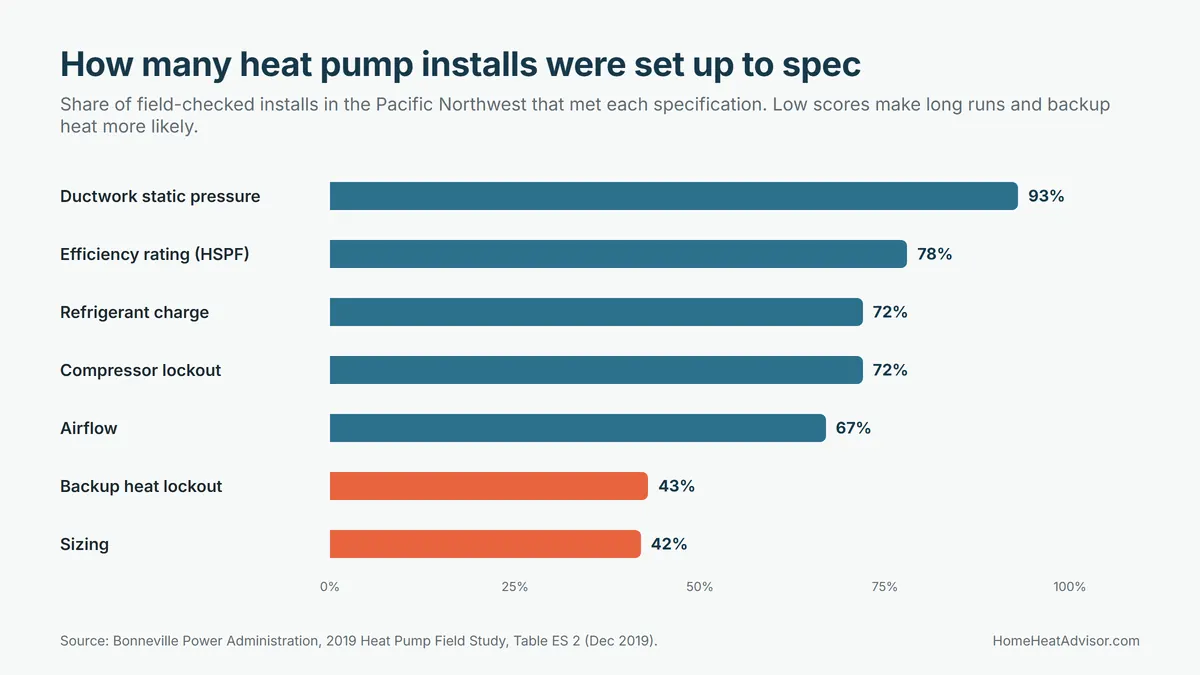
Setup errors are common. In a Bonneville Power Administration field study of Pacific Northwest homes, only 43% of installs had the auxiliary heat lockout set to spec (BPA, December 2019). The study is from 2019 and one region, but it shows how often this setting is missed.
The cost difference is real. Our calculation from EIA and PNNL figures: a 5 kW first stage of backup heat costs about $0.91 an hour at 18.2¢/kWh, while the heat pump makes the same heat for about $0.48 an hour at a COP of 1.9. Our guide to emergency heat vs auxiliary heat explains how each works.
Fix: Ask your installer to check the outdoor lockout for backup heat. NEEP’s cold-climate installation guide suggests a cutout between 20 and 35°F (NEEP); an ecobee setup guide for single-stage heat pumps suggests 30 to 45°F (Berkeley Electric Cooperative, August 2020).
3. A big setback, or large swings in the setpoint
Turning the thermostat down at night or while you are out forces the heat pump to run hard to recover, and often calls in backup heat. The CEE guide says to avoid abrupt temperature changes of 3°F or more during unoccupied hours (CEE, January 2024). Boulder County suggests making no more than 2° of change in a 24-hour period (Boulder County, March 2024).
Fix: Pick one comfortable temperature and leave it. If you do use a setback, keep it to a degree or two.
4. The fan is set to ON, not AUTO
With the thermostat fan set to ON, the indoor blower runs all day even when the heat pump is not heating, which can look like a heat pump running constantly and blows cooler air between cycles. The CEE guide warns that continuous indoor fan operation can harm heat pump performance and advises: “Begin with ‘Auto Fan’” (CEE, January 2024).
Fix: Set the fan to AUTO, then watch whether the outdoor unit still runs as much.
5. Dirty filter or blocked registers and returns
A clogged filter or blocked vents cut airflow, so the heat pump runs longer to move the same heat. Carrier says a clogged filter “will increase operating costs and shorten the life of the unit” (Carrier, September 2019). The CEE guide suggests changing ducted system filters about every 90 days and cleaning ductless filters monthly at a minimum; Boulder County says every 1 to 3 months.

Fix: Replace or clean the filter, then make sure furniture, rugs and curtains are not covering supply registers or return grilles.
6. Outdoor coil blocked by snow, ice, leaves or shrubs
The outdoor unit needs free airflow to collect heat. Drifted snow, packed leaves or overgrown plants make it work longer for less heat. Carrier asks for at least 12 inches of clearance to shrubs (Carrier, September 2019). A coil that stays coated in ice after a defrost cycle is one of the CEE warning signs.
Fix: Turn the power off at the outdoor disconnect, then clear snow and debris by hand or with a soft brush. Never chip ice off the coil with a tool. If ice keeps coming back, see our guide to a frozen heat pump.
7. Low refrigerant, an undersized unit or leaky ducts
If none of the above explains it, the cause may be inside the system. In the BPA field study, only 72% of installs had the right refrigerant charge and just 42% met the sizing spec (BPA, December 2019). A unit with too little refrigerant, one that is too small for the house, or ducts that leak warm air into the attic will all keep a heat pump running constantly for longer than it should. Boulder County’s owner’s guide says about 20 to 30% of the air moving through ducts can be lost to leaks.
Fix: Call a licensed HVAC technician. Only an EPA Section 608 certified technician can work on refrigerant (EPA, March 2026). Sizing should come from a room-by-room Manual J calculation; our heat pump installation cost guide explains what a proper load calculation involves.
What a long runtime costs, and what to check on the bill
The first warning sign on the CEE list is “a sudden increase in electricity consumption (kWh) on your utility bills” (CEE, January 2024). That is a better test than counting hours of runtime. Most utilities show your monthly kWh online, so compare this January with last January, allowing for a colder month.
At the U.S. average residential price of 18.2¢/kWh projected for 2026 (EIA Short-Term Energy Outlook, October 2026), every extra 100 kWh adds about $18 to the bill. A heat pump running constantly at low speed uses little; backup heat running for hours is what pushes kWh up. If your use jumped and auxiliary heat shows often, start with reasons 2 and 3 above.
When to call a pro, and typical repair costs
Call a licensed HVAC technician if the house cannot hold its temperature, the coil stays frozen, the unit cycles on and off frequently, or the owner checks above did not change anything. These are national typical ranges:
| Repair | Typical cost |
|---|---|
| Service call | $75–$250 |
| Thermostat replacement | $85–$300 |
| Condenser coil cleaning | $100–$300 |
| Capacitor replacement | $100–$400 |
| Refrigerant recharge | $100–$600 |
| Refrigerant leak repair | $200–$1,500 |
| Blower motor replacement | $300–$1,000 |
| Compressor replacement | $800–$2,500 |
Owner checks stop at the filter, thermostat settings, registers and clearing around the outdoor unit with the power off. Anything with refrigerant needs an EPA 608 certified technician, and electrical work such as breakers, wiring or heat strips needs a licensed electrician. Never open the unit’s panels yourself.
Settings that keep long runs efficient
These settings keep a heat pump running constantly in winter as efficient as it can be.
- Hold a steady temperature. NYSERDA says heat pumps are most efficient when maintained at a steady temperature.
- Fan on AUTO, not ON (CEE).
- Choose HEAT, not the Auto heat/cool mode, in winter. The CEE guide advises avoiding Auto mode.
- Leave it on in deep cold. NYSERDA: “It is not advised to shut your heat pump off, even when temperatures fall below zero” (NYSERDA, March 2020).
- Book a tune-up every 1 to 2 years, as the CEE guide suggests, and ask the technician to confirm backup heat only comes on when needed.
Frequently asked questions
Should a heat pump run constantly in winter?
In cold weather, yes. Boulder County’s owner’s guide says heat pumps, especially cold-climate models, are designed to run continuously at a low level, and the DOE-hosted CEE guide says they work best when running continuously. So if you are asking whether a heat pump should run constantly, the answer is usually yes, as long as the house stays warm.
Is it bad for a heat pump to run all the time?
Not if the house holds its temperature and auxiliary heat is not on most of the time. Carrier’s owner’s manual tells new owners to expect longer run times. It becomes a concern when long runs come with a missed setpoint, a frozen coil or a jump in kWh.
How long should a heat pump run in cold weather?
There is no fixed number. At or below its balance point, a heat pump running constantly, 100% of the time, is normal. Watch whether the house reaches the set temperature and how often auxiliary heat comes on, not the minutes of runtime.
Why does my heat pump run constantly and not reach the set temperature?
A setpoint that is never reached is a warning sign in the CEE guide. Check the filter, the outdoor coil and whether backup heat is coming on. If the house is getting cold, see our heat pump not heating guide and call a licensed HVAC technician.
Does a heat pump use more electricity when it runs constantly?
Not necessarily. Running at low speed is efficient. Backup electric heat, which has a COP of 1, is what drives bills up. A heat pump running constantly in winter with no auxiliary heat may use less than one that cycles on and off with frequent setbacks.
Should I turn my heat pump off when it’s very cold?
No. NYSERDA says it is not advised to shut your heat pump off, even when temperatures fall below zero. Turning it off lets the house cool down and then forces a long, costly recovery, often with backup heat.
Sources
- Center for Energy and Environment, hosted by U.S. DOE: You installed an air source heat pump. Now what? (January 2024)
- Boulder County: Ducted air-source heat pump owner’s guide (March 2024)
- NYSERDA Clean Heat: Air source heat pump tips (March 2020)
- Carrier: Infinity 25VNA variable-speed heat pump owner’s manual, OM25VNA-02 (September 2019)
- Mitsubishi Electric: MSZ-FS12NA / MUZ-FS12NA submittal (2021)
- PNNL: Performance results from DOE Cold Climate Heat Pump Challenge field validation, PNNL-37127 (January 2025)
- Bonneville Power Administration: 2019 heat pump field study (December 2019)
- NEEP: Guide to installing air-source heat pumps in cold climates
- Berkeley Electric Cooperative: ecobee setup guidelines for single-stage heat pumps (August 2020)
- U.S. EIA: Short-Term Energy Outlook, electricity (October 2026)
- Fixr: Heat pump repair cost (January 2026)
- U.S. EPA: Section 608 technician certification (March 2026)
About this guide
Published by HomeHeatAdvisor. This guide is based on manufacturer owner’s manuals and submittal data, energy program guidance from CEE, Boulder County and NYSERDA, national laboratory and utility field studies, and 2026 price data, checked in October 2026; each figure names its source and date. The checks here are for homeowners only. Anything beyond them needs a licensed HVAC technician, refrigerant work needs an EPA 608 certified technician, and electrical work needs a licensed electrician. Our editorial policy explains how we research, fact-check and update our guides. Spotted an error? Let us know. More troubleshooting guides.